Friday, May 26, 2006

Gutters and Moles and... Bears?? Oh my...

Well, the bucket-truck has been called off. Our contractor has a new roofer who thinks the job of removing the old gutters and replacing the facia on the house crown can be done with scaffolding, so next week they're going to put that up. It'll be less dramatic, but also better for the lawn- we weren't all that thrilled about a big truck driving all around the house, though with the front lawn currently a Mole Paradise I'm not sure it would have looked all that different. If you used to have problems with moles under your lawn and you don't have any this year, they're all at Foggygates, chawing down.

Speaking of wildlife- I walked down to the local barbershop yesterday (about a quarter mile away), and on my way back, in the middle of a sunny afternoon, I saw a big black bear come across the church rectory's lawn (right next door to us), wait for a passing car, and then lope across the street and wander off into the woods on the other side. That caused a little excitement in town for a while. I'd never seen a bear in the wild before; Amy saw some years ago while camping at Yellowstone, but I think the operative words there are "camping" and "Yellowstone", which seem more appropriate venues for bear watching than "the neighbor's lawn".

And our cats wonder why we don't let them out...

Tuesday, May 23, 2006

Auction Catalogs-

The Book Elves have been pruning the trees and shrubs here at Foggygates, and somebody (I'd really, *really* like to know who) sent them a little book titled: "Erotic Topiary Designs for Beginners" which they have been using on the azaleas. We now have a thirty-year old azalea shaped like the picture on the cover of the latest Madonna album, and traffic on our little street has increased tenfold this week.

However, before they got us summoned before the next meeting of the Board of Selectman, they finished our new printed catalog #274, "Going Once... Going Twice... A Selection of Auction Catalogs from Our Stock", which is now available.

This issue includes catalogs covering Collectors & Collections; French Decorative & Fine Arts; Furniture & Americana; Folk Art; Metals; Garden Furniture & accessories; Ceramics; Glass; Silver; Jewelry; Judaica; Russian Arts; Miniatures; and Horology.

Please let us know if you would like a printed copy. You can also browse it on our website.

Monday, May 22, 2006

Spring?


Well, the sun has finally come out at Foggygates -but it's cold! It seems that this May we either have rain or chilly weather. I miss Spring. The rains of the last few weeks caught our roofers just as they were about to remove the gutters and replace the facia boards around the top of the house crown, but they hope to do that in the next few days. It's going to be quite an operation- because of the shape of the roofs, they can't get up there safely with ladders to remove the facia, so they are going to bring in one of those bucket trucks. It's going to be quite a sight for the neighbors, and I'll try to get some pictures.

We've got our new Catalog of Auction Catalogs hitting the streets tomorrow- let us know if you would like a free copy. It will also be on our website. More about that tomorrow.

Thursday, May 18, 2006

New Titles in Our New Catalog-

If you have glanced through our new May-June catalog, you will have noticed by now that we have added quite a few in-print titles to our stock. We started adding in-print titles a few months ago, and it proved so popular that we are augmenting that area of our stock, and will continue to expand it in the coming months. There are some great new books out there, so why not carry them? This month we feature important new books on windsor chairs, mocha ware, Gothic Revival decorative arts, Pairpoint glass, and Georgia furniture. If there is anything in the way of in-print antiques references you are looking for, please let us know.

You can browse our new May-June catalog on our website, or if you would like a printed copy, please let us know.

Tuesday, May 16, 2006

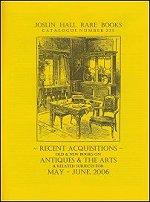
Our New May-June Catalog-

It's been raining for about 10 days now, with no end in sight. The Book Elves are busily constructing an ark. However, before they loaded the shovels and rakes and implements of destruction into the old clawfoot bathub in the basement and tried to drag it down to the Connecticut River, they finished our new May-June catalog, which is available either in printed format, or on our website.

Please let us know if you would like a printed copy, or you can browse it here.

Friday, May 12, 2006

An Impressive Collection of Judaica-

We just bought the remaining copies of a very nice small catalog of an impressive Judaica collection-

"Catalog of the Bernice and Henry Tumen Collection of Jewish Ceremonial Objects in the Harvard College Library and the Harvard Semitic Museum" by Violet Gilboa. Published by the Harvard University Library in 1993.

This volume features photographs and descriptions of 166 Jewish ceremonial objects including wine cups; beakers; Sabbath lamps; candlesticks; spice boxes; Hanukkah lamps; Torah pointers; crowns, shields, and finials; plates for the Passover Seder and other occasions; charity boxes; Esther scrolls; containers for the etrog fruit used on Sukkot; marriage rings; amulets; and others. The vast majority of the objects are made of silver, with some additional pieces of pewter, a few brass and ceramic objects, and some textiles. Violet Gilboa is Littauer Hebraica Technical and Research Services Librarian at the Judaica Division of the Harvard College Library. Softcover. 6”x9”, 172 pages, b/w illustrations; bibliography. $25.00

We're offering a special price on them this week-
Single copies- $15.00, postpaid (Media Mail)
5 copies- $6 each ($30.00 postpaid -Media Mail)
10 copies- $5 each ($50.00 postpaid -Media Mail)

Wednesday, May 10, 2006

Victorian Fashions-

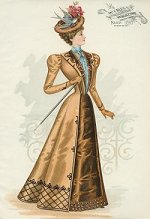
We are still unpacking boxes here, and recently came across several interesting Victorian fashion plates from McCall's Magazine, which we promptly plopped up on Ebay. These are somewhat stylized (think wasp waists and oddly shaped bodices) and quite colorful. We put in starting bids down at $9.99, with no reserves, so if you need something to spice up your walls, click the "Our Auctions" link in the right-hand column!

Monday, May 08, 2006

The Gothic Revival-

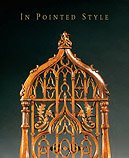
We have a new exhibition catalog in stock- "In Pointed Style. The Gothic Revival in America, 1800-1860".

The catalog is by Elizabeth & Stuart Feld, and accompanies the current exhibition at the Hirschl & Adler Galleries in New York, the first comprehensive exhibition of Gothic Revival furniture and arts in 30 years.

This is a wonderful catalog, featuring furniture, architecture, glass, lighting, silver and other decorations. It is illustrated with many period prints and artwork, as well as stunning new color photographs,and has an introductory essay by David B. Warren. Softcover. 9”x11”, 144 pages, color and b/w illustrations. Bibliography. [90200] $45.00

Friday, May 05, 2006

Point of View-

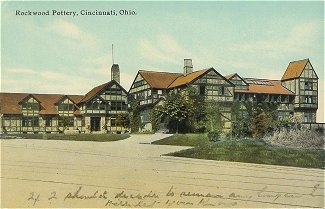
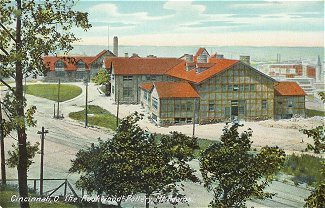
Cincinnati's Rookwood Pottery is legendary among art pottery collectors, and probably the best known American art pottery. I recently found several ca.1910 postcards showing the pottery which I thought were interesting.

This one, the oldest of the two, shows a front view that makes the pottery look almost like a rambling tudor mansion in some suburb-


This view, apparently taken a few years later, shows a more business-like viewpoint-


Wednesday, May 03, 2006

Liar, Liar?

He sailed the Mississippi...
or did he?


Father Louis Hennepin was a Franciscan Friar who accompanied La Salle on his Western expedition of 1679 to reach the Gulf of Mexico from Canada, via the Mississippi River. After the trip Hennepin wrote his famous “A New Discovery of a vast Country in America”, originally published in French in 1697 and in English in 1698.

Hennepin tells of his travels with La Salle on the Griffon, the first ship on the Great Lakes, to Green Bay and across the Mississippi by the Illinois route. From there Hennepin was sent with an expedition, led by Michel Aco, which was the first to explore the upper Mississippi valley. They ascended the river to Minnesota, where they were captured by the Issati Sioux. The party was eventually rescued by Duluth who insisted on their release, though some claim that Hennepin’s constant complaints and lectures had already become so tedious to the Sioux, that they were happy to be rid of him.

Unfortunately, Hennepin was a notorious liar. In his accounts he claims close association with La Salle, but La Salle thought little of Hennepin, even warning his colleagues about Hennepin’s habit of exaggeration. Prompted by his efforts at political maneuvering and his own penchant for tellings fibs, Hennepin’s accounts of his journeys along the Mississippi vary from only slightly overblown to outright plagiarism. He claims to have traversed both the upper and the lower Mississippi all the way down to the Gulf of Mexico, but the time between his departure from the country of the Illinois and his capture by the Issati is not sufficient for such a long canoe voyage.

Despite the falsehoods about some aspects of the expeditions described in his narrative, Hennepin’s book became a standard text on North America. It should also be said that he was an acute observer, and his books contain detailed and accurate descriptions of the characteristics, arts, and customs of the Indians. He made careful note of the wildlife they encountered, and his descriptions of natural history convey not only a physical description of the animal in question, but Hennepin’s own personal reaction to the creatures as well. His is the first written description, complete with illustration, of Niagara Falls and his examination of every facet of American Indian culture is a gold mine of information.

In 1903 Reuben Gold Thwaites edited a new edition of “A New Discovery of a Vast Country in America”, with facsimiles of the original title-pages, maps and illustrations, and a new introduction, notes and index.

We have a copy of the 1903 edition up for auction this week -click our Auction link in the right-hand column.


We're hard at work on our new May-June catalog, which will be mailed in a few weeks -if you're not on our mailing list and would like a copy, please let us know.


We're also hard at work (or hardly at work) on the new edition of A Grave Affair -Books on Gravestones & Memorial Arts -again, let us know if you would like a copy of the catalog when it is ready.

Tuesday, May 02, 2006

A New Windsor Chair Book-

We just got a case of that nice new book on windsor chairs everyone's talking about-

"Windsor-Chair Making in America -From Craft Shop to Consumer"
By Nancy Goyne Evans. Published by the University Press of New England in 2006. Hardcover, 9"x12", 496 pages, color and b/w illustrations, dj. $65.00

"The definitive work on the production of Windsor furniture, from one of America’s premier authorities. Drawing principally on original source materials, Nancy Goyne Evans’s elegantly written and extensively illustrated book presents an authoritative and absorbing historical picture of the vernacular chair shop and industry. Of the book’s five chapters, three deal extensively with the craft shop. Evans discusses everything from structure to tools and equipment, from shop personnel to power sources, and from raw materials to ornament, both painted and stenciled. A chapter on marketing explores the booming Windsor-chair trade in the American coastal South and the islands of the Caribbean, furniture distribution to local, overland, and overseas markets, and general methods of doing business. Another section explores consumerism and the use of Windsor furniture in domestic and public settings."

Wednesday, April 26, 2006

Did George Washington Wear a Tuxedo?


I like books which have interesting stories to tell beyond the text, and I also like association copies- a copy of a book which belonged to somebody interesting. Every so often a book comes along that combines both, and we’ve got one in our new Spring catalog (you knew that’s where this was going, didn’t you?).

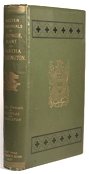
James Walter wrote "Memorials of Washington and of Mary, His Mother, and Martha, His Wife, from Letters and Papers of Robert Cary and James Sharples" in 1887. On the surface, as John Lovari, writing in Karpel’s “Arts in America” writes- it is “Apparently an interesting and valuable account of Sharples's connection with the Washington family, with comments on Robert Fulton and his friendship with Sharples and on the two men as artists and scientists.”

But all is not as it seems... Lovari continues-

“Although this is a seemingly plausible and valid description of the book after a first reading of it, the work, an abridged version of which had appeared in 1886 under the title 'History and Descriptive Details of Middleton's Portraits of Mary, the Mother of Washington', ranks with Clifford Irving's recent 'biography' of Howard Hughes as one of the major hoaxes of the publishing world. Walter was attacked on twelve points of plagiarism, forgery, and fabrication of evidence by the members of the Massachusetts Historical Society".

Well now.

All that’s interesting enough, but this copy has the small printed book ticket of the noted American book collector Grenville Kane, the bulk of whose Americana and Incunabula collections are now at Princeton. In addition to being an important book collector, Kane was also a founding member of the Tuxedo Club, a group of wealthy New Yorkers who summered together at Tuxedo Park in upstate New York; the group was responsible for introducing to American Society the new-fangled semi-formal dinner jacket worn at a dinner by the Prince of Wales, and naming it the... yes, that's right.

ok, I'll admit that I'm pretty easily amused, but I think that's fairly cool.

Our new Spring catalog is now available online or as a printed catalog; please let us know if you would like a copy.

Tuesday, April 25, 2006

New Spring Catalog

Spring is sprung,
the grass is ris,
I wonder where
the new catalog is?

Well, the Book Elves are busy this week in the garden, flinging daffodil bulbs at each other, but before the loaded up the wheelbarrow with wood chips and accidentally had the first barbecue of the spring, they finished our new Spring Catalog, featuring 310 books & catalogs on furniture, ceramics, glass, silver, metals, textiles, and other decorative arts & related subjects.

This catalog is available in printed format,and it may also be viewed on our website.

If you would prefer a printed copy, please let us know.

Monday, April 24, 2006

A Far Cry from Kensington-

The English novelist Muriel Spark died last week in Italy. Over a career spanning more than five decades, Ms. Spark wrote many much-loved novels, including “The Prime of Miss Jean Brodie”, “A Far Cry from Kensington”, “The Ballad of Peckham Rye”, and “Memento Mori”. But in her autobiography of the first four decades of her life, Muriel Spark recounts some of her other jobs, and one, her first job after working on a secret project for the British Foreign Office during the War, may be of particular interest to antiques collectors-

“The year after the war I found a job on a good quarterly magazine called Argentor... Argentor was a beautifully produced magazine, resembling the Connoisseur in style and format, the official quarterly journal of the National Jewellers’ Association. My job was mainly research in museums, libraries, art galleries; a truly refreshing occupation. I loved it. Even now, looking back at the list of contents of the first number in which I was involved, the pleasure of that world comes back to me. The editor, William Llewellyn-Amos, was particularly trusting, and quite uncaring about my lack of experience. His confidence in me was stimulating. I had no hesitation about writing contributions on a subject hitherto unknown to me. Another journalist, Mona Curran, was employed in the office; we worked together well. Quite a lot of articles by specialists had to be touched up from the stylistic point of view, and we spent long hours recasting the articles that had been commissioned.

The list of contents in the number under preparation when I joined the magazine included an article on English domestic silver, and one on spoons and forks; another was ‘Old Clocks of England’ and James Gunn, a celebrated portrait painter, contributed ‘Jewels and the Painter’. The journal, very well illustrated, aimed to express high standards of workmanship, and to give the readers an idea of the history of the jewellers’ art, and that of goldsmiths, silversmiths, horologists and the allied crafts. One of my first assignments was to work on an article (signed by the editor) called ‘The Goldsmith Painters’, relating how many of the Renaissance artists began as goldsmiths. On my own account I wrote ‘Some Jewels of English Poetry’, in which I showed how the names of jewels were used figuratively throughout English poetry. (To my surprise and joy this article was picked our for a highly favourable mention by the Evening Standard: my stock in the office went up). Later on, before I left Argentor, I had researched and written a long article on the Order of the Golden Fleece which adorns many famous and historical portraits. About this article I have a sense of great satisfaction. It bears no signs of immaturity and I would not hesitate to reprint it today.

The number of subjects connected with the goldsmiths’, silversmiths’ and jewellers’ art was inexhaustible. The essays written by experts which needed some form of recasting were mainly passed on to me. I learned how to copy-edit tactfully. I recall that I took out a great many adjectives.

My working days were long. I spent hours on research at the College of Heralds, the National Gallery, the British Museum and similar institutions. Further hours were spent in the office, writing and editing. And sometimes I would work at home on an interesting article, far, far into the night.

I got no extra pay for work I had done at home, and of my own composition. I wasn’t expected to sell my work to the magazine. Even when I wrote a small poem, much approved of by the editor, this too went in with my wages, six pounds a week, as a matter of course. I was perfectly happy with this arrangement. I enjoyed the work and was learning, too, how to edit a magazine, and how to proof-read and copy-edit. Argentor continued to publish my work (no pay) till 1948, two years after I left, and was editing Poetry Review for the Poetry Society. But Argentor is no more. It is now an expensive production often quoted in the rare book lists”.

-Muriel Spark, Curriculum Vitae. Autobiography. London, Constable and Company, 1992.

Wednesday, April 19, 2006

That's funny, I don't see it on the map...

We have a sub-specialty in books about fakes, forgery & fraud, and I'm always excited when I run across the tale of a new fraud I did not know about before. We just brought in a nice publisher's overstock title which falls into that category.

Ever vacation on the broad, sandy beaches, or go hiking through the temperate, leafy woodlands of the tiny Central American Country of Poyais? No? Well, there may be a reason for that...

Sir Gregor MacGregor and the Land that Never Was. The Extraordinary Story of the Most Audacious Fraud in History. by David Sinclair. Published by Headline Book Publishing in 2003.

”Once upon a time, in the heart of Central America, there was a country called Poyais. It was a country exceptionally rich in natural resources, civilization and culture, and was ruled by a brave an enlightened Scottish soldier, General Sir Gregor MacGregor, who had been made its cazique, or prince, after his many heroic exploits in the cause of South America’s struggle to liberate itself from the Spanish empire. In 1821 the Cazique of Poyais and his beautiful princess arrived in Britain to promote the virtues of their country and encourage immigration and investment.”

Within a year Sir Gregor MacGregor had become a celebrity, been honored by the Mayor of London, and had persuaded thousands of savvy investors to subscribe a L200,000 loan he floated on the London Stock Market. He also succeeded in persuading hundreds of settlers to uproot their lives and families, sell everything they owned, and set out on the long and perilous journey to this promised land in two ships. It was a journey from which most of them would never return, because, of course, there was no such country as Poyais...

This book is a hardcover. 5.5”x9”, 358 pages, b/w illustrations, dj. New. Published at $25.00. Copies available for a limited time for $10.00

Monday, April 17, 2006

The Shot Heard Round the World-

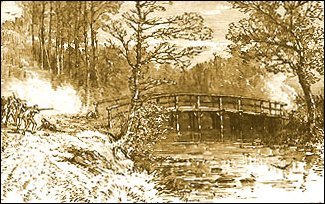
It's Patriot's Day here in Massachusetts, a legal holiday not familiar to many folks outside the Bay State. It commemorates the Lexington-Concord Battle of 1775, as immortalized by favorite son Ralph Waldo Emerson-

By the rude bridge which arched the flood,
their flag to to April breeze unfurled,
here once the embattled farmers stood,
and fired the shot heard round the world


Patriot's Day now means an 11 a.m. Red Sox game, the Boston Marathon, and services and re-enactments in many towns which have companies of volunteer Minutemen who dress up in colonial-era garb and march on their town greens. The Lexington-Concord area has the whole panapoly of celebrations, including a local company of the British 10th Regiment of Foot, the soldiers who were among the companies that marched to Concord that day. As a kid growing up in Concord, I always wanted to be one of the Redcoats. My illusions were shattered one day when I was walking down by the post office and saw a lanky Redcoat take off his tall tin hat and squeeze himself into a tiny VW parked by the curb.

We have an interesting Lexington-Concord-related book ending on Ebay tomorrow- it's a reminiscence about the battle, and the subsequent siege of Boston, by a British officer who was there- Concord Fight. Being so much of the Narrative of Ensign Jeremy Lister of the 10th Regiment of Foot as pertains to his services on the 19th of April, 1775, and to his experiences in Boston during the early months of the Siege.

Published in Cambridge by the Harvard University Press in 1931. Edition limited to 500 copies. An interesting account of the Lexington & Concord fights and subsequent retreat back to Boston by an officer who was wounded at the Concord Bridge. The manuscript account, written in 1782, first came to light when portions were published in the London Telegraph in 1928. Richard Eaton and Allen French of Concord tracked the original manuscript to its owner, a Lister descendant, who agreed to let them make a copy of the entire short memoir, and publish in full the parts that pertained to the Lexington-Concord battle and siege of Boston.

Ensign Jeremy Lister was a twenty-something junior officer in April, 1775, and he volunteered to join Colonel Smith's detachment on the march to Concord. Shot in the elbow at the Concord bridge, Lister's account of the devestating journey back to Boston and his stay there during the siege, as he recieved medical care for his shattered arm, contain many interesting details. This book also contains an interesting Introduction which gives further details about Lister and explains how difficult it is to figure out what happened on April 19th when using conflicting period accounts. At the end of the book there are several letters Lister wrote to his father, giving additonal details of the siege, including a short description of the Battle of Bunker Hill.

For more details click our Auctions link in the right-hand column. And Happy Patriot's Day!

Thursday, April 13, 2006

Reasons to Collect-

There is an interesting passage in the preface to Julia Torrey's 1917 book Old Sheffield Plate. Writing at the height of World War I, Torrey feels the need to explain her decision to publish a book on a subject as 'frivolous' as antique collecting-

"While it claims no direct bearing upon the serious problems of existence in these strenuous times, this book is offered without apology; for concerning war directly and indirectly there is literature without end, and it has been virtuously assumed by many of us that the finer and quieter things of life must be too much neglected. The spirit of destruction is rampant, and is eating its way into our lives whether we will it or no. Our best energies are spent in the creation of huge and elaborate mechanisms for the sole purpose of destroying and of being destroyed. In view of this very fact is it not the more appropriate, in moments of necessary relaxation, to draw attention to some of the minor but truly excellent works of art that are well worth saving from the general wreckage? May not some fragments that have remained to us from the days when many an artisan was also an artist, help to revive in us the spirit of the workman who wrought well that his work might not only serve a useful purpose, but that it might also please and endure?"

- - -
Our new Books on Silver catalog is now available, please let us know if you would like a copy.

- - -
We have a few interesting books ending on Ebay over the weekend, including a scarce Civil War memoir, the 1936 prospectus for the magnificent Arent Tobacco Collection catalog, a very nice Derrydale Press book, and an 1873 account of the Great Fire of Boston. Click the link to our Ebay auctions in the links column for more information.

Wednesday, April 12, 2006

Cutlery: it's more than knives, forks & spoons-

Our new printed catalog, "Books on Silver & Silversmiths", just out this week, rolls along -if you want a copy and did not get one, please let us know. One of the most popular new books in the catalog is a great book on cutlery-

"Cutlery. From Gothic to Art Deco. The J. Hollander Collection" by Jan Van Trigt, published in 2003 by Pandora. There are no words to adequately describe the 534 sets of antique cutlery illustrated and described here. I’m not sure how anyone could eat while holding such objects- you’d just sit there, staring at the intricate details and wonderful carving or enamel or engraved work. One might literally starve while attempting to dine. There are knives and forks with handles of carved bone and ivory, decorated porcelain, gleaming enamels, chased, gilt or engraved silver, handles of coral and agate and other semi-precious stones, traveling cutlery of brass or mother-of-pearl... there are heads, stags, flowers, scrolls, bears, priests, angels, buxom women and bearded sages. There may even be buxom sages, I’ve lost track. Published at the time of the exhibition of the Hollander Collection at the Design Museum of Ghent in 2003. Essential for the lover of silver, and cutlery. Essential even if you don’t love cutlery. It’s that good. Hardcover. 10”x12”, 298 pages, color illustrations, dj; bibliography. New. $75.00

Tuesday, April 11, 2006

A New Silver Catalog-

Our new "Books on Silver & Silversmiths" catalog, featuring 267 books, is out today. If you would like a copy, let us know.

- - - - - -

Although most of the books in the catalog are out of print, one featured book is a great new publisher's overstock- "Contemporary Silver. Commissioning. Designing. Collecting" by Benton Seymour Rabinovitch. Published by Merrell Publishers in 2000.

This is a sumptuous feast of a book for the silver lover, filled with gorgeous photographs of unique and surprising fantasies on the theme of the broad-bladed silver server. Rabinovitch, author of a book on antique broad-bladed silver servers, commissioned more than 60 new servers from a variety of working silver craftsmen, and the results are stunning and provocative. The text describes each server and the silversmiths' ideas in creating it, and also explores the relationship between artist and patron, and even how to become a patron, on a large or small scale, yourself. A fun book which silver lovers will spend hours going through again and again. Hardcover. 9.5"x10", 160 pages, color illustrations, dj. New. Published at $49.95

Publisher’s Overstock available for a limited time for $25.00.

- - - - - -

We have a few Hunting & Fishing books ending on ebay this week. No reserves, because my Uncle Cal, a Maine fisherman for his entire life, always said- "A reserve in hand is worth two if be sea". Of course my Uncle Cal had had a few bourbons at that point and usually ended up snagging his own hat with his fly. But he made a mean meatloaf.


Anyway, we have some books, reasonable bids & no reserves. Click our Ebay Auction link for more details.

Friday, April 07, 2006

Books & Cooks-

We've got a nice new book in this morning- "The Book Lover's Cookbook" by Shaunda Kennedy Wenger & Janet Kay Jensen. A hardcover published by Ballantine in 2003 for $21.95, we can offer a few for $10.00 while they last. Here's the publisher's blurb-

Just imagine—a literary and gastronomical feast contained in a single book! This lovely volume features 200 recipes that were cooked up, served, or mentioned in favorite novels and works of non-fiction, all accompanied by an excerpt from the book in which it was featured. For breakfast there are Mrs. Dalby's Buttermilk Scones (from James Herriot's All Things Bright and Beautiful and Mammy's Yams from Gone With the Wind, while main dishes include Any Beginner's Sweet-and-Sour Chicken (Barbara Kingsolver's The Bean Trees) and Empanadas (Isabel Allende's Daughter of Fortune). The Book Lover's Cookbook also includes such literary specialties as Mrs. Leibowitz's Lentil-Vegetable Soup (Isak Dinesen's Babette's Feast), Ruby's Potato Salad (Charles Frazier's Cold Mountain), Traditional Southern Crackling Corn Bread (The Adventures of Tom Sawyer), Merry Punch (Pride and Prejudice), Pure Pleasure Apple Pie (Garrison Keillor's "Lutheran Pie" from We Are Still Married), and the tempting treat that trumped sibling loyalty in C.S. Lewis's The Lion, the Witch, and the Wardrobe, Turkish Delight.


We have a new issue of our catalog Books on Silver & Silversmiths going into the mail early next week. If you'd like a copy, please send us an email.


We have some interesting Hunting & Fishing and Hunting & Fishing Art books up for auction on Ebay at the moment, and will be adding more in the next week or two, including some nice Derrydale Press items. Please click our "Current Ebay Auctions" link on the sidebar for more information.


Have a great weekend, everyone!

Wednesday, April 05, 2006

An Engineer and the Untranslatable Book...

Future-President Herbert Hoover was first and last an engineer who specialized in mining, and he took both great pride in his profession as well as an acute interest in its history and antecedents. Accordingly, he was fascinated by Georgius Agricola's 1556 folio "De Re Metallica", which was, as he wrote in his autobiography, "the first important attempt to assemble systematically in print the world-knowledge on mining, metallurgy, and industrial chemistry. It was the great textbook of those industries for two centuries and had dominated thought and practice all that time. In many mining regions and camps, including the Spanish South America, it was chained to the church altar and translated by the priest to the miners between religious services."

Hoover continues- "No one had ever succeeded in translating it into English, although several had tried... The problem of the 'untranslatable' Agricola fascinated us both (he and Mrs. Hoover, who was a good Latinist) and finally in 1907 we resolved to translate it jointly. There were formidable difficulties; for while Agricola's Latin was scholarly enough, he was dealing with subjects the whole nomenclature and practice of which had developed hundreds of years after the Latin language had ceased to grow. He did not adopt into the text the German, Italian or English terms for the operations or substances he described, but coined or adapted Latin terms for them... The job (of properly translating) involved finding out -either from the context, from German, French, Italian, or other fragmentary literature of the times, or from study of the processes themselves -what he meant... Sometimes the task amounted more to scientific detective work than to translation...I could often have the meaning of one of his terms worked out in our laboratories. Often enough, when we discovered the meaning of a term we found that there was no modern word to express it because that particular process had been long abandoned. In any event, we grappled with it sentence by sentence, during our spare time, month after month, for over five years."

The production of the book itself, once the manuscript was completed and had been revised four times, was equally painstaking. Hoover asked a fellow-engineer for advice, and was introduced to a printer in the north of England named Frost...

"When Frost saw the manuscript and the original his eyes glistened. He exclaimed that all his life he had been a commercial printer and had always wanted to do such a book. In order to make the book as like the original as possible, he found a papermaker who could produce a sixteenth-century linen paper. He had a font of type cast in exact reproduction of the original except for the ancient letter S, which is confusing to modern readers. He printed it as a folio volume with all the old prints and illustrations in astonishing fidelity to the original. By a little juggling of the opening sentence in each chapter, we were able to include reproductions of the old illuminated initial letters. Mr. Frost bound it in white vellum as the original was bound. No more beautiful job of printing was ever turned out."

But more than simply a translation and reproduction, Hoover also added his own knowledge to the book- "In addition to the translation, I wrote an introduction covering the times and circumstances under which Agricola lived and worked, with a brief biography of him. We included full statement of all the known editions. I prepared extensive footnotes describing previous processes so far as knowledge of them is preserved -including those in Roman and Greek times. The footnotes also explained the processes and methods described by Agricola in relation to our modern practice."

Hoover's translation remains the definitive one, and a beautiful example of bookmaking as well. Perhaps the last word on the profession of mining should be left to Hoover himself, as he related an incident in his autobiography. It occurred one morning at breakfast in the fashionable dining salon of a great ocean liner on which he was returning to America from a stint at Oxford.

"At my ship's table sat an English lady of great cultivation and a happy mind, who contributed much to the evanescent conversation... we were coming up New York harbor at the final farewell breakfast, when she turned to me and said, 'I hope you will forgive my dreadful curiosity, but I should like awfully to know -what is your profession?' I replied that I was an engineer. She emitted an involuntary exclamation and said "Why, I thought you were a gentleman!'

Monday, April 03, 2006

The Portland Vase-

We just got a great little remainder title in- The Portland Vase -The Extraordinary Odyssey of a Mysterious Roman Treasure by Robin Brooks. The vase is a marvelous piece of ancient cameo glass, intricately carved by modern standards, to say nothing of the problems it must have presented for ancient Roman glass carvers.

"Created for an Emperor, exhumed from a burial ground, coveted, traded, smashed, restored, and stuffed full of incident and intrigue, the Portland Vase- the most famous of all Roman antiquities- has captivated everyone who has come into contact with it."

There was Fabrizio Lazzaro, the archeologist/tomb robber who discovered it, Pope Urban VIII who wanted to acquire it, the Princess of Palestrina who supported her gambling by selling it, the Duchess of Portland, who owned it in secret yet gave it a name, Josiah Wedgwood, whose intricate copies finished the job of immortalizing it, the madman who smashed it to bits, and the restorers who managed to piece it back together... all those figures, and more, dance across the glassy stage.


Published by HarperCollins in 2004. Hardcover, 6"x8.5", 250 pages, dj. Published at $24.95. Available now for $10.00.

Sunday, April 02, 2006

Silly Sunday


There are several men sitting around in the locker room of a golf club after a round, showering and getting ready for the 19th hole. Suddenly, a mobile phone on one of the benches rings. One of the men picks it up and the following conversation ensues:

HUSBAND: "Hello?"

WIFE: "Honey, it's me. Are you at the club?"

HUSBAND: "Yes."

WIFE: "Great! I am at the mall two blocks from where you are. I just saw a beautiful leather coat. It's absolutely gorgeous! Can I buy it?"

HUSBAND: "What's the price?"

WIFE: "Only $1,000."

HUSBAND: "Well, okay, go ahead and get it if you like it that much."

WIFE: "Ahh, and I also stopped by a Mercedes dealership and saw the 2002 models. I saw one I really liked. I spoke with the salesman and he gave me a really good price... and since we need to exchange the BMW that we bought last year..."

HUSBAND: "What price did he quote you?"

WIFE: "Only $60,000."

HUSBAND: "Okay, but for $60,000, I want it with all the options."

WIFE: "Great! But before we hang up, something else..."

HUSBAND: "What?"

WIFE: "It might look like a lot, but I was reconciling your bank account and I stopped by the real estate agent this morning and I saw the house we had looked at last year. It's for sale! Remember the one with a pool, English garden, acre of park area, and beachfront property?"

HUSBAND: "How much are they asking?"

WIFE: "Only $450,000, a magnificent price! and I see that we have that much in the bank to cover."

HUSBAND: "Well, then go ahead and buy it, just bid up to $450,000. Okay?"

WIFE: "Okay sweetie, thanks! I'll see you later! I love you."

HUSBAND: "Bye, I love you too."

The man hangs up and closes the phone's flap. The other men are looking at him in astonishment. The husband raises his hand while holding the phone and asks, "Does anyone know who this phone belongs to?"

Friday, March 31, 2006

Backstory

One of the interesting sidelights of cataloging books and auction catalogs is the "backstory" of the folks "behind the book" so to speak. This can be especially true of auction catalogs. How do I get from an illustration of the famous "gypsy" on Mexico's 5-peso note to a 1942 auction of Old Masters and Italian Primitives?

Child's play.

You see, we recently had a copy of the auction catalog for a collection of 37 paintings sold in 1942 by a collector named Alberto J. Pani, who was an interesting man...

Alberto J. Pani was an important and colorful figure in Mexican history. He served as Finance Minister, and also was responsible, with architect Federico Mariscal, for completing the fabulous 'Palace of Fine Arts', a building which had originally been conceived as a national theater. Pani and Mariscal came up with the concept of making it a multi-use civic building for all the arts, a new idea at the time which has today become commonplace.

Pani was also a friend of artist Diego Rivera, and when Pani was the Mexican Minister to France he was instrumental in urging Rivera, who had been living in Paris and Italy, to return to Mexico.

Pani made headlines in other ways as well. He was what was politely known as a "ladies' man", and one of his mistresses was the well-known Catalan dancer Gloria Faure, whose image became immortalized when her portrait was used (anonymously) for Mexico's 5-peso banknotes from 1925-1972. Pani took Faure with him to New York in 1925 while negotiating a financial deal on behalf of the Mexican government. While there he was accused of "white slavery" under the Mann Act and his hotel room was searched. Although no formal charges were brought, an international scandal erupted, and Pani offered to resign. Mexican President Calles refused the offer, and is said to have commented at the time that he "did not want a Cabinet of eunuchs".

Oh, and the auction? The 37 Old Masters and Italian Primitives show that Pani had good taste in art as well...

Thursday, March 30, 2006

To the Editor...

I found this letter to the Editor glued to the endpaper of a copy of the 1903 edition of Buck's "Old Plate" from the reference library of Shreve, Crump & Low. I find this sort of old ephemera fascinating- a rare glimpse into the everyday lives of the early collectors as they growsed and grumbled. The letter-writer, Francis Hill Bigelow, was one of the most important early collectors and students of Colonial American silver in the early decades of the 20th century. Can anyone imagine such a letter being written or printed today?


ART IN COLONIAL SILVER
------
Vandalism of Modern Jeweller - Abuse of the "Buffing" Process - Makers' Marks Obliterated
------

To the Editor of the Transcript:

The ruination by the modern jeweller of so much of the beautiful early silver made by the Colonial craftsmen in the seventeenth and eighteenth centuries is simply vandalism. For more than ten years I have devoted my time and attention to the subject, trying to identify the makers names from the marks which appear on the vessels, and which is so important from the historical point of view. I have been privileged to examine not only the church silver, but a very large number of domestic pieces in private hands which are priceless relics of the past. The beautiful blue color which alone comes from age and hand cleaning is being ruthlessley destroyed by the modern jeweller, whose one ambition is to make the vessels look like tin! The "buffing" process removes the surface, and the makers' marks, of such great value to the investigator, are so rubbed off as to be indistinguishable. The commercial value is destroyed by at least one-half, and the sentimental value also suffers when the initials of the original owners are obliterated.

Such a flagrant case perpetrated by these malefactors -for such they are- has recently come to my attention, that I must make special mention of it. One of the choicest lots of old family silver which I have ever seen I examined a few years ago in its original condition. This most unfortunately was left in a jeweller's hands to clean. The result is most disheartening, and it would never be recognized as the same lot. It is the perfection of "shine," in which the jeweller revels, but alas! the makers' marks of the seventeenth century are all but obliterated. Will the modern jeweller ever learn what art is?

If the jewellers ever hold a convention in Boston, it is to be hoped that they will go en masse to the Museum of Fine Artsand see the beautiul old silver which has been gathered there. A special case containing the pieces upon which they have wrought their havoc should be especially prepared for them to gaze upon also.

To send your family portraits to a house painter for restoration would be no greater outrage than to send old silver to the modern jeweller without instructions not to "buff" it. If silver is badly tarnished, one or two applications of a harsher metal polish used for brass or copper will, with a little patience remove the worst of the tarnish, when silver polish should be used. Camphor placed with silver when packed will prevent tarnish.

Francis Hill Bigelow
Channing st, Cambridge,Mass., June 2, 1916.

Wednesday, March 29, 2006

Pressing Matters-

I first became aware of the Southworth - Anthoensen Press because they published many of the Walpole Society's "Notebooks", as well as many fine antiques-related titles in the 1940s-1960s. Their books were always beautifully designed and finely printed.

The Portland, Maine press variously known as the Southworth Press, Southworth - Anthoensen Press, and Anthoensen Press, was founded in 1875 by the Reverend Francis Southworth to print tracts for Maine-based mariners who populated Portland’s busy port.

Fred Anthoensen was hired as a compositor at the press in 1901, and eventually became Managing Director. In 1934 the press became the Southworth - Anthoensen Press, and in 1944 the name was changed to Anthoensen Press.

For much of the 20th century the press was known for its fine presswork and design, and it printed books, pamphlets and other materials for Harvard, Yale, Bowdoin College, the Boston Athenaeum, the Metropolitan Museum of Art, the Peabody Museum, the Massachusetts Historical Society, the Walpole Society, the Limited Editions Club, and many individuals and organizations who wanted fine presswork.

It was especially known for printing maritime histories, genealogies, and fine press productions, and its books were designed by such luminaries in the trade as W.A. Dwiggins, Bruce Rogers, George Macy and Fred Anthoensen. A.S. Rosenbach's “Early American Childrens' Books”, and first editions of works by Marianne Moore and Stephen Vincent Benet were printed by the Press.

The press closed in 1987.

We have a small pile of book prospectus's and other promotional material from the Southworth, Southworth - Anthoensen, and Anthoensen Press, much of it related to Americana and literature, which we will be auctioning n the coming weeks. Please keep checking our auction listings if you are interested.

Tuesday, March 28, 2006

Cold? Get a Wrap...

Have we got a book for you! "Shawls of the East: From Kerman to Kashmir" by Parviz Nemati is a wonderful book we just bought a limited number of copies of as a remainder! This is a gorgeous hardcover with tons of color plates of Kashmir and Kerman shawls of the 18th, 19th and 20th centuries from the collection of the author.

Information is included on the history of these shawls from India and Persia, both as used in their native lands and in Europe and America. While Kashmir shawls are the subject of several books (though none as sumptuous as this one), Kerman shawls have been less well documented, until now. In Iran, these shawls have been woven since Safavid times and were used by the male nobility, only becoming an article of female apparel when they reached the West.

The Nemati family spent four generations building the splendid private collection that is illustrated and described here.

It's big, it's heavy, it's a book you will never regret, unless you pass it up at this price, and I don't say that about very many books... well- but this time it's true! This is a hardcover book, published by pdn Publishing in 2003. It is 10"x13", 335 pages, loaded with color, it was published at $125, but can be yours for just $60 for a limited time.

Operators are standing by...

Monday, March 27, 2006

Do You Think We Italians Are Such Fools?

Icilio Federico Joni (1866-1946) was an ingenious, prolific and outspokenly candid artist, art restorer and forger. Joni forged a variety of paintings and other objects, including furniture and book bindings, often in Renaissance styles.

"Forged" is perhaps a harsh word, because he sold his creations to antique and art dealers for what they were, at appropriate prices. He knew that the dealers were then selling the objects as genuine, but he didn't care much, so long as he had steady work which gave him a comfortable living. The word "Pragmatist" has never found a better illustration that Icilio Federico Joni.

He was also quick-witted and had a high sense of honor, both for his profession and his country, as is vividly depicted in the following scene, drawn from his 1936 autobiography.

Among Joni's creations were antique wooden "tavolette" and "Biccherna" book covers, splendidly decorated and quite handsome. These found a ready market with antique dealers, and Joni turned out quite a few of over a period of several years-

"One day a gentleman burst into my lodgings with a parcel under his arm," Joni writes. "He gave a lira tip to the man who had come with him, and then, pointing to the door, dismissed him in tones that did not admit of a reply. I watched his imperious manners with a certain interest, and wondered what could have brought a fellow like this to see me. Without a word he placed the parcel on a table, unwrapped it and took out a Biccherna book cover, which he showed me.

'Is this your work?' he demanded.

"I said that it was, and he flew into a rage, saying that it was shameful the way the Italians cheated foreigners. I let him blow off steam and then asked him: 'How much did you pay for it?'

'Four hundred lira.'

'Ah! So you think we Italians are such fools that we would sell a rare thing like that, if it was genuine, for four hundred lira?' It was then my turn to tell him to be off at once. He did the parcel up again, and left without another word."

Sunday, March 26, 2006

Silly Sunday

Church Bulletin Bloopers-

Bertha Belch, a missionary from Africa, will be speaking tonight at Calvary Methodist. Come hear Bertha Belch all the way from Africa.

Announcement in a church bulletin for a national PRAYER & FASTING Conference: "The cost for attending the Fasting and Prayer conference includes meals."

The sermon this morning: "Jesus Walks on the Water." The sermon tonight: "Searching for Jesus."

"Ladies, don't forget the rummage sale. It's a chance to get rid of those things not worth keeping around the house. Don't forget your husbands."

Miss Charlene Mason sang "I will not pass this way again," giving obvious pleasure to the congregation.

For those of you who have children and don't know it, we have a nursery down stairs.

Next Thursday there will be tryouts for the choir. They need all the help they can get.

During the absence of our Pastor, we enjoyed the rare privilege of hearing a good sermon when J. F. Stubbs supplied our pulpit.

The Rector will preach his farewell message after which the choir will sing "Break Forth into Joy."

Irving Benson and Jessie Carter were married on October 24 in the church. So ends a friendship that began in their school days.

At the evening service tonight, the sermon topic will be "What is Hell?" Come early and listen to our choir practice.

Eight new choir robes are currently needed, due to the addition of several new members and to the deterioration of some older ones.

Scouts are saving aluminum cans, bottles, and other items to be recycled. Proceeds will be used to cripple children.

Potluck supper Sunday at 5:00 P. M. - prayer and medication to follow.

The ladies of the Church have cast off clothing of every kind. They may be seen in the basement on Friday afternoon.

Ladies Bible Study will be held Thursday morning at 10. All ladies are invited to lunch in the Fellowship Hall after the B. S. is done.

The pastor would appreciate it if the ladies of the congregation would lend him their electric girdles for the pancake breakfast next Sunday.

Low Self Esteem Support Group will meet Thursday at 7 PM. Please use the back door.

The eighth-graders will be presenting Shakespeare's Hamlet in the Church basement Friday at 7 PM. The Congregation is invited to attend this tragedy.

The Associate Minister unveiled the church's new tithing campaign slogan last Sunday: "I Upped My Pledge - Up Yours"

Friday, March 24, 2006

A Grand New Style-


B.J. Talbert was an extremely influential Mediaevalist designer, "probably," writes Elisabeth Aslin in her study ‘19th Century English Furniture’, "the most influential (designer) of the whole period”.

Apprenticed as a woodcarver in Dundee, Talbert [1838-1881] soon took up the designers' pencil and flourished in his new vocation. In 1867 he moved to London to design for the furniture maker Hollands, who won a medal at the Paris Exhibition that year with a Talbert-designed sideboard.

In that same year Talbert published his work, 'Gothic Forms Applied to Furniture, Metalwork, and Decoration for Domestic Purposes', and its influence was immediate. J. Moyr Smith wrote in his book ‘The Rise of Modern Styles’ that Talbert’s book was “without doubt the cause of the new style of decoration taking hold of the public; for the book soon found its way to the chief designers and cabinet-makers in the kingdom and imitations, which were sometimes improvements, were produced on all sides”.

Talbert himself designed directly for a number of popular furniture makers besides Hollands, but whatever the source, his influence was broad and profound. The text of 'Gothic Forms...' discusses general principles for the design and construction of Gothic-Revival furniture as well as such subjects as metal fittings and inlays. He also essays into the Victorian house, room by room, giving his suggestions for its decoration.

The plates illustrate a variety of cupboards, cabinets, side-boards, tables, bookcases, and chairs, many presented as entire suites of designs for all the pieces he proposes putting in a particular room.

If all this interest you, you are in luck, because we happen to have a copy of the book in our latest "Just Catalogued" list...

Thursday, March 23, 2006

Reasonably Rembrandtesque...

In the last years of the 19th century, and the first years of the 20th, a man named Charles T. Yerkes was busy building a streetcar empire in Chicago. In this endeavor he was fabulously successful and he became immensely rich, and so he began to indulge his taste in art. Unfortunately he was not as knowledgeable about art as he was about streetcars. He would learn as time went on, and become an important and pioneering collector of truly fine Oriental rugs, but in the meantime he waded into paintings with somewhat predictable results-

Wesley Towner, in “The Elegant Auctioneers” relates-

“In Brussels, Amsterdam, Paris, London, The Hague, Yerkes bought no end of pictures. He got a Clouet that had belonged to Horace Walpole- which of the three Clouets had painted it he did not inquire. What did it matter? It had hung, they said, in Strawberry Hill before that dream of glory ended in the auctions. He bought four Brueghels before he learned that there were seven Flemish painters by the name of Brueghel who had painted with irreconcilable degrees of skill. The Countess de Bearn sold him a David, which turned out to be by the Flemish primitive Gerard David, not by the great French classicist that everyone admired. (That was, perhaps, an error on the credit side). But thanks to the more respectable European dealers, Yerkes brought back to Chicago some of the best Dutch paintings that had come to America: four by Frans Hals, one of them a masterpiece; two Jan Steens; [and] four Rembrandts, all of them reasonably Rembrandtesque”.

Wednesday, March 22, 2006

Warm Memoir or Literary Fraud?

Fact or fraud? For some reason that question always intrigues me...

Robert Leroy Parker, aka “Butch Cassidy”, lives, with his pal the “Sundance Kid”, in history and legend, and his exploits, both factual and imagined, have been told and retold in book, story and movie in the years since his death, or at least disappearance, in Bolivia in 1908.

In 1975 his sister, Lula Parker Betenson, wrote a book, "Butch Cassidy, My Brother", claiming that he survived the infamous Bolivia shootout and actually returned home some years later. According to Betenson, Butch drove a black Ford automobile up to the family homestead one night for a touching reunion with his father and other members of the family. While telling the story of his life she also puts to rest, in her own mind at least, many other “lies” which had been told about him.

What do we make of all this? Opinions conflict. The state of Utah’s website appears to be at least somewhat sympathetic to the idea that Butch did indeed fake his death in Bolivia and return to America, to die in 1937.

On the other hand, Daniel Buck and Anne Meadows have written a very well-documented article suggesting that not only is Betenson’s story bad history, it may even have been an attempt at fraud, noting that historian Roger McCord recalled that he was sitting with Lula and she said “Roger, let's make some money. Six movies have been made about Butch, and the family's never got anything."

So what is this book? A touching memoir of a long-lost wayward brother sneaking back for a last reunion with his loving family, or an attempt at literary fraud almost on par on the chutzpah scale with Clifford Irving’s “biography” of Howard Hughes? Personally, I tend to doubt Betenson’s story, but then I’ve always preferred a good tale of deception to a heartfelt reunion. But it could all be true… that’s something for the reader to decide.

We have a nice copy of the book up for auction on eBay this week, signed by Betenson and her co-author. If you're interested in the book you can see it on our List of Ebay auctions.

Tuesday, March 21, 2006

Springing into a new Catalog...

Spring is here, and the Book Elves are in full fettle, putting away sleds and shovels and dragging out the barbecue, lawn furniture and hammocks. But before they dis-assembled the last snowman out front and tried to stuff him into the freezer, they finished a new printed catalog of our latest acquisitions...

"Recent Acquisitions & other Interesting Books for March-April, 2006" is now available as a printed catalog, and is also available on our website.

This catalog features a selection of 122 books on furniture, ceramics, glass, silver, textiles and other decorative arts, as well as the odd and intriguing tidbit that just happened to slip by.

Highlights include-

- Wonderful newly-published books on mocha-ware and boxes...

- A scarce Victorian collection of Renaissance furniture designs...

- A 1923 auction catalog of Barye bronzes...

- Potter Eric Ellis Soderholtz's copy of a 1908 catalog of ancient Arretine pottery...

- A folio volume celebrating the houses and gardens of the rich and frivolous in pre-and post-Revolutionary France...

- An interesting study of Moscow pewter...

- An important 1901 book on the dangers of the Staffordshire potteries...

- A key 1918 book on Bennington pottery...

- A bound set of an 1870 newspaper printed aboard the very first trans-continental excursion train...

- An important Gothic Revival furniture design book...

- The catalog of the very first Parke-Bernet auction, and the catalog of the most important auction of American furniture ever held...

- and much more, including wonderful new books on cutlery, glass decanters, porcelain cats, and needlework tools!

Let us know if you would like a printed copy, or you can browse the catalog on our website here.

Monday, March 20, 2006

Orphans Preferred

The ad in the California newspaper read: ”Wanted. Young skinny, wiry fellows. Not over 18. Must be expert riders. Willing to risk death daily. Orphans preferred.”

The pay was $100 a month.

At age 11, Charlie Miller became the youngest person ever to ride for the Pony Express and he lived to be one of the last. He was, in his day, the West’s most famous bronco buster and carried his prowess across the ocean when he went to England with Buffalo Bill to display his horsemanship before Queen Victoria, the crowned heads of Europe, and Li Hung Chang of China.

He also met General Custer in North Dakota in 1876, visited with Chief Joseph, of the Nez Perce Indians, got shot in a saloon at Butte, showed General U.S. Grant how to bust a bronco, was scolded by a young rancher named "Teddy" Roosevelt, rode with Buffalo Bill’s Wild West Show and, at age 68, he lied about his age to join Queen Mary’s 18th Hussars and rode in World War I.

Such was the life of Broncho Charlie.

We have his autobiography, as told to Gladys Shaw Erskine on the terrace of her Manhattan penthouse, up for auction on Ebay this week. Please click the "Our Ebay Auctions" link on the sidebar for more information.

Sunday, March 19, 2006

Silly Sunday...

Things I've Learned From My Children:

If you spray hair spray on dust bunnies and run over them with roller blades, they can ignite.

When you hear the toilet flush and the words uh-oh, it's already too late.

Brake fluid mixed with bleach makes smoke, and lots of it.

A six-year-old can start a fire with a flint rock even though a 36-year-old man says they can only do it in the movies.

A magnifying glass can start a fire even on an overcast day.

Legos will pass through the digestive tract of a four-year-old.

Duplos will not.

Play-doh and microwave should never be used in the same sentence.

Super glue is forever.

Pool filters do not like Jello.

VCR's do not eject peanut butter and jelly sandwiches even though television commercials show they do.

Marbles in gas tanks make lots of noise when driving.

You probably do not want to know what that odor is.

Always look in the oven before you turn it on.

The fire department in San Diego has at least a five minute response time.

The spin cycle on the washing machine does not make earth worms dizzy.

It will however make cats dizzy.

Cats throw up twice their body weight when dizzy.

Quiet does not necessarily mean don't worry.

Friday, March 17, 2006

Back to Work!


A few years ago we had a rare little 24-page pamphlet written and printed by Josiah Wedgwood in 1783, addressed to the workers in his factories. In 1783 the war with America and the Industrial Revolution had both caused unrest in the manufacturing districts of England. The cotton spinners were destroying their own factories and robbers and highwaymen ruled the roads. To the general unrest was added resentment at provision dealers who were felt to be overcharging the poor and taking advantage of the workers. A mob seized one of Wedgwood's barges and sold the contents at auction, whereupon Wedgwood sent for help and received a company of Welsh Fusileers and Staffordshire Militia, who arrested and hanged several of the alleged culprits.

After the tumult had calmed, Wedgwood made an address to the workmen of his factory which was also printed up in pamphlet form and distributed amongst them. Dated March 27th, 1783, Wedgwood addresses "My Young Friends", assuring them that they are more apt to be deluded and lacking in judgment than those of "riper years". He drew their attention to the difficulty of judging which side to take, and which side is right and which is wrong, especially in "the unsettled state of the mind in the midst of riot and tumult", but he also drew their attention to "the danger of judging and acting wrong" -no doubt a pointed reference to those about to be swinging from local gallows.

Wedgwood called for calm, explained at length the reasons for food and provision shortages, pointing out that the farmer and tradesman must also make a living, and outlined at length his own proposals for renewed commerce and betterment of trade. He ended by urging the workmen to consider themselves lucky to be working under the paternalism of the factory system which had bettered their condition considerably from what their parents enjoyed-

"I would request you to ask your parents for a description of the country we inhabit when they first knew it... Their houses were miserable huts; the lands poorly cultivated... roads almost impassable... Compare this picture...with the present state of the country. The workmen earning near double their former wages -their houses mostly new and comfortable, and the lands, roads and every other circumstance bearing evident marks of the most pleasing and rapid improvements. From whence, and from what cause has this happy change taken place? Industry is the parent of this happy change."

In other words, be quiet and get back to work.

Our new Books on Ceramics catalog is now available. Please let us know if you would like a copy.

Wednesday, March 15, 2006

A Friend to Pots...


In our new "Books on Ceramics" catalog we have several books featuring the writings of an important early collector of English ceramics, Sir Arthur Herbert Church. Church [1834-1915] was a professor of Chemistry at the Royal Academy of Arts and a landscape painter "of no small talent"(1) who exhibited at the Royal Academy and the British Institution. Church was also a friend of that prodigious collector, Lady Charlotte Schreiber, as well as such ceramics-oriented scholars and collectors as Sir Augustus Wollaston Franks and Henry Willet.

Church is especially important to the history of English ceramic collecting for the early role he played in the appreciation of English pottery, long regarded as the poor stepchild of the splendid and shiny porcelains. In the 1870s Church “stood foremost in the small group of independent spirits who, setting at defiance the dictates of the then prevailing taste for dainty porcelain, did not shrink from asserting their sincere appreciation of the robust and genuine character of the old English pottery. If the interest presented by a choice of salt-glaze, agate, tortoiseshell, and embossed and cloudy cream-coloured ware, is no longer questioned, it is chiefly due to the efforts that Church and his friends have made in vindication of their artistic and technical merits ”(Solon)

His own "splendid Staffordshire salt-glazed stonewares"(2) can now be viewed at the Ashmolean Museum.

1. Solon -Ceramic Literature: 1906.
2. Mellor -The Asmolean, Magazine Antiques: June, 2002.

Monday, March 13, 2006

It Takes All Kinds-


”Francis Seymour-Conway, Earl of Yarmouth and later 3rd Marquess of Hertford, was not a likeable man. He was a wayward son, a wretched husband, a feckless Irish landlord, a Tory autocrat abusive of reform, and an example, according to the self-righteous Greville, of undisguised debauchery. His redeeming characteristic was the sensibility which he exercised in the [art] sale-rooms of London and Paris in the first thirty years of the 19th century”.

from "The 3rd Marquess of Hertford (1777-1842) as a Collector" by John Ingamells. London; 1983.

Desperado

We've started to try to clear some shelves out by putting some books up on eBay, and we have a few on Western Americana up there this week, including a book on the "Buntline Special Myth".

I'm always a sucker for stories about fakes and frauds, artistic, archeolohggical or historical, and this seems to fit the bill. The story of how Wyatt Earp and four other Dodge City marshalls were given special long-barreled guns by dime-novelist Ned Buntline in 1876 has become part of Western lore. The tale first appeared in Stuart N. Lake's 1931 book "Wyatt Earp: Frontier Marshall", and has been repeated as gospel ever since.

But is it true?

In his book "Wyatt Earp & the 'Buntline Special Myth'" historian William Shillingberg takes a close look not only at the "Buntline Special" story, but at other aspects of Lake's book, and comes to a conclusion that you've probably already guessed from the title... Suffice it to say that Lake has always been a controversial author, and there's a lot wrong with his biography.

Along the way Shillingberg quotes from the letters and recollections of many folks who knew Earp throughout his life, and other period sources about Dodge City and the goings-on there during its wild and wooly days, so this is a piece of Western history in itself, as well as an expose of a popular fraud.

It's ending this evening, but we have other books up as well ending as the week goes along. Please take a look if you're interested in this sort of thing.

Sunday, March 12, 2006

Silly Sunday


Absolute Truths from the Movies-

Large, loft-style apartments in New York are within the price range of most people, whether they are employed or not.

At least one out of every pair of identical twins is born evil.

If you are blonde and pretty, it's possible to become a world expert on nuclear fission at age 22.

When you turn out the light to go to bed, everything in your bedroom will still be clearly visible, just slightly bluish.

The Eiffel Tower can be seen from any window in Paris.

If a large pane of glass is visible, someone will soon be thrown through it.

A detective can only solve a case once he has been suspended from duty.

All grocery bags contain at least one loaf of French bread.

Should you wish to pass yourself off as a German officer, it will not be necessary to speak the language. A German accent will do.

If staying in a haunted house, women should investigate strange noises in their most revealing underwear.

If you decide to start dancing in the street, everyone else on the street will know all the steps.

All bombs are fitted with electronic timing devices with large red readouts so you know exactly when they're going to go off.

Rather than wasting bullets, megalomaniacs prefer to kill their arch-enemies using complicated machinery involving fuses, pulley systems, deadly gasses, lasers, and man-eating sharks, which will allow their captives at least 20 minutes to escape.

Police departments give their officers personality tests to make sure they are deliberately assigned a partner who is their opposite.

Television news bulletins usually contain a story that affects you personally at that precise moment.

A man will show no pain while taking the most ferocious beating but will wince when a woman tries to clean his wounds.

Friday, March 10, 2006

Thinking Inside the Box-


All right boxing fans, have we got a book for you! It is titled "Antique Boxes –Inside and Out. For Eating, Drinking and Being Merry, Work, Play and the Boudoir" by Genevieve Cummins.

You really have to see this book to believe it. It’s big, it’s beautiful, and it’s packed with fantastic antique boxes- boxes for eating, drinking, “being merry” (oh my), work boxes, alms boxes, boxes for play, hobbies, sewing, gaming, knives, tea, salt, betel boxes, cricket boxes, hat boxes, writing boxes, perfume boxes –if somebody put it in a box, the box is here.

And Cummins is not only concerned with outward appearances- one of the most valuable aspects of this book is that most of the boxes are also shown opened- with their original, or nearly original, contents. “Boxes are beguiling,” the jacket says, “because they can have the double delight of an enticing exterior and the anticipation and satisfaction of a fully fitted interior.” There’s a lot of satisfaction to be had from this book.

Here are the details- Published by Antique Collectors' Club: 2006. Hardcover. 9.5”x12”, 439 pages, packed with color and b/w illustrations, dj; bibliography. $69.50


As usual we will give our Foggygates readers a discount for the next few days -take 20% off onthis wonderful new book today through Sunday. That means your price is $55 plus $5 shipping.

Thursday, March 09, 2006

A Little Cat Psychology

Winter just refuses to let go its grip on the Pioneer Valley- we are scheduled for a Winter Stew today- a little rain, a little snow, a little sleet. So it's a gray, gloomy morning at Foggygates and I'm behind on the new catalog. That seems like an obvious time to browse old photo files, and I found a photo that always makes me laugh, and there's a story to go with it...

A few years ago, a while after we got our two cats, they began to start trying to get us up earlier and earlier each morning for breakfast. First we closed the bedroom door. That didn't work. They'd gather outside the door at about 4 a.m. and begin leaping at the knob, bumping the door, rattling the knob, then thudding to the floor.

bump, rattle, thump...
(silence)
bump, rattle, thump...
(silence)
bump, - you get the idea. We gave that up pretty fast.

Then we bought one of those timed feeders. It's a simple idea. You load the food the night before, set the timer, and it clicks around until it hits "open" and a little flange flips and the lids pop up. What could possibly go wrong with that?

What indeed. The folks who designed that contraption had never met our cats.

To begin with, one of the cats (ok, it was Pywackett) started sitting -on top- of the lids, trying to pry the lid off with her paw. It was hard plastic, and she was sitting on it, weighing it down, so all she could do was lift a corner and then let go, and it would snap back into place with a whack.

So we started hearing this at about 2 a.m.-

whack!
(silence)
whack!
(silence)
whack! whack!

We didn't actually have to decide what to do about the timed feeder, because the second night Pie got down to business and this is what I walked in to the next morning-


I'm not sure how the paper towels got involved...

Oh, the problem with them getting us up earlier and earlier to be fed? It went away immediately when we discovered an interesting psychological fact about cats- if you don't feed them the minute you get up, they won't get you up when they want to be fed.

Who knew?

Wednesday, March 08, 2006

A New Mocha Wares Book


The new book on Mocha pottery came in yesterday, and it's a beauty. Mocha and related dipped wares, 1770-1939 is a colorful explosion of a book, packed with beautiful photographs that vividly capture the colors and wild designs on this distinctive pottery. But it's not all photos- author Jonathan Rickard provides a mighty and solid text to back up the illustrations, exploring the history, makers and styles of these ceramics in England, America and France. Long thought of as a Victorian ceramic, Rickard shows that the style actually dates from the late 18th century. There are many chapters exploring the various patterns and decorating techniques, and the book finishes off with a chapter on the potters and potteries of Mocha and their marks. An exuberant, important study of an under-documented type of pottery.

Here are the technical details- Hardcover, 8.5"x11", 178 pages, color and b/w illustrations, dj. $65.00

Foggygates readers can take a 20% discount on copies through next Monday, which works out to $52.00, plus $5 shipping (it's heavy!).

Please remind us that you saw that offer here.

Tuesday, March 07, 2006

The Time to Buy a Book is When You See It...

The famous bibliophile Thomas J. Wise was a friend and bibliographer of the poet Robert Browning, "a young worshipper at the great man's shrine ..a member of the Browning Society (who) often called on Sunday afternoons..." (Hood, "Letters of Robert Browning, Collected by Thomas J. Wise", 1933). Browning would also give young Wise an unforgettable lesson that the time to buy a book is when you see it...


Augustus Muir, in his article in 'Strand Magazine' in September, 1929, recounts the story of Browning, Browning's very rare first book, 'Pauline' and Thomas J. Wise-

"In the year 1884 Mr. Wise first met Robert Browning; and one of his visits to the poet was an exciting one. Dr. Furnivall, a friend of both, went along with him to 19, Warwick Crescent. Browning was in a front room on the ground floor destroying letters and papers. He had dragged from the top of the house an old leather trunk that had once belonged to his father, and was dipping into it. Mr. Wise, to his horror, saw letters of Carlyle go into the fire and a lot of Browning's own early verses... Out from the old trunk came two precious copies of the original edition of 'Pauline'.

'If I had asked Browning for one of them I am convinced he would have given it to me,' Mr. Wise has declared. 'But I let the chance go'.

"On leaving the Browning house, he told Dr. Furnivall how keen he was to get the book. The good Furnivall was amused at the thrill his friend had got at a glimpse of such a prize in duplicate. 'Write to Browning,' he said, 'and ask him for one of the copies. Offer in return to give to a charity any sum he thinks just'.

"Delicacy held back Thomas J. Wise, but the story does not end here. A few days later, James Dykes Campbell invited him to dine at his flat in Albert Hall Mansions. Browning was the only other guest. After dinner Mr. Wise and his host sat and smoked, while Browning, who did not smoke, was making a leisurely tour of the bookshelves of the room. 'I see you have everything here of mine,' he said to Campbell. 'No,' replied Campbell, 'I still lack "Pauline".' 'Oh, that gap can soon be filled!' exclaimed Browning. 'The other morning I came across two copies of it. One of them will be sent to you tomorrow'. Here again was a god-sent chance for Mr. Wise to ask for the other. But again he let it slip.

"Next day, after much wrestling of spirit, he took Dr. Furnivall's advice and wrote to Robert Browning. But he was too late. Browning had already decided to give the other copy to his son."

Thomas J. Wise did eventually get his copy of 'Pauline' after a long hunt, and for a considerable price. Browning inscribed it for him- "I see with much interest this little book, the original publication of which can hardly have cost more than has been expended on a single copy by its munificent Proprietor and my friend -Mr. Wise."

Wise eventually reprinted the book himself in a limited editon, and years later he would become a forger of Browning's works, forever staining his own bibliophilic reputation and bringing about one of the most famous literary frauds of the 20th century. But that is a story for another day...

Monday, March 06, 2006

Early Morning Visitor

I was making coffee in the kitchen at about 6-30 this morning when I happened to glance out the windows and saw a bobcat walking slowly along the edge of the side lawn, where it meets a large row of pine trees. The cat disappeared into some bushes, then came out the other side, stalked along the edge of the carriage house, and then settled down between the corner of the carriage house and another bush, in the shadows, waiting for an unwary chipmunk at the edge of the stone wall. It stayed for about half an hour.

Bobcats are common enough in western Massachusetts, but they generally prefer a rockier, more wooded areas and tend to be shy of the open fields that we have around here. I suppose we must have just enough woods for him to find enough shelter to be comfortable, especially our woods out back, which is more than three acres and fairly dense.

Well, that was a nice way to start the week off. Back in the city the most wildlife we saw was the neighborhood skunk who would camp out under the side porch every once in a while.

We've got a busy week in store- the "Just Catalogued" proofs have to be sent to the printer by Friday, so I'm busy cataloging books now, and the "Books on Ceramics" catalog will return from the printer a week from today, so we are putting the finishing touches on that mailing list. If you'd like a copy of either, just let us know.

Tomorrow we will have a tale about buying books when you see them...

Sunday, March 05, 2006

Silly Sunday

Many of us sit at desks all day, and are past an age where physical fitness is an easy attainment. A friend sent me this excercise suggestion, and I thought I would pass it along. My friend suggested doing it three days a week. Begin by standing on a comfortable surface, where you have plenty of room at each side.

With a 5-lb. potato sack in each hand, extend your arms straight out from your sides, and hold them there as long as you can. Try to reach a full minute, then relax. Each day, you'll find that you can hold this position for just a bit longer.

After a couple of weeks, move up to 10-lb. potato sacks. Then 15-lb. potato sacks, and then eventually try to get to where you can lift a 25-lb. potato sack in each hand and hold your arms straight for more than a full minute.

Once you feel confident at that level, put a potato in each of the sacks.

Friday, March 03, 2006

Bird Food


We have a rising songbird population here at Foggygates thanks to a number of new feeders we put outside the Morning Room, and that also means we have a thriving squirrel population. I've never been one to deny squirrels their fair share of seed -hey, everyone's gotta eat, and it can be amusing to see the trouble and contortions they go through to get at the feeders. The increasing girth of the local squirrels, however, can lead other inhabitants of the surrounding fields to look at them with the same feelings they have for bird seed...

There's a squirrel sitting on the fence
going Naw! Naw! Naw! at the birds.
The birds flap their wings
and do silly things
but the squirrel isn't disturbed.

He's munching their corn
and he's eating their millet,
he's gulping their thistle
and he's nibbling their suet,
he's wolfing down bird seed
one type at a time,
as the birds all watch
and go out of their minds.

So squirrel just sits
on the fence post and lunches,
looking quite debonair
as he rests on his haunches;
but a high flying hawk sees
the squirrel out there,
away from his tree,
not safe in his lair.

And if bird food is squirrel food,
it's not so absurd,
that squirrels can be bird food,
for just the right bird.

Thursday, March 02, 2006

Where there's a Will, there's a Play...


William Shakespeare. For centuries now there has been a recurring controversy over who wrote Shakespeare's plays. You can put me firmly in the "well, Shakespeare wrote Shakespeare's plays" camp, but the question of putting a face to the name is a bit more puzzling -the fact is, we don't really know what the man looked like. London's National Portrait Gallery is holding an exhibition of Shakespeare portraits- Searching for Shakespeare, which opens today. The exhibition includes paintings traditionally thought (by at least some folks) to have been of Shakespeare, a few of which the experts believe might actually picture the Immortal Bard himself. The others? Understudies, I suppose...

Wednesday, March 01, 2006

A Perdigious Bargain

This eerily familiar auction scene is taken from Richard Graves' 1805 book "The Triflers"

"Now came the principal object of Lady Bustleton's attention -an elegant mahogany chest of drawers; an useful piece of furniture which her ladyship wanted.

"Half a guinea, (cries one of her ladyship's humble companions)

"A guinea and a half," (cries some spirited bidder)

"five shillings more", says the young lady; in short it went on to three guineas and a half! - four guineas!" cries her ladyship herself, when down it was knocked.

Well! says one of her companions, it is a perdigious bargain! Yes! indeed, says another of her ladyship's friends, I had no ideur it would have gone under five guineas.

A plain looking man, who sat beside me (and who I found was a cabinet maker) whispered to one who sat next to him "it went new out of my shop for three guineas".
"

We have bargains of a more modest sort amongst the offerings in our new Catalog of Auction Catalogs, available as a printed catalog, or on the web here.