Friday, March 24, 2006

A Grand New Style-


B.J. Talbert was an extremely influential Mediaevalist designer, "probably," writes Elisabeth Aslin in her study ‘19th Century English Furniture’, "the most influential (designer) of the whole period”.

Apprenticed as a woodcarver in Dundee, Talbert [1838-1881] soon took up the designers' pencil and flourished in his new vocation. In 1867 he moved to London to design for the furniture maker Hollands, who won a medal at the Paris Exhibition that year with a Talbert-designed sideboard.

In that same year Talbert published his work, 'Gothic Forms Applied to Furniture, Metalwork, and Decoration for Domestic Purposes', and its influence was immediate. J. Moyr Smith wrote in his book ‘The Rise of Modern Styles’ that Talbert’s book was “without doubt the cause of the new style of decoration taking hold of the public; for the book soon found its way to the chief designers and cabinet-makers in the kingdom and imitations, which were sometimes improvements, were produced on all sides”.

Talbert himself designed directly for a number of popular furniture makers besides Hollands, but whatever the source, his influence was broad and profound. The text of 'Gothic Forms...' discusses general principles for the design and construction of Gothic-Revival furniture as well as such subjects as metal fittings and inlays. He also essays into the Victorian house, room by room, giving his suggestions for its decoration.

The plates illustrate a variety of cupboards, cabinets, side-boards, tables, bookcases, and chairs, many presented as entire suites of designs for all the pieces he proposes putting in a particular room.

If all this interest you, you are in luck, because we happen to have a copy of the book in our latest "Just Catalogued" list...

Thursday, March 23, 2006

Reasonably Rembrandtesque...

In the last years of the 19th century, and the first years of the 20th, a man named Charles T. Yerkes was busy building a streetcar empire in Chicago. In this endeavor he was fabulously successful and he became immensely rich, and so he began to indulge his taste in art. Unfortunately he was not as knowledgeable about art as he was about streetcars. He would learn as time went on, and become an important and pioneering collector of truly fine Oriental rugs, but in the meantime he waded into paintings with somewhat predictable results-

Wesley Towner, in “The Elegant Auctioneers” relates-

“In Brussels, Amsterdam, Paris, London, The Hague, Yerkes bought no end of pictures. He got a Clouet that had belonged to Horace Walpole- which of the three Clouets had painted it he did not inquire. What did it matter? It had hung, they said, in Strawberry Hill before that dream of glory ended in the auctions. He bought four Brueghels before he learned that there were seven Flemish painters by the name of Brueghel who had painted with irreconcilable degrees of skill. The Countess de Bearn sold him a David, which turned out to be by the Flemish primitive Gerard David, not by the great French classicist that everyone admired. (That was, perhaps, an error on the credit side). But thanks to the more respectable European dealers, Yerkes brought back to Chicago some of the best Dutch paintings that had come to America: four by Frans Hals, one of them a masterpiece; two Jan Steens; [and] four Rembrandts, all of them reasonably Rembrandtesque”.

Wednesday, March 22, 2006

Warm Memoir or Literary Fraud?

Fact or fraud? For some reason that question always intrigues me...

Robert Leroy Parker, aka “Butch Cassidy”, lives, with his pal the “Sundance Kid”, in history and legend, and his exploits, both factual and imagined, have been told and retold in book, story and movie in the years since his death, or at least disappearance, in Bolivia in 1908.

In 1975 his sister, Lula Parker Betenson, wrote a book, "Butch Cassidy, My Brother", claiming that he survived the infamous Bolivia shootout and actually returned home some years later. According to Betenson, Butch drove a black Ford automobile up to the family homestead one night for a touching reunion with his father and other members of the family. While telling the story of his life she also puts to rest, in her own mind at least, many other “lies” which had been told about him.

What do we make of all this? Opinions conflict. The state of Utah’s website appears to be at least somewhat sympathetic to the idea that Butch did indeed fake his death in Bolivia and return to America, to die in 1937.

On the other hand, Daniel Buck and Anne Meadows have written a very well-documented article suggesting that not only is Betenson’s story bad history, it may even have been an attempt at fraud, noting that historian Roger McCord recalled that he was sitting with Lula and she said “Roger, let's make some money. Six movies have been made about Butch, and the family's never got anything."

So what is this book? A touching memoir of a long-lost wayward brother sneaking back for a last reunion with his loving family, or an attempt at literary fraud almost on par on the chutzpah scale with Clifford Irving’s “biography” of Howard Hughes? Personally, I tend to doubt Betenson’s story, but then I’ve always preferred a good tale of deception to a heartfelt reunion. But it could all be true… that’s something for the reader to decide.

We have a nice copy of the book up for auction on eBay this week, signed by Betenson and her co-author. If you're interested in the book you can see it on our List of Ebay auctions.

Tuesday, March 21, 2006

Springing into a new Catalog...

Spring is here, and the Book Elves are in full fettle, putting away sleds and shovels and dragging out the barbecue, lawn furniture and hammocks. But before they dis-assembled the last snowman out front and tried to stuff him into the freezer, they finished a new printed catalog of our latest acquisitions...

"Recent Acquisitions & other Interesting Books for March-April, 2006" is now available as a printed catalog, and is also available on our website.

This catalog features a selection of 122 books on furniture, ceramics, glass, silver, textiles and other decorative arts, as well as the odd and intriguing tidbit that just happened to slip by.

Highlights include-

- Wonderful newly-published books on mocha-ware and boxes...

- A scarce Victorian collection of Renaissance furniture designs...

- A 1923 auction catalog of Barye bronzes...

- Potter Eric Ellis Soderholtz's copy of a 1908 catalog of ancient Arretine pottery...

- A folio volume celebrating the houses and gardens of the rich and frivolous in pre-and post-Revolutionary France...

- An interesting study of Moscow pewter...

- An important 1901 book on the dangers of the Staffordshire potteries...

- A key 1918 book on Bennington pottery...

- A bound set of an 1870 newspaper printed aboard the very first trans-continental excursion train...

- An important Gothic Revival furniture design book...

- The catalog of the very first Parke-Bernet auction, and the catalog of the most important auction of American furniture ever held...

- and much more, including wonderful new books on cutlery, glass decanters, porcelain cats, and needlework tools!

Let us know if you would like a printed copy, or you can browse the catalog on our website here.

Monday, March 20, 2006

Orphans Preferred

The ad in the California newspaper read: ”Wanted. Young skinny, wiry fellows. Not over 18. Must be expert riders. Willing to risk death daily. Orphans preferred.”

The pay was $100 a month.

At age 11, Charlie Miller became the youngest person ever to ride for the Pony Express and he lived to be one of the last. He was, in his day, the West’s most famous bronco buster and carried his prowess across the ocean when he went to England with Buffalo Bill to display his horsemanship before Queen Victoria, the crowned heads of Europe, and Li Hung Chang of China.

He also met General Custer in North Dakota in 1876, visited with Chief Joseph, of the Nez Perce Indians, got shot in a saloon at Butte, showed General U.S. Grant how to bust a bronco, was scolded by a young rancher named "Teddy" Roosevelt, rode with Buffalo Bill’s Wild West Show and, at age 68, he lied about his age to join Queen Mary’s 18th Hussars and rode in World War I.

Such was the life of Broncho Charlie.

We have his autobiography, as told to Gladys Shaw Erskine on the terrace of her Manhattan penthouse, up for auction on Ebay this week. Please click the "Our Ebay Auctions" link on the sidebar for more information.

Sunday, March 19, 2006

Silly Sunday...

Things I've Learned From My Children:

If you spray hair spray on dust bunnies and run over them with roller blades, they can ignite.

When you hear the toilet flush and the words uh-oh, it's already too late.

Brake fluid mixed with bleach makes smoke, and lots of it.

A six-year-old can start a fire with a flint rock even though a 36-year-old man says they can only do it in the movies.

A magnifying glass can start a fire even on an overcast day.

Legos will pass through the digestive tract of a four-year-old.

Duplos will not.

Play-doh and microwave should never be used in the same sentence.

Super glue is forever.

Pool filters do not like Jello.

VCR's do not eject peanut butter and jelly sandwiches even though television commercials show they do.

Marbles in gas tanks make lots of noise when driving.

You probably do not want to know what that odor is.

Always look in the oven before you turn it on.

The fire department in San Diego has at least a five minute response time.

The spin cycle on the washing machine does not make earth worms dizzy.

It will however make cats dizzy.

Cats throw up twice their body weight when dizzy.

Quiet does not necessarily mean don't worry.

Friday, March 17, 2006

Back to Work!


A few years ago we had a rare little 24-page pamphlet written and printed by Josiah Wedgwood in 1783, addressed to the workers in his factories. In 1783 the war with America and the Industrial Revolution had both caused unrest in the manufacturing districts of England. The cotton spinners were destroying their own factories and robbers and highwaymen ruled the roads. To the general unrest was added resentment at provision dealers who were felt to be overcharging the poor and taking advantage of the workers. A mob seized one of Wedgwood's barges and sold the contents at auction, whereupon Wedgwood sent for help and received a company of Welsh Fusileers and Staffordshire Militia, who arrested and hanged several of the alleged culprits.

After the tumult had calmed, Wedgwood made an address to the workmen of his factory which was also printed up in pamphlet form and distributed amongst them. Dated March 27th, 1783, Wedgwood addresses "My Young Friends", assuring them that they are more apt to be deluded and lacking in judgment than those of "riper years". He drew their attention to the difficulty of judging which side to take, and which side is right and which is wrong, especially in "the unsettled state of the mind in the midst of riot and tumult", but he also drew their attention to "the danger of judging and acting wrong" -no doubt a pointed reference to those about to be swinging from local gallows.

Wedgwood called for calm, explained at length the reasons for food and provision shortages, pointing out that the farmer and tradesman must also make a living, and outlined at length his own proposals for renewed commerce and betterment of trade. He ended by urging the workmen to consider themselves lucky to be working under the paternalism of the factory system which had bettered their condition considerably from what their parents enjoyed-

"I would request you to ask your parents for a description of the country we inhabit when they first knew it... Their houses were miserable huts; the lands poorly cultivated... roads almost impassable... Compare this picture...with the present state of the country. The workmen earning near double their former wages -their houses mostly new and comfortable, and the lands, roads and every other circumstance bearing evident marks of the most pleasing and rapid improvements. From whence, and from what cause has this happy change taken place? Industry is the parent of this happy change."

In other words, be quiet and get back to work.

Our new Books on Ceramics catalog is now available. Please let us know if you would like a copy.

Wednesday, March 15, 2006

A Friend to Pots...


In our new "Books on Ceramics" catalog we have several books featuring the writings of an important early collector of English ceramics, Sir Arthur Herbert Church. Church [1834-1915] was a professor of Chemistry at the Royal Academy of Arts and a landscape painter "of no small talent"(1) who exhibited at the Royal Academy and the British Institution. Church was also a friend of that prodigious collector, Lady Charlotte Schreiber, as well as such ceramics-oriented scholars and collectors as Sir Augustus Wollaston Franks and Henry Willet.

Church is especially important to the history of English ceramic collecting for the early role he played in the appreciation of English pottery, long regarded as the poor stepchild of the splendid and shiny porcelains. In the 1870s Church “stood foremost in the small group of independent spirits who, setting at defiance the dictates of the then prevailing taste for dainty porcelain, did not shrink from asserting their sincere appreciation of the robust and genuine character of the old English pottery. If the interest presented by a choice of salt-glaze, agate, tortoiseshell, and embossed and cloudy cream-coloured ware, is no longer questioned, it is chiefly due to the efforts that Church and his friends have made in vindication of their artistic and technical merits ”(Solon)

His own "splendid Staffordshire salt-glazed stonewares"(2) can now be viewed at the Ashmolean Museum.

1. Solon -Ceramic Literature: 1906.
2. Mellor -The Asmolean, Magazine Antiques: June, 2002.

Monday, March 13, 2006

It Takes All Kinds-


”Francis Seymour-Conway, Earl of Yarmouth and later 3rd Marquess of Hertford, was not a likeable man. He was a wayward son, a wretched husband, a feckless Irish landlord, a Tory autocrat abusive of reform, and an example, according to the self-righteous Greville, of undisguised debauchery. His redeeming characteristic was the sensibility which he exercised in the [art] sale-rooms of London and Paris in the first thirty years of the 19th century”.

from "The 3rd Marquess of Hertford (1777-1842) as a Collector" by John Ingamells. London; 1983.

Desperado

We've started to try to clear some shelves out by putting some books up on eBay, and we have a few on Western Americana up there this week, including a book on the "Buntline Special Myth".

I'm always a sucker for stories about fakes and frauds, artistic, archeolohggical or historical, and this seems to fit the bill. The story of how Wyatt Earp and four other Dodge City marshalls were given special long-barreled guns by dime-novelist Ned Buntline in 1876 has become part of Western lore. The tale first appeared in Stuart N. Lake's 1931 book "Wyatt Earp: Frontier Marshall", and has been repeated as gospel ever since.

But is it true?

In his book "Wyatt Earp & the 'Buntline Special Myth'" historian William Shillingberg takes a close look not only at the "Buntline Special" story, but at other aspects of Lake's book, and comes to a conclusion that you've probably already guessed from the title... Suffice it to say that Lake has always been a controversial author, and there's a lot wrong with his biography.

Along the way Shillingberg quotes from the letters and recollections of many folks who knew Earp throughout his life, and other period sources about Dodge City and the goings-on there during its wild and wooly days, so this is a piece of Western history in itself, as well as an expose of a popular fraud.

It's ending this evening, but we have other books up as well ending as the week goes along. Please take a look if you're interested in this sort of thing.

Sunday, March 12, 2006

Silly Sunday


Absolute Truths from the Movies-

Large, loft-style apartments in New York are within the price range of most people, whether they are employed or not.

At least one out of every pair of identical twins is born evil.

If you are blonde and pretty, it's possible to become a world expert on nuclear fission at age 22.

When you turn out the light to go to bed, everything in your bedroom will still be clearly visible, just slightly bluish.

The Eiffel Tower can be seen from any window in Paris.

If a large pane of glass is visible, someone will soon be thrown through it.

A detective can only solve a case once he has been suspended from duty.

All grocery bags contain at least one loaf of French bread.

Should you wish to pass yourself off as a German officer, it will not be necessary to speak the language. A German accent will do.

If staying in a haunted house, women should investigate strange noises in their most revealing underwear.

If you decide to start dancing in the street, everyone else on the street will know all the steps.

All bombs are fitted with electronic timing devices with large red readouts so you know exactly when they're going to go off.

Rather than wasting bullets, megalomaniacs prefer to kill their arch-enemies using complicated machinery involving fuses, pulley systems, deadly gasses, lasers, and man-eating sharks, which will allow their captives at least 20 minutes to escape.

Police departments give their officers personality tests to make sure they are deliberately assigned a partner who is their opposite.

Television news bulletins usually contain a story that affects you personally at that precise moment.

A man will show no pain while taking the most ferocious beating but will wince when a woman tries to clean his wounds.

Friday, March 10, 2006

Thinking Inside the Box-


All right boxing fans, have we got a book for you! It is titled "Antique Boxes –Inside and Out. For Eating, Drinking and Being Merry, Work, Play and the Boudoir" by Genevieve Cummins.

You really have to see this book to believe it. It’s big, it’s beautiful, and it’s packed with fantastic antique boxes- boxes for eating, drinking, “being merry” (oh my), work boxes, alms boxes, boxes for play, hobbies, sewing, gaming, knives, tea, salt, betel boxes, cricket boxes, hat boxes, writing boxes, perfume boxes –if somebody put it in a box, the box is here.

And Cummins is not only concerned with outward appearances- one of the most valuable aspects of this book is that most of the boxes are also shown opened- with their original, or nearly original, contents. “Boxes are beguiling,” the jacket says, “because they can have the double delight of an enticing exterior and the anticipation and satisfaction of a fully fitted interior.” There’s a lot of satisfaction to be had from this book.

Here are the details- Published by Antique Collectors' Club: 2006. Hardcover. 9.5”x12”, 439 pages, packed with color and b/w illustrations, dj; bibliography. $69.50


As usual we will give our Foggygates readers a discount for the next few days -take 20% off onthis wonderful new book today through Sunday. That means your price is $55 plus $5 shipping.

Thursday, March 09, 2006

A Little Cat Psychology

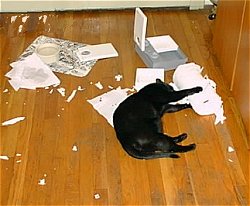
Winter just refuses to let go its grip on the Pioneer Valley- we are scheduled for a Winter Stew today- a little rain, a little snow, a little sleet. So it's a gray, gloomy morning at Foggygates and I'm behind on the new catalog. That seems like an obvious time to browse old photo files, and I found a photo that always makes me laugh, and there's a story to go with it...

A few years ago, a while after we got our two cats, they began to start trying to get us up earlier and earlier each morning for breakfast. First we closed the bedroom door. That didn't work. They'd gather outside the door at about 4 a.m. and begin leaping at the knob, bumping the door, rattling the knob, then thudding to the floor.

bump, rattle, thump...
(silence)
bump, rattle, thump...
(silence)
bump, - you get the idea. We gave that up pretty fast.

Then we bought one of those timed feeders. It's a simple idea. You load the food the night before, set the timer, and it clicks around until it hits "open" and a little flange flips and the lids pop up. What could possibly go wrong with that?

What indeed. The folks who designed that contraption had never met our cats.

To begin with, one of the cats (ok, it was Pywackett) started sitting -on top- of the lids, trying to pry the lid off with her paw. It was hard plastic, and she was sitting on it, weighing it down, so all she could do was lift a corner and then let go, and it would snap back into place with a whack.

So we started hearing this at about 2 a.m.-

whack!
(silence)
whack!
(silence)
whack! whack!

We didn't actually have to decide what to do about the timed feeder, because the second night Pie got down to business and this is what I walked in to the next morning-


I'm not sure how the paper towels got involved...

Oh, the problem with them getting us up earlier and earlier to be fed? It went away immediately when we discovered an interesting psychological fact about cats- if you don't feed them the minute you get up, they won't get you up when they want to be fed.

Who knew?

Wednesday, March 08, 2006

A New Mocha Wares Book


The new book on Mocha pottery came in yesterday, and it's a beauty. Mocha and related dipped wares, 1770-1939 is a colorful explosion of a book, packed with beautiful photographs that vividly capture the colors and wild designs on this distinctive pottery. But it's not all photos- author Jonathan Rickard provides a mighty and solid text to back up the illustrations, exploring the history, makers and styles of these ceramics in England, America and France. Long thought of as a Victorian ceramic, Rickard shows that the style actually dates from the late 18th century. There are many chapters exploring the various patterns and decorating techniques, and the book finishes off with a chapter on the potters and potteries of Mocha and their marks. An exuberant, important study of an under-documented type of pottery.

Here are the technical details- Hardcover, 8.5"x11", 178 pages, color and b/w illustrations, dj. $65.00

Foggygates readers can take a 20% discount on copies through next Monday, which works out to $52.00, plus $5 shipping (it's heavy!).

Please remind us that you saw that offer here.

Tuesday, March 07, 2006

The Time to Buy a Book is When You See It...

The famous bibliophile Thomas J. Wise was a friend and bibliographer of the poet Robert Browning, "a young worshipper at the great man's shrine ..a member of the Browning Society (who) often called on Sunday afternoons..." (Hood, "Letters of Robert Browning, Collected by Thomas J. Wise", 1933). Browning would also give young Wise an unforgettable lesson that the time to buy a book is when you see it...


Augustus Muir, in his article in 'Strand Magazine' in September, 1929, recounts the story of Browning, Browning's very rare first book, 'Pauline' and Thomas J. Wise-

"In the year 1884 Mr. Wise first met Robert Browning; and one of his visits to the poet was an exciting one. Dr. Furnivall, a friend of both, went along with him to 19, Warwick Crescent. Browning was in a front room on the ground floor destroying letters and papers. He had dragged from the top of the house an old leather trunk that had once belonged to his father, and was dipping into it. Mr. Wise, to his horror, saw letters of Carlyle go into the fire and a lot of Browning's own early verses... Out from the old trunk came two precious copies of the original edition of 'Pauline'.

'If I had asked Browning for one of them I am convinced he would have given it to me,' Mr. Wise has declared. 'But I let the chance go'.

"On leaving the Browning house, he told Dr. Furnivall how keen he was to get the book. The good Furnivall was amused at the thrill his friend had got at a glimpse of such a prize in duplicate. 'Write to Browning,' he said, 'and ask him for one of the copies. Offer in return to give to a charity any sum he thinks just'.

"Delicacy held back Thomas J. Wise, but the story does not end here. A few days later, James Dykes Campbell invited him to dine at his flat in Albert Hall Mansions. Browning was the only other guest. After dinner Mr. Wise and his host sat and smoked, while Browning, who did not smoke, was making a leisurely tour of the bookshelves of the room. 'I see you have everything here of mine,' he said to Campbell. 'No,' replied Campbell, 'I still lack "Pauline".' 'Oh, that gap can soon be filled!' exclaimed Browning. 'The other morning I came across two copies of it. One of them will be sent to you tomorrow'. Here again was a god-sent chance for Mr. Wise to ask for the other. But again he let it slip.

"Next day, after much wrestling of spirit, he took Dr. Furnivall's advice and wrote to Robert Browning. But he was too late. Browning had already decided to give the other copy to his son."

Thomas J. Wise did eventually get his copy of 'Pauline' after a long hunt, and for a considerable price. Browning inscribed it for him- "I see with much interest this little book, the original publication of which can hardly have cost more than has been expended on a single copy by its munificent Proprietor and my friend -Mr. Wise."

Wise eventually reprinted the book himself in a limited editon, and years later he would become a forger of Browning's works, forever staining his own bibliophilic reputation and bringing about one of the most famous literary frauds of the 20th century. But that is a story for another day...

Monday, March 06, 2006

Early Morning Visitor

I was making coffee in the kitchen at about 6-30 this morning when I happened to glance out the windows and saw a bobcat walking slowly along the edge of the side lawn, where it meets a large row of pine trees. The cat disappeared into some bushes, then came out the other side, stalked along the edge of the carriage house, and then settled down between the corner of the carriage house and another bush, in the shadows, waiting for an unwary chipmunk at the edge of the stone wall. It stayed for about half an hour.

Bobcats are common enough in western Massachusetts, but they generally prefer a rockier, more wooded areas and tend to be shy of the open fields that we have around here. I suppose we must have just enough woods for him to find enough shelter to be comfortable, especially our woods out back, which is more than three acres and fairly dense.

Well, that was a nice way to start the week off. Back in the city the most wildlife we saw was the neighborhood skunk who would camp out under the side porch every once in a while.

We've got a busy week in store- the "Just Catalogued" proofs have to be sent to the printer by Friday, so I'm busy cataloging books now, and the "Books on Ceramics" catalog will return from the printer a week from today, so we are putting the finishing touches on that mailing list. If you'd like a copy of either, just let us know.

Tomorrow we will have a tale about buying books when you see them...

Sunday, March 05, 2006

Silly Sunday

Many of us sit at desks all day, and are past an age where physical fitness is an easy attainment. A friend sent me this excercise suggestion, and I thought I would pass it along. My friend suggested doing it three days a week. Begin by standing on a comfortable surface, where you have plenty of room at each side.

With a 5-lb. potato sack in each hand, extend your arms straight out from your sides, and hold them there as long as you can. Try to reach a full minute, then relax. Each day, you'll find that you can hold this position for just a bit longer.

After a couple of weeks, move up to 10-lb. potato sacks. Then 15-lb. potato sacks, and then eventually try to get to where you can lift a 25-lb. potato sack in each hand and hold your arms straight for more than a full minute.

Once you feel confident at that level, put a potato in each of the sacks.

Friday, March 03, 2006

Bird Food


We have a rising songbird population here at Foggygates thanks to a number of new feeders we put outside the Morning Room, and that also means we have a thriving squirrel population. I've never been one to deny squirrels their fair share of seed -hey, everyone's gotta eat, and it can be amusing to see the trouble and contortions they go through to get at the feeders. The increasing girth of the local squirrels, however, can lead other inhabitants of the surrounding fields to look at them with the same feelings they have for bird seed...

There's a squirrel sitting on the fence
going Naw! Naw! Naw! at the birds.
The birds flap their wings
and do silly things
but the squirrel isn't disturbed.

He's munching their corn
and he's eating their millet,
he's gulping their thistle
and he's nibbling their suet,
he's wolfing down bird seed
one type at a time,
as the birds all watch
and go out of their minds.

So squirrel just sits
on the fence post and lunches,
looking quite debonair
as he rests on his haunches;
but a high flying hawk sees
the squirrel out there,
away from his tree,
not safe in his lair.

And if bird food is squirrel food,
it's not so absurd,
that squirrels can be bird food,
for just the right bird.

Thursday, March 02, 2006

Where there's a Will, there's a Play...


William Shakespeare. For centuries now there has been a recurring controversy over who wrote Shakespeare's plays. You can put me firmly in the "well, Shakespeare wrote Shakespeare's plays" camp, but the question of putting a face to the name is a bit more puzzling -the fact is, we don't really know what the man looked like. London's National Portrait Gallery is holding an exhibition of Shakespeare portraits- Searching for Shakespeare, which opens today. The exhibition includes paintings traditionally thought (by at least some folks) to have been of Shakespeare, a few of which the experts believe might actually picture the Immortal Bard himself. The others? Understudies, I suppose...

Wednesday, March 01, 2006

A Perdigious Bargain

This eerily familiar auction scene is taken from Richard Graves' 1805 book "The Triflers"

"Now came the principal object of Lady Bustleton's attention -an elegant mahogany chest of drawers; an useful piece of furniture which her ladyship wanted.

"Half a guinea, (cries one of her ladyship's humble companions)

"A guinea and a half," (cries some spirited bidder)

"five shillings more", says the young lady; in short it went on to three guineas and a half! - four guineas!" cries her ladyship herself, when down it was knocked.

Well! says one of her companions, it is a perdigious bargain! Yes! indeed, says another of her ladyship's friends, I had no ideur it would have gone under five guineas.

A plain looking man, who sat beside me (and who I found was a cabinet maker) whispered to one who sat next to him "it went new out of my shop for three guineas".
"

We have bargains of a more modest sort amongst the offerings in our new Catalog of Auction Catalogs, available as a printed catalog, or on the web here.