Wednesday, July 16, 2008

Summertime!

Ah, Summer is really here- the corn is in!

Please forgive me if I get a bit pedantic for moment, because summer corn is one of my favorite topics. Here are some guidelines to follow for the best summer corn- the kind whose sweetness and freshness just pops like a firecracker in your mouth.

First, a few observations- the main thing you have to be aware of is that the sweetness in corn is the sugar, and that this converts itself to starch after the ear is picked, and that this process goes more quickly dependng on how hot the ear gets and how old it is. Grocery store corn is hopeless, as it was picked a few days ago, and was probably not stored properly. Save your money.

For the best taste, buy your corn in the morning from a farm stand that has just harvested it. The ears need to be cool to the touch, and moist. If the tassels are brown you don't need to peel it down and look inside- just look for bug holes in the ear itself. Take it home and put it in the refrigerator until you are ready to cook it. City people take heart- when we lived in the city, our local farmer's market consistently provided corn that had been picked that morning and was still cool when bought shortly after the market opened.

When cooking corn, get the biggest pot you have and fill it with water, and bring it to a boil. Then throw in the corn and bring it back to a boil as quickly as possible- put a cover on the pot if it has one. The point is to keep the corn in the water for as short a time as possible. Boil it for three minutes, not a second longer, take it out and plate it, with a towel for a cover until you eat it with butter, salt and pepper, hopefully within fifteen minutes.

There is no better summer food than fresh picked corn on the cob, if you store it and cook it correctly. Trust me- I bring a lifetime of experience to this question. Here is your diligent reporter harvesting corn straight from the garden some, um, well... ok, maybe 40 years ago.


Tuesday, July 15, 2008

Our New Furniture Catalog-


Our new "Books on Furniture & Cabinetmakers" catalog is ready, and features 288 scarce and out of print books and catalogs on all aspects of antique furniture.

You can browse the catalog on our website.

Wednesday, July 02, 2008

Books, Books, Everywhere!

We have three separate collections we are in the middle of cataloging and offering for sale at the moment- a collection of fine books on Islamic arts, oriental carpets and ethnic textiles from a former dealer, a collection of reference books on silver, ceramics and glass from a customer, and of course there are still about 40 boxes of books on furniture, folk art and Americana from the reference library of Wayne Pratt.

So, despite a taxing Summer schedule of barbecuing, gardening, woods-clearing, and reading on the porch, the Book Elves are hard at work getting all those books catalogued, pictured and up for sale! We'll be issuing printed catalogs on Furniture, Oriental Arts, and "Recent Acquisitions" this month, which will also be posted on the web, so stay tuned!

Thursday, June 26, 2008

A Martha's Vineyard Cookbook-

We have a somewhat beat-up but desirable Martha’s Vineyard cookbook of an unusually early date up for auction this week-

"Island Cook Book. A Collection of Approved Recipes Contributed by the Women of Martha’s Vineyard for the Benefit of Martha’s Vineyard Hospital" Printed by Herald Printing Company of Oak Bluffs, in July, 1924.

This cookbook features several hundred recipes contributed by Vineyarders, as well as scores of advertisements by local businesses. In fact, leafing through the ads is almost as interesting as looking at the recipes, and gives one a real sense of life on the island at the time. Included is an ad for a “public Market” run by the Cronig brothers, which was located in Vineyard Haven (as it still is) and Oak Bluffs. If memory serves me right, Cronig’s was started in 1924, so the markets were only five years old at the time!

You can see the auction here. It began down low, and as always, there is no reserve!

Friday, June 20, 2008

Back at Work (sort of)-

We're back from a short Spring vacation, and it's time to get back to cataloging some of the vast piles of books that are now lining the hallways and stacked in every corner. First up this morning, taking some pictures for our Ebay store.

Um, wait, why is the table shaking?


oh.


oops.


ok, never mind.


[no kitties or books were hurt during the filming of this scene]

Friday, May 30, 2008

And Now for Something Completely Different...


Just spent the long weekend at an old family house that's supposed to be haunted. I've never seen anything there, but others say they have. It reminded me of this absolutely true ghost story-

This happened about a month ago just outside a little town in the backwoods of Maine, and while it sounds like a Stephen King tale, it's real.

This guy was on the side of the road hitchhiking on a real dark night in the middle of a thunder storm. Time passed slowly and no cars went by. It was raining so hard he could hardly see his hand in front of his face.

Suddenly he saw a car moving slowly approaching and appearing ghostlike in the rain. It slowly crept toward him and stopped.

Wanting a ride real bad the guy jumped in the car and closed the door, only then did he realize that there was nobody behind the wheel. The car slowly started moving and the guy was terrified, too scared to think of jumping out and running. The guy saw that the car was slowly approaching a sharp curve, still too scared to jump out, he started to pray and beg for his life, he was sure the ghost car would go off the road and in the marsh and he would surely drown, when just before the curve, a hand appeared through the driver's window and turned the steering wheel, guiding the car safely around the bend.

Paralyzed with fear, the guy watched the hand reappear every time they reached a curve. Finally the guy, scared to near death, had all he could take and jumped out of the car and ran to town.

Wet and in shock, he went into a bar and voice quavering, ordered two shots of whiskey, then told everybody about his supernatural experience.

A silence enveloped and everybody got goose bumps when they realized the guy was telling the truth and not just some drunk.

About half an hour later two loggers walked into the bar and one says to the other: "Hey Jack, there's that idiot who jumped into our car while we were pushing it."

Tuesday, May 06, 2008

Our Latest Catalog-


Spring has finally come to Foggygates and the Book Elves are in full fettle, cleaning up winter debris, getting the flower beds in order and expanding the vegetable garden beds on the side lawn. Never ones to take a long route when a shorter, more dramatic one is available, the Book Elves decided to employ what they termed “advanced quarrying techniques” to break up the new beds. . .

What I find most troubling about the ensuing “incident” (as the State Police report terms it) isn’t simply that they attracted the attentions of the fine folks at Homeland Security when they advertised for 2 cases of dynamite on Craigslist, it’s that they were actually able to purchase them, rig them, and send half of our lawn sailing into the Connecticut River before anyone could stop them.

But before they created a really dandy crater in the yard which we can use as a root cellar, and sent a new island floating lazily south on the Connecticut River, in the direction of Hartford, the Book Elves finished our new Spring Catalog, which features almost 300 books and catalogs on furniture, folk art, ceramics, glass, silver, metalwares, fine arts & prints, many from the reference library of a noted Connecticut antiques
dealer.

The catalog is posted on our website.

We also have free printed copies.
If you would like a free printed copy,
please send us your mailing address.

Monday, April 28, 2008

All Feasts, All the Time-

We just got in a wonderful new publisher's overstock on the history of feasting-
"Charlemagne’s Tablecloth. A Piquant History of Feasting" by Nichola Fletcher. Published by St. Martin’s Press: 2004.

“Not only Charlemagne himself, but King Midas and Robert Burns also make appearances in this award-winning history. From a humble meal of potatoes provided by an angel and the extravagance of medieval and Renaissance revels, to Mardi Gras and the refinement of the Japanese tea ceremony, Charlemagne's Tablecloth covers an astonishing array of unique feasts.”

Hardcover. 6.5”x9.5”, 256 pages, black & white illustrations, dust jacket. New condition. $12.00.

You can buy a copy in our Ebay store.

Monday, April 21, 2008

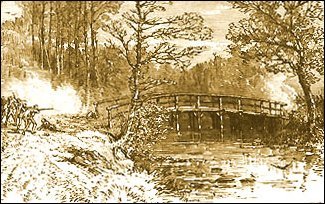
By the Rude Bridge-

It's Patriot's Day here in Massachusetts, a legal holiday not familiar to many folks outside the Bay State. It commemorates the Lexington-Concord Battle of 1775, as immortalized by favorite son Ralph Waldo Emerson, in his famous poem written for the ceremony for the completion of the Battle Monument at the bridge, April 19, 1836-

By the rude bridge that arched the flood,
Their flag to April's breeze unfurled,
Here once the embattled farmers stood,
And fired the shot heard round the world.

The foe long since in silence slept;
Alike the conqueror silent sleeps;
And Time the ruined bridge has swept
Down the dark stream which seaward creeps.

On this green bank, by this soft stream,
We set to-day a votive stone;
That memory may their deed redeem,
When, like our sires, our sons are gone.

Spirit, that made those heroes dare
To die, and leave their children free,
Bid Time and Nature gently spare
The shaft we raise to them and thee.


Patriot's Day now means an 11 a.m. Red Sox game, the Boston Marathon, and services and re-enactments in many towns which have companies of volunteer Minutemen who dress up in colonial-era garb and march on their town greens. The Lexington-Concord area has the whole panapoly of celebrations, including a local company of the British 10th Regiment of Foot, the soldiers who were among the companies that marched to Concord that day. As a kid growing up in Concord, I always wanted to be one of the Redcoats. My illusions were shattered one day when I was walking down by the post office and saw a lanky Redcoat take off his tall tin hat and squeeze himself into a tiny VW parked by the curb.

Oh well. Happy Patriot's Day!

Friday, April 18, 2008

Judging a Book by Its Cover-

I admit it- I do sometimes judge a book by its cover, and sometimes I can't resist buying a book for its cover. Here are a few garden-related covers that struck my fancy lately-

I love the Art Deco feel of this one, and its simplicity-


This is from the 1920s, and I loved both the cover, which shows the classic 1920s suburban cottage garden, and the subject matter-


I picked this one up last year. Its a beautiful cover, and it also looks a lot like our woods out back do in the winter at sunset-


And how was I supposed to resist this?


Wednesday, April 16, 2008

Well, I'll Be A Monkey's Uncle-

Here's an interesting little piece of Victorian Architecturalia (no, I'm not sure if that's a word either) -


"The Oxford Museum" By John Ruskin & Henry W. Acland. Published in London by Smith, Elder and Co.: 1859.

An interesting discourse touching on the principles of the Gothic Revival, handwork and the dignity of workmen, and the proper decoration of buildings, as they were related to the architecture of Oxford’s famous Museum of Natural History, popularly known as the Oxford Museum. Championed in the 1850s by Sir Henry Acland, who felt that Oxford was ignoring the natural sciences, the Museum brought all those disciplines, including geology, astronomy, geometry, chemistry, and zoology under one roof. And quite a neo-Gothic roof it was... The building was designed by Deane and Woodward of Dublin, with assistance of one sort or another from Ruskin, who notes here-

“In the competition [for the design] scarce any limitation was imposed, and to style none. Thirty-two designs by anonymous contributors were sent in; the majority of the judges, after a thoroughly English battle, in which some professed advocates of Gothic architecture deprecated the application of Gothic Art to secular purposes, -thereby denying to their own style that malleability which is, perhaps, its highest prerogative, -the design, ‘Nisi Dominus oedificaverit domum,’ was accepted”.

The Museum was the scene of the famous 1860 debate during which Samuel Wilberforce, Bishop of Oxford, asked Thomas Huxley whether he was descended from a monkey on his grandfather’s or grandmother’s side, to which Huxley replied that he had-

"no need to be ashamed of having an ape for his grandfather, but that he would be ashamed of having for an ancestor a man of restless and versatile interest who distracts the attention of his hearers from the real point at issue by eloquent digression and skilled appeals to religious prejudice."

Hardcover. 4.75”x7.5”, 111 pages plus a 4-page list of other titles by the authors; steel-engraved frontispiece of a pillar with fern carvings; a full-page woodblock plate of decorative tracery; a folding plan of the museum; publisher’s pebbled & embossed cloth with gilt titles; spine slightly faded, minor soil and a little wear, but overall a very nice, fresh copy.

This copy has the handsome engraved bookplate of Herbert John Gladstone [1854-1930] on the front pastedown. Lord Gladstone was the son of Prime Minister William Gladstone, and after lecturing on history at Keble College, Oxford, he embarked on a long political career which culminated in his appointment as Home Secretary under Asquith from whence, after some controversy over domestic policy, he was booted “upstairs” and sent to South Africa as the first Governor-General and High Commissioner of the Union of South Africa.

$350.00

Monday, April 14, 2008

The Things You Find in Books-

This was actually the title of a thread on an email list recently. It is always fun to find something quirky, odd, or interesting tucked into a book. A few months ago I picked up a copy of a very obscure little book of poetry published in 1898 titled"Sandwort" by Anna J. Granniss because it was printed in my hometown of Keene, New Hampshire. As I opened it up, this little card fell out-


Paying by the poem! I thought that was rather clever, and it seems we're basically back to that business model now in the online music industry...

Tuesday, April 08, 2008

The Artist Who Knew Poe-

Anonymous books are always a puzzle- why did the author choose not to reveal his name? What is the story behind it? Often there is an interesting tale to tell, and that is the case with a little 19th century book titled "Handbook of Young Artists and Amateurs in Oil Painting...by an American Artist", published in New York in 1845.

The author was a man named Laughton Osborn [1809-1878], who was an amateur painter and professional (though usually anonymous) author, whose work is now largely forgotten. He is seen most vividly today through the eyes of Edgar Alan Poe, who knew him as an entertaining, sometimes virulent author, and a poetic contributor to several of Poe's magazines.

Poe included a vivid sketch of Osborn in his 1850 essay "The Literati", where he related that he had read and been amused by several of Osborn's anonymous literary works, the most notable of which had been "The Confessions of a Poet, by Himself". "Confessions" had been widely criticized by literary critics as obscene.

"It is not precisely the work to place in the hands of a lady," Poe admits, while judging it "quite remarkable For artistic unity and perfection [with] sentiments audacious and suggestive at least, if not at all times tenable."

Violent criticism of the "Confessions" from one New York newspaper editor brought forth a stinging satirical rebuke from Osborn titled "The Vision of Rubeta, an Epic of the Island of Manhattan". This satire, Poe notes-

"was not only bitter but personal in the last degree. It was, moreover, very censurably indecent - filthy is, perhaps, the more appropriate word".

Still, Poe declares, it was the best satire written to the time in America, which was, he admits, not saying all that much, as it was also just about the only satire written up to that time in America. Osborn had once complained in a private letter to Poe that he had absolutely no friends, and Poe muses that he was-

"undoubtedly one of "Nature's own noblemen, full of generosity, courage, honor - chivalrous in every respect, but, unhappily, carrying his ideas of chivalry, or rather of independence, to the point of Quixotism, if not of absolute insanity," and that Osborn had "few equals at downright invective."

Odd then, that he had no friends...

America's own foul-mouthed Quixote was also a playwright, specializing in pseudo-historical tragedies and comedies, and an amateur painter, from which hobby came his interest in the French works he translated to produce this "Handbook of Young Artists". In this book Osborn discusses materials and implements, coloring, finishing, the technique of painting drapery, painting landscapes, and finally varnishing, cleaning, repairing and lining. The book is a source of much useful information on 19th century techniques and materials, and is also of interest as an example of an influential 19th century American art manual. It was re-issued a number of times in the 1850s and 60s.

Poe summed up Osborn as-

"a poet, painter and musician (who has) absolutely succeeded as each. His scholarship is extensive. In the French and Italian languages, he is [quite] at home, and in everything he is thorough and accurate."

Osborn's "Treatise on Oil Painting," Poe concludes, was "highly spoken of by those well qualified to judge."

Well, it would have been, wouldn't it? Who would have wanted to cross pens, or paintbrushes, with Laughton Osborn?

We have a copy of this book for sale here.

Tuesday, April 01, 2008

They Call it... Fake!!

We're featuring an interesting item in our Ebay store this week, a catalog that played major part in one of the more fascinating tales of antiquities forgery in the 20th Century-

It had all started in late 1915 when Gisela Richter, renowned expert on Greek and Roman antiquities at New York’s Metropolitan Museum of Art, received a letter from John Marshall, the Museum’s veteran purchasing agent in Italy, describing a newly discovered life-size Etruscan warrior figure in terra-cotta which had been discovered in an Italian field. The “old warrior” (he had a white beard and was emaciated, somewhat like, as one observer commented later, a Giacommetti sculpture) was soon followed by a massive four-foot tall terra cotta warrior’s head, and there was even talk of a greater treasure waiting to be found...

You can read the complete story here.

Thursday, March 27, 2008

An Interesting Early Western Survey-

We're offering an interesting 1857 US/Mexican border Survey for auction this week. The book has a few problems and is rough, but still has many interesting plates.

"United States and Mexican Boundary Survey, made under the Direction of the Secretary of the Interior" by William H. Emory, Major First Cavalry and United States Commissioner. Printed by A. O. P. Nicholson, Printer, Washington: 1857. Volume 1, Parts One & Two.

In 1848 Major William H. Emory, a highly skilled and talented American Army officer, topographer and geologist, was sent to make a survey of the new U.S.-Mexican boundary, as stipulated in the 1848 Treaty of Guadalupe-Hidalgo, which ended the Mexican American War. On his return, an elaborately illustrated report consisting of two volumes, each divided into two parts was prepared for distribution to Congress. A later edition was issued in three volumes.

Up for auction is Volume one of the two-volume set that was originally presented to Congress, one volume at a time.

You can see the auction and many more illustrations here.

Tuesday, March 25, 2008

1854 Map Collection

We've got an interesting 19th century compilation of state maps and charts being offered for auction this week on Ebay. Low starting bid, no reserve!


"Maps and Views to Accompany Message from the President of the United States to the Two Houses of Congress, at the Commencement of the Second Session of the Thirty-Third Congress.” Printed by A.O.P. Nicholson, Printer: 1854.

This is a bound copy of the various maps, charts and plans submitted to the second session of the 33rd Congress of the United States in 1854. It consists of 43 maps and folding plates of wildly varying sizes, from a map of California clocking in at 44"x21" to a plan of the "Triangular Reservation on Pennsylvania Avenue, between Twentieth and Twenty-first Streets West" at a mere 5"x9".

States include California, Florida, Michigan, Wisconsin, Arkansas, Iowa, Kansas, Nebraska, Minnesota, Ohio, New York, Maryland, and Washington, D.C.

Despite the ragged looking edges and some water stains, the maps are quite robust, with all folds intact.

You can see the complete description and more pictures by clicking here.

Monday, March 24, 2008

Spring is finally here-


It hasn't seemed very Springlike, since we still have about 50% snow-cover here, but yesterday I was actually able to get outside and clean off a few beds, and the parsley, lemon balm, thyme and oregano are all coming up. And there are other signs...

The Red Sox are about to open the season. OK, they're opening in Japan, and we'll be listening at breakfast either Tuesday or Wednesday morning (I still haven't figured that out) but Opening Day means Spring!

The sun is now in my eyes in the late afternoon. Our house is oriented exactly North-South (front faces North) and one of my office widows faces due West. In the late afternoon during the Spring, Summer and Fall the sun shines in and reflects off my computer screen. In the Winter, when the Sun traces a much more southerly course, I don't get it in my window in the afternoon. So another sign of Spring here is that the Sun is moving back into the sky high enough to shine in my eye in the afternoon.

So- how long 'till we start harvesting home-grown tomatoes???

Friday, March 21, 2008

A Rare Civil War Poem at Auction-


A cup of cold water
For him wounded sore:
He asks if a brother
Needs it not more.
Look! On this dark skin
Grim slave-scars are found,
Where blood rushes red

From the freedman’s deep wound.

"Our Work" Author unknown, probably printed in New York, circa 1862-1864.

5.5”x8.5” pamphlet. Printed in red and blue. Light soil, and a few spots.

A poem paying tribute to the work of male and female nurses on the battlefield in the Civil war, with an intriguing reference to wounded African-American soldiers.

The poem was also printed in the book “Pen Pictures of the War, and Sketches of the Rebellion”, edited by William Ledyard and published in 1864.

The 1864 printing of Ledyard’s volume is itself somewhat uncommon in the marketplace, and our printing of the poem appears to be downright scarce, with OCLC locating only one copy, which is in the New York Historical Society.

You can see and bid on the poem here.

We have several other interesting 19th Century Americana items up for auction this week. See our Current Auctions for all four Americana items.

Wednesday, March 19, 2008

R.I.P., Arthur C. Clarke


Arthur C. Clarke died yesterday. This post is not going to be a review of his life, you can look on Wikipedia or any newspaper today for that.

This is simply a tribute to my favorite science fiction writer, whose death saddens me.

When I was in Middle School and High School I was (surprise, surprise) a nerd. A geek. My friends and I loved science and science fiction. We read it and we watched it and we wrote it. In my own particular circle, the face-off was always between Isaac Asimov and Arthur C. Clarke, and I was an Arthur C. Clarke nerd.

Don't get me wrong, I loved Asimov too, but Sir Arthur had something more for me, and that was a sly sense of humor. You can see it in his mainstream works, such as the ever-popular 2001 (I'm sorry, Dave), and in his lesser-known works, such as his "Tales from the White Hart' series of stories. 'Tales from the White Hart' remains among my favorite science-fiction books ever. It takes place in a British pub, and recounts the tall tales of Harry Purvis, a scientist who can trade stories with the best of them. The stories are witty, intelligent, and funny.

The first Arthur C. Clarke story I ever read was called "The Nine Billion Names of God", in a paperback anthology of the same name. The coincidence here is that this story dealt with llamas in Tibet, who were programming a computer to compute the nine billion names of God, at which point His purpose would be served, and the Universe would cease to exist. Tibet is, of course, in the news and my thoughts today.

When I was in 7th grade we had things called "Mini Courses"- these were extra-curricular course taught twice a week by teachers on subjects like word games, fencing, bargello, weather forecasting, and so on. Somehow my friend Marc and I persuaded my homeroom teacher, Mrs. Lewis, to sponsor us as "teachers" of a Mini-Course called "The Science-Fiction Book Club". We didn't have this idea in time to get it into the booklet they passed around at the beginning of the term, so not many people knew it existed. When Mini-Course sign-up period came, we sat in Mrs. Lewis's room at our own table, ready to take our students, as other students came in for Mrs. Lewis's course on word games.

When the room was full Mrs. Lewis stood up and said "Everyone who is here for Word Games, sit where you are. Everyone who is here for the Science Fiction Book Club, go over and sit with Marc and Forrest".

And everyone looked at us, sitting at our table, all alone, and nobody moved.

But hey, it turned out ok. We had a classroom and a whole two extra periods a week all to ourselves, and we signed the "passed course" sheets for each other the first day, and just read books and goofed off for the entire term. It was cool.

And I read a lot of Arthur C. Clarke stories that period. Arthur C. Clarke had the rare gift to be a serious scientist and a witty and original storyteller, and his passing saddens me.

I raise a glass tonight to Sir Arthur. May the Nine Billion Names of God include yours.

Tuesday, March 18, 2008

Luck of the Irish-


A day late for St. Patrick's Day, but here's a little gem of a catalog that keeps the spirit goin' -

Davis, John D. The Genius of Irish Silver. A Texas Private Collection. Colonial Williamsburg Foundation: 1991. The catalog of a loan exhibition of 118 pieces of Irish silver from the last decades of the 17th century to 1800. A slim catalog, but beautifully photographed, and uncommon. Softcover. 8.5”x10”, 47 pages, b/w illustrations. Light wear. [31737] $125.00

You can easily order this catalog by clicking here.