Wednesday, May 31, 2006

Let the Sunshine In-

As I have mentioned before, sometimes I come across books which have interesting stories behind them. Usually the stories concern either the author or the history of the book itself, but sometimes they have to do with prior owners.

We have a copy of an 1884 book by Arthur Charleston titled "Tin: Describing the Chief Methods of Mining, Dressing & Smelting it Abroad". An interesting enough book itself, if you are inclined tin-ward, but additionally, this copy bears the ownership signature- "Rev. M.A.G. Himalaya, Braga, Portugal, 1907" on the title page, and therein lies another story.

Manuel Antonio Gomes 'Himalaya' [1868-1933(?)], "Father Himalaya", is considered to be the father of solar energy in Portugal, and a visionary pioneer in the field of renewable energy. After taking Holy Orders in the Society of Jesus he studied natural sciences, physics, chemistry, mathematics and astronomy, and traveled to France where he studied with the noted chemist Marcelin Berthelot.

In 1899 he was granted a patent by the French government for a device to produce heat by focusing the sun's rays; in 1900 he constructed a test device in the Pyrenees and attained a temperature of 1100 degrees centigrade.

In 1902 an experiment in Lisbon attained 2000 degrees, and he made a final, startling demonstration of the power of such a device at the St. Louis Exposition in Missouri 1904. There he constructed his "Pireliofero", a 3-story high parabolic mirror mounted on a monstrous iron framework which focused sunlight on an oven mounted at the top of the structure. The oven reached a temperature of 3500 degrees, melting a test chunk of basalt, and Father Himalaya won a Grand Prize for his efforts.

He promoted other forms of renewable energy as well, including tidal energy and hydroelectric power, wind power, and geothermal power. Alas, there was plenty of cheap coal and oil available, and his work was generally ignored and forgotten. Father Himalaya retired to become chaplain at Viana Castle, a charity home, where he died at the age of 65. His work has excited interest in Europe in recent years, and his ideas have only lately attained a measure of the respect which eluded them in his lifetime.

Father Manuel Antonio Gomes 'Himalaya' and his "Pireliofero"

Friday, May 26, 2006

Gutters and Moles and... Bears?? Oh my...

Well, the bucket-truck has been called off. Our contractor has a new roofer who thinks the job of removing the old gutters and replacing the facia on the house crown can be done with scaffolding, so next week they're going to put that up. It'll be less dramatic, but also better for the lawn- we weren't all that thrilled about a big truck driving all around the house, though with the front lawn currently a Mole Paradise I'm not sure it would have looked all that different. If you used to have problems with moles under your lawn and you don't have any this year, they're all at Foggygates, chawing down.

Speaking of wildlife- I walked down to the local barbershop yesterday (about a quarter mile away), and on my way back, in the middle of a sunny afternoon, I saw a big black bear come across the church rectory's lawn (right next door to us), wait for a passing car, and then lope across the street and wander off into the woods on the other side. That caused a little excitement in town for a while. I'd never seen a bear in the wild before; Amy saw some years ago while camping at Yellowstone, but I think the operative words there are "camping" and "Yellowstone", which seem more appropriate venues for bear watching than "the neighbor's lawn".

And our cats wonder why we don't let them out...

Tuesday, May 23, 2006

Auction Catalogs-

The Book Elves have been pruning the trees and shrubs here at Foggygates, and somebody (I'd really, *really* like to know who) sent them a little book titled: "Erotic Topiary Designs for Beginners" which they have been using on the azaleas. We now have a thirty-year old azalea shaped like the picture on the cover of the latest Madonna album, and traffic on our little street has increased tenfold this week.

However, before they got us summoned before the next meeting of the Board of Selectman, they finished our new printed catalog #274, "Going Once... Going Twice... A Selection of Auction Catalogs from Our Stock", which is now available.

This issue includes catalogs covering Collectors & Collections; French Decorative & Fine Arts; Furniture & Americana; Folk Art; Metals; Garden Furniture & accessories; Ceramics; Glass; Silver; Jewelry; Judaica; Russian Arts; Miniatures; and Horology.

Please let us know if you would like a printed copy. You can also browse it on our website.

Monday, May 22, 2006

Spring?


Well, the sun has finally come out at Foggygates -but it's cold! It seems that this May we either have rain or chilly weather. I miss Spring. The rains of the last few weeks caught our roofers just as they were about to remove the gutters and replace the facia boards around the top of the house crown, but they hope to do that in the next few days. It's going to be quite an operation- because of the shape of the roofs, they can't get up there safely with ladders to remove the facia, so they are going to bring in one of those bucket trucks. It's going to be quite a sight for the neighbors, and I'll try to get some pictures.

We've got our new Catalog of Auction Catalogs hitting the streets tomorrow- let us know if you would like a free copy. It will also be on our website. More about that tomorrow.

Thursday, May 18, 2006

New Titles in Our New Catalog-

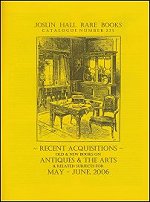
If you have glanced through our new May-June catalog, you will have noticed by now that we have added quite a few in-print titles to our stock. We started adding in-print titles a few months ago, and it proved so popular that we are augmenting that area of our stock, and will continue to expand it in the coming months. There are some great new books out there, so why not carry them? This month we feature important new books on windsor chairs, mocha ware, Gothic Revival decorative arts, Pairpoint glass, and Georgia furniture. If there is anything in the way of in-print antiques references you are looking for, please let us know.

You can browse our new May-June catalog on our website, or if you would like a printed copy, please let us know.

Tuesday, May 16, 2006

Our New May-June Catalog-

It's been raining for about 10 days now, with no end in sight. The Book Elves are busily constructing an ark. However, before they loaded the shovels and rakes and implements of destruction into the old clawfoot bathub in the basement and tried to drag it down to the Connecticut River, they finished our new May-June catalog, which is available either in printed format, or on our website.

Please let us know if you would like a printed copy, or you can browse it here.

Friday, May 12, 2006

An Impressive Collection of Judaica-

We just bought the remaining copies of a very nice small catalog of an impressive Judaica collection-

"Catalog of the Bernice and Henry Tumen Collection of Jewish Ceremonial Objects in the Harvard College Library and the Harvard Semitic Museum" by Violet Gilboa. Published by the Harvard University Library in 1993.

This volume features photographs and descriptions of 166 Jewish ceremonial objects including wine cups; beakers; Sabbath lamps; candlesticks; spice boxes; Hanukkah lamps; Torah pointers; crowns, shields, and finials; plates for the Passover Seder and other occasions; charity boxes; Esther scrolls; containers for the etrog fruit used on Sukkot; marriage rings; amulets; and others. The vast majority of the objects are made of silver, with some additional pieces of pewter, a few brass and ceramic objects, and some textiles. Violet Gilboa is Littauer Hebraica Technical and Research Services Librarian at the Judaica Division of the Harvard College Library. Softcover. 6”x9”, 172 pages, b/w illustrations; bibliography. $25.00

We're offering a special price on them this week-
Single copies- $15.00, postpaid (Media Mail)
5 copies- $6 each ($30.00 postpaid -Media Mail)
10 copies- $5 each ($50.00 postpaid -Media Mail)

Wednesday, May 10, 2006

Victorian Fashions-

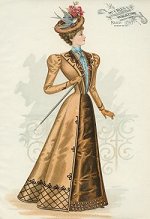
We are still unpacking boxes here, and recently came across several interesting Victorian fashion plates from McCall's Magazine, which we promptly plopped up on Ebay. These are somewhat stylized (think wasp waists and oddly shaped bodices) and quite colorful. We put in starting bids down at $9.99, with no reserves, so if you need something to spice up your walls, click the "Our Auctions" link in the right-hand column!

Monday, May 08, 2006

The Gothic Revival-

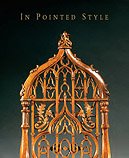
We have a new exhibition catalog in stock- "In Pointed Style. The Gothic Revival in America, 1800-1860".

The catalog is by Elizabeth & Stuart Feld, and accompanies the current exhibition at the Hirschl & Adler Galleries in New York, the first comprehensive exhibition of Gothic Revival furniture and arts in 30 years.

This is a wonderful catalog, featuring furniture, architecture, glass, lighting, silver and other decorations. It is illustrated with many period prints and artwork, as well as stunning new color photographs,and has an introductory essay by David B. Warren. Softcover. 9”x11”, 144 pages, color and b/w illustrations. Bibliography. [90200] $45.00

Friday, May 05, 2006

Point of View-

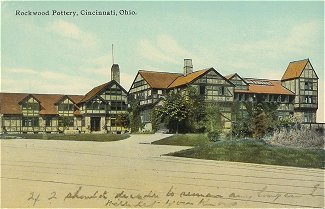
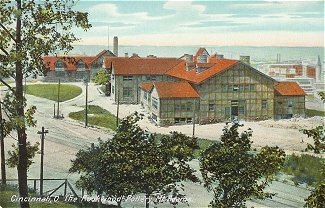
Cincinnati's Rookwood Pottery is legendary among art pottery collectors, and probably the best known American art pottery. I recently found several ca.1910 postcards showing the pottery which I thought were interesting.

This one, the oldest of the two, shows a front view that makes the pottery look almost like a rambling tudor mansion in some suburb-


This view, apparently taken a few years later, shows a more business-like viewpoint-


Wednesday, May 03, 2006

Liar, Liar?

He sailed the Mississippi...
or did he?


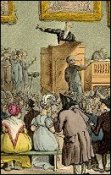
Father Louis Hennepin was a Franciscan Friar who accompanied La Salle on his Western expedition of 1679 to reach the Gulf of Mexico from Canada, via the Mississippi River. After the trip Hennepin wrote his famous “A New Discovery of a vast Country in America”, originally published in French in 1697 and in English in 1698.

Hennepin tells of his travels with La Salle on the Griffon, the first ship on the Great Lakes, to Green Bay and across the Mississippi by the Illinois route. From there Hennepin was sent with an expedition, led by Michel Aco, which was the first to explore the upper Mississippi valley. They ascended the river to Minnesota, where they were captured by the Issati Sioux. The party was eventually rescued by Duluth who insisted on their release, though some claim that Hennepin’s constant complaints and lectures had already become so tedious to the Sioux, that they were happy to be rid of him.

Unfortunately, Hennepin was a notorious liar. In his accounts he claims close association with La Salle, but La Salle thought little of Hennepin, even warning his colleagues about Hennepin’s habit of exaggeration. Prompted by his efforts at political maneuvering and his own penchant for tellings fibs, Hennepin’s accounts of his journeys along the Mississippi vary from only slightly overblown to outright plagiarism. He claims to have traversed both the upper and the lower Mississippi all the way down to the Gulf of Mexico, but the time between his departure from the country of the Illinois and his capture by the Issati is not sufficient for such a long canoe voyage.

Despite the falsehoods about some aspects of the expeditions described in his narrative, Hennepin’s book became a standard text on North America. It should also be said that he was an acute observer, and his books contain detailed and accurate descriptions of the characteristics, arts, and customs of the Indians. He made careful note of the wildlife they encountered, and his descriptions of natural history convey not only a physical description of the animal in question, but Hennepin’s own personal reaction to the creatures as well. His is the first written description, complete with illustration, of Niagara Falls and his examination of every facet of American Indian culture is a gold mine of information.

In 1903 Reuben Gold Thwaites edited a new edition of “A New Discovery of a Vast Country in America”, with facsimiles of the original title-pages, maps and illustrations, and a new introduction, notes and index.

We have a copy of the 1903 edition up for auction this week -click our Auction link in the right-hand column.


We're hard at work on our new May-June catalog, which will be mailed in a few weeks -if you're not on our mailing list and would like a copy, please let us know.


We're also hard at work (or hardly at work) on the new edition of A Grave Affair -Books on Gravestones & Memorial Arts -again, let us know if you would like a copy of the catalog when it is ready.

Tuesday, May 02, 2006

A New Windsor Chair Book-

We just got a case of that nice new book on windsor chairs everyone's talking about-

"Windsor-Chair Making in America -From Craft Shop to Consumer"
By Nancy Goyne Evans. Published by the University Press of New England in 2006. Hardcover, 9"x12", 496 pages, color and b/w illustrations, dj. $65.00

"The definitive work on the production of Windsor furniture, from one of America’s premier authorities. Drawing principally on original source materials, Nancy Goyne Evans’s elegantly written and extensively illustrated book presents an authoritative and absorbing historical picture of the vernacular chair shop and industry. Of the book’s five chapters, three deal extensively with the craft shop. Evans discusses everything from structure to tools and equipment, from shop personnel to power sources, and from raw materials to ornament, both painted and stenciled. A chapter on marketing explores the booming Windsor-chair trade in the American coastal South and the islands of the Caribbean, furniture distribution to local, overland, and overseas markets, and general methods of doing business. Another section explores consumerism and the use of Windsor furniture in domestic and public settings."

Wednesday, April 26, 2006

Did George Washington Wear a Tuxedo?


I like books which have interesting stories to tell beyond the text, and I also like association copies- a copy of a book which belonged to somebody interesting. Every so often a book comes along that combines both, and we’ve got one in our new Spring catalog (you knew that’s where this was going, didn’t you?).

James Walter wrote "Memorials of Washington and of Mary, His Mother, and Martha, His Wife, from Letters and Papers of Robert Cary and James Sharples" in 1887. On the surface, as John Lovari, writing in Karpel’s “Arts in America” writes- it is “Apparently an interesting and valuable account of Sharples's connection with the Washington family, with comments on Robert Fulton and his friendship with Sharples and on the two men as artists and scientists.

But all is not as it seems... Lovari continues-

Although this is a seemingly plausible and valid description of the book after a first reading of it, the work, an abridged version of which had appeared in 1886 under the title 'History and Descriptive Details of Middleton's Portraits of Mary, the Mother of Washington', ranks with Clifford Irving's recent 'biography' of Howard Hughes as one of the major hoaxes of the publishing world. Walter was attacked on twelve points of plagiarism, forgery, and fabrication of evidence by the members of the Massachusetts Historical Society".

Well now.

All that’s interesting enough, but this copy has the small printed book ticket of the noted American book collector Grenville Kane, the bulk of whose Americana and Incunabula collections are now at Princeton. In addition to being an important book collector, Kane was also a founding member of the Tuxedo Club, a group of wealthy New Yorkers who summered together at Tuxedo Park in upstate New York; the group was responsible for introducing to American Society the new-fangled semi-formal dinner jacket worn at a dinner by the Prince of Wales, and naming it the... yes, that's right.

ok, I'll admit that I'm pretty easily amused, but I think that's fairly cool.

Our new Spring catalog is now available online or as a printed catalog; please let us know if you would like a copy.

Tuesday, April 25, 2006

New Spring Catalog

Spring is sprung,
the grass is ris,
I wonder where
the new catalog is?

Well, the Book Elves are busy this week in the garden, flinging daffodil bulbs at each other, but before the loaded up the wheelbarrow with wood chips and accidentally had the first barbecue of the spring, they finished our new Spring Catalog, featuring 310 books & catalogs on furniture, ceramics, glass, silver, metals, textiles, and other decorative arts & related subjects.

This catalog is available in printed format,and it may also be viewed on our website.

If you would prefer a printed copy, please let us know.

Monday, April 24, 2006

A Far Cry from Kensington-

The English novelist Muriel Spark died last week in Italy. Over a career spanning more than five decades, Ms. Spark wrote many much-loved novels, including “The Prime of Miss Jean Brodie”, “A Far Cry from Kensington”, “The Ballad of Peckham Rye”, and “Memento Mori”. But in her autobiography of the first four decades of her life, Muriel Spark recounts some of her other jobs, and one, her first job after working on a secret project for the British Foreign Office during the War, may be of particular interest to antiques collectors-

“The year after the war I found a job on a good quarterly magazine called Argentor... Argentor was a beautifully produced magazine, resembling the Connoisseur in style and format, the official quarterly journal of the National Jewellers’ Association. My job was mainly research in museums, libraries, art galleries; a truly refreshing occupation. I loved it. Even now, looking back at the list of contents of the first number in which I was involved, the pleasure of that world comes back to me. The editor, William Llewellyn-Amos, was particularly trusting, and quite uncaring about my lack of experience. His confidence in me was stimulating. I had no hesitation about writing contributions on a subject hitherto unknown to me. Another journalist, Mona Curran, was employed in the office; we worked together well. Quite a lot of articles by specialists had to be touched up from the stylistic point of view, and we spent long hours recasting the articles that had been commissioned.

The list of contents in the number under preparation when I joined the magazine included an article on English domestic silver, and one on spoons and forks; another was ‘Old Clocks of England’ and James Gunn, a celebrated portrait painter, contributed ‘Jewels and the Painter’. The journal, very well illustrated, aimed to express high standards of workmanship, and to give the readers an idea of the history of the jewellers’ art, and that of goldsmiths, silversmiths, horologists and the allied crafts. One of my first assignments was to work on an article (signed by the editor) called ‘The Goldsmith Painters’, relating how many of the Renaissance artists began as goldsmiths. On my own account I wrote ‘Some Jewels of English Poetry’, in which I showed how the names of jewels were used figuratively throughout English poetry. (To my surprise and joy this article was picked our for a highly favourable mention by the Evening Standard: my stock in the office went up). Later on, before I left Argentor, I had researched and written a long article on the Order of the Golden Fleece which adorns many famous and historical portraits. About this article I have a sense of great satisfaction. It bears no signs of immaturity and I would not hesitate to reprint it today.

The number of subjects connected with the goldsmiths’, silversmiths’ and jewellers’ art was inexhaustible. The essays written by experts which needed some form of recasting were mainly passed on to me. I learned how to copy-edit tactfully. I recall that I took out a great many adjectives.

My working days were long. I spent hours on research at the College of Heralds, the National Gallery, the British Museum and similar institutions. Further hours were spent in the office, writing and editing. And sometimes I would work at home on an interesting article, far, far into the night.

I got no extra pay for work I had done at home, and of my own composition. I wasn’t expected to sell my work to the magazine. Even when I wrote a small poem, much approved of by the editor, this too went in with my wages, six pounds a week, as a matter of course. I was perfectly happy with this arrangement. I enjoyed the work and was learning, too, how to edit a magazine, and how to proof-read and copy-edit. Argentor continued to publish my work (no pay) till 1948, two years after I left, and was editing Poetry Review for the Poetry Society. But Argentor is no more. It is now an expensive production often quoted in the rare book lists”.

-Muriel Spark, Curriculum Vitae. Autobiography. London, Constable and Company, 1992.
Wednesday, April 19, 2006

That's funny, I don't see it on the map...

We have a sub-specialty in books about fakes, forgery & fraud, and I'm always excited when I run across the tale of a new fraud I did not know about before. We just brought in a nice publisher's overstock title which falls into that category.

Ever vacation on the broad, sandy beaches, or go hiking through the temperate, leafy woodlands of the tiny Central American Country of Poyais? No? Well, there may be a reason for that...

Sir Gregor MacGregor and the Land that Never Was. The Extraordinary Story of the Most Audacious Fraud in History. by David Sinclair. Published by Headline Book Publishing in 2003.

”Once upon a time, in the heart of Central America, there was a country called Poyais. It was a country exceptionally rich in natural resources, civilization and culture, and was ruled by a brave an enlightened Scottish soldier, General Sir Gregor MacGregor, who had been made its cazique, or prince, after his many heroic exploits in the cause of South America’s struggle to liberate itself from the Spanish empire. In 1821 the Cazique of Poyais and his beautiful princess arrived in Britain to promote the virtues of their country and encourage immigration and investment.”

Within a year Sir Gregor MacGregor had become a celebrity, been honored by the Mayor of London, and had persuaded thousands of savvy investors to subscribe a L200,000 loan he floated on the London Stock Market. He also succeeded in persuading hundreds of settlers to uproot their lives and families, sell everything they owned, and set out on the long and perilous journey to this promised land in two ships. It was a journey from which most of them would never return, because, of course, there was no such country as Poyais...

This book is a hardcover. 5.5”x9”, 358 pages, b/w illustrations, dj. New. Published at $25.00. Copies available for a limited time for $10.00

Monday, April 17, 2006

The Shot Heard Round the World-

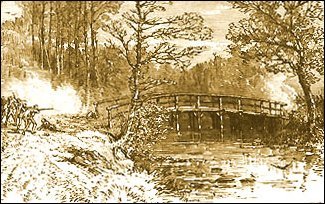
It's Patriot's Day here in Massachusetts, a legal holiday not familiar to many folks outside the Bay State. It commemorates the Lexington-Concord Battle of 1775, as immortalized by favorite son Ralph Waldo Emerson-

By the rude bridge which arched the flood,
their flag to to April breeze unfurled,
here once the embattled farmers stood,
and fired the shot heard round the world


Patriot's Day now means an 11 a.m. Red Sox game, the Boston Marathon, and services and re-enactments in many towns which have companies of volunteer Minutemen who dress up in colonial-era garb and march on their town greens. The Lexington-Concord area has the whole panapoly of celebrations, including a local company of the British 10th Regiment of Foot, the soldiers who were among the companies that marched to Concord that day. As a kid growing up in Concord, I always wanted to be one of the Redcoats. My illusions were shattered one day when I was walking down by the post office and saw a lanky Redcoat take off his tall tin hat and squeeze himself into a tiny VW parked by the curb.

We have an interesting Lexington-Concord-related book ending on Ebay tomorrow- it's a reminiscence about the battle, and the subsequent siege of Boston, by a British officer who was there- Concord Fight. Being so much of the Narrative of Ensign Jeremy Lister of the 10th Regiment of Foot as pertains to his services on the 19th of April, 1775, and to his experiences in Boston during the early months of the Siege.

Published in Cambridge by the Harvard University Press in 1931. Edition limited to 500 copies. An interesting account of the Lexington & Concord fights and subsequent retreat back to Boston by an officer who was wounded at the Concord Bridge. The manuscript account, written in 1782, first came to light when portions were published in the London Telegraph in 1928. Richard Eaton and Allen French of Concord tracked the original manuscript to its owner, a Lister descendant, who agreed to let them make a copy of the entire short memoir, and publish in full the parts that pertained to the Lexington-Concord battle and siege of Boston.

Ensign Jeremy Lister was a twenty-something junior officer in April, 1775, and he volunteered to join Colonel Smith's detachment on the march to Concord. Shot in the elbow at the Concord bridge, Lister's account of the devestating journey back to Boston and his stay there during the siege, as he recieved medical care for his shattered arm, contain many interesting details. This book also contains an interesting Introduction which gives further details about Lister and explains how difficult it is to figure out what happened on April 19th when using conflicting period accounts. At the end of the book there are several letters Lister wrote to his father, giving additonal details of the siege, including a short description of the Battle of Bunker Hill.

For more details click our Auctions link in the right-hand column. And Happy Patriot's Day!

Thursday, April 13, 2006

Reasons to Collect-

There is an interesting passage in the preface to Julia Torrey's 1917 book Old Sheffield Plate. Writing at the height of World War I, Torrey feels the need to explain her decision to publish a book on a subject as 'frivolous' as antique collecting-

"While it claims no direct bearing upon the serious problems of existence in these strenuous times, this book is offered without apology; for concerning war directly and indirectly there is literature without end, and it has been virtuously assumed by many of us that the finer and quieter things of life must be too much neglected. The spirit of destruction is rampant, and is eating its way into our lives whether we will it or no. Our best energies are spent in the creation of huge and elaborate mechanisms for the sole purpose of destroying and of being destroyed. In view of this very fact is it not the more appropriate, in moments of necessary relaxation, to draw attention to some of the minor but truly excellent works of art that are well worth saving from the general wreckage? May not some fragments that have remained to us from the days when many an artisan was also an artist, help to revive in us the spirit of the workman who wrought well that his work might not only serve a useful purpose, but that it might also please and endure?"

- - -
Our new Books on Silver catalog is now available, please let us know if you would like a copy.

- - -
We have a few interesting books ending on Ebay over the weekend, including a scarce Civil War memoir, the 1936 prospectus for the magnificent Arent Tobacco Collection catalog, a very nice Derrydale Press book, and an 1873 account of the Great Fire of Boston. Click the link to our Ebay auctions in the links column for more information.

Wednesday, April 12, 2006

Cutlery: it's more than knives, forks & spoons-

Our new printed catalog, "Books on Silver & Silversmiths", just out this week, rolls along -if you want a copy and did not get one, please let us know. One of the most popular new books in the catalog is a great book on cutlery-

"Cutlery. From Gothic to Art Deco. The J. Hollander Collection" by Jan Van Trigt, published in 2003 by Pandora. There are no words to adequately describe the 534 sets of antique cutlery illustrated and described here. I’m not sure how anyone could eat while holding such objects- you’d just sit there, staring at the intricate details and wonderful carving or enamel or engraved work. One might literally starve while attempting to dine. There are knives and forks with handles of carved bone and ivory, decorated porcelain, gleaming enamels, chased, gilt or engraved silver, handles of coral and agate and other semi-precious stones, traveling cutlery of brass or mother-of-pearl... there are heads, stags, flowers, scrolls, bears, priests, angels, buxom women and bearded sages. There may even be buxom sages, I’ve lost track. Published at the time of the exhibition of the Hollander Collection at the Design Museum of Ghent in 2003. Essential for the lover of silver, and cutlery. Essential even if you don’t love cutlery. It’s that good. Hardcover. 10”x12”, 298 pages, color illustrations, dj; bibliography. New. $75.00

Tuesday, April 11, 2006

A New Silver Catalog-

Our new "Books on Silver & Silversmiths" catalog, featuring 267 books, is out today. If you would like a copy, let us know.

- - - - - -

Although most of the books in the catalog are out of print, one featured book is a great new publisher's overstock- "Contemporary Silver. Commissioning. Designing. Collecting" by Benton Seymour Rabinovitch. Published by Merrell Publishers in 2000.

This is a sumptuous feast of a book for the silver lover, filled with gorgeous photographs of unique and surprising fantasies on the theme of the broad-bladed silver server. Rabinovitch, author of a book on antique broad-bladed silver servers, commissioned more than 60 new servers from a variety of working silver craftsmen, and the results are stunning and provocative. The text describes each server and the silversmiths' ideas in creating it, and also explores the relationship between artist and patron, and even how to become a patron, on a large or small scale, yourself. A fun book which silver lovers will spend hours going through again and again. Hardcover. 9.5"x10", 160 pages, color illustrations, dj. New. Published at $49.95

Publisher’s Overstock available for a limited time for $25.00.

- - - - - -

We have a few Hunting & Fishing books ending on ebay this week. No reserves, because my Uncle Cal, a Maine fisherman for his entire life, always said- "A reserve in hand is worth two if be sea". Of course my Uncle Cal had had a few bourbons at that point and usually ended up snagging his own hat with his fly. But he made a mean meatloaf.


Anyway, we have some books, reasonable bids & no reserves. Click our Ebay Auction link for more details.