
 I bought this photo at the Northampton book Fair two years ago and just ran across it today. If you look closely in the tent, I believe you will find that our 1920s flapper has brought along an actual bed to sleep on. My favorite part of the photo, though, aside from her headband, is the cast iron stove, with a pot on it. How on earth did she drag that in??
Showing posts with label Wayback-Machine. Show all posts
Showing posts with label Wayback-Machine. Show all posts
Thursday, April 29, 2010
Excuse Me, But I Believe Your Flapper is Camping...
I bought this photo at the Northampton book Fair two years ago and just ran across it today. If you look closely in the tent, I believe you will find that our 1920s flapper has brought along an actual bed to sleep on. My favorite part of the photo, though, aside from her headband, is the cast iron stove, with a pot on it. How on earth did she drag that in??

Monday, June 01, 2009
Oh. Well, That's innocent Enough.
Here's a rather frightening series of illustrations from a 19th century French inventor's magazine I just bought-


Now, I'm not sure what this looks like to you,
but I know what it looks like to me-
but I know what it looks like to me-
ok, yeah, this is what I thought the next step would be...
please please please please don't show what comes next.
oops. Oh.
oops. Oh.
It's just a roll of paper advertisements
to be read by passersby.
I'm not sure whether this makes me happy or sad...
to be read by passersby.
I'm not sure whether this makes me happy or sad...
Monday, September 24, 2007
The Affair of the Diamond Necklace- Part 2
 [Click here for our story so far...]
The first Marie Antoinette knew of her "purchase" of the necklace was when the jewelers (most humbly and very, very anxiously) sent her a dunning letter for the gigantic unpaid bill. Then, as they say, all Hell broke loose. The scandal became public; the Cardinal was denounced, and Jeanne was arrested along with just about everybody else who had ever as much as shaken hands with the Cardinal.
Acting against some very good advice, Marie Antoinette insisted on a trial for the Cardinal on the charge that he was guilty simply because he had believed that she was capable of having the sort of "relationship" with him he had thought she had. This, of course, played right into the hands of the Queen's numerous enemies who were only too happy to have publicly broadcast the exact nature of what the Cardinal had thought were the Queen's morals, or lack thereof.
There followed a sensational trial, which was ostensibly about the Cardinal's actions but was really about the Queen's reputation. Jeanne's lawyer was Maitre Doillot, a respected advocate who was in somewhat over his head in dealing with Jeanne. He was the family lawyer of the Paris Police Lieutenant General, and had been recommended to Jeanne by that worthy as a favor -for what we will not speculate, though many others did at the time. The Count Beugnot, himself a lawyer (and another one of Jeanne's former lovers) had turned down her plea that he defend her, and had this to say about Maitre Doillot-
 "Doillot had been in practice before the Paris bar for many, many years, and not without renown. Deep in his sixties or beyond, he had retired to his study, where he was still consulted as an eminent jurist. Even a sage old gentleman such as this could not with impunity survive close contact with the Countess de la Motte. She completely turned his head. He believed implicitly all the tales she spun him, became emotionally involved with his client and put up an impassioned defense of her innocence, making his debut in the case with the publication of a trial brief, the most extravagant defense plea ever to flow from the pen of an attorney in all the years since attorneys first began composing defense pleas. Fantastic as a tale out of 'The Arabian Nights', it enjoyed, nonetheless, a sensational success. And to think that it was the composition of a venerable white-wig of seventy summers!".
The Abbe Georgel called Doillot's first plea "a tissue of lies, of striking improbabilities, contradictions and anachronisms". Doillot's own brother agreed-
"The man has either gone stark raving mad or Madame de la Motte has bewitched him as she did the Cardinal".
After much scandal mongering in both the courtroom and the streets the Queen's enemies won and the Cardinal was acquitted. Others were not so lucky- the Count Cagliostro was exiled from France, and eventually returned to Italy where he was arrested and convicted on charges of practicing Freemasonry; he died in prison in 1795.
Jeanne was convicted and whipped, branded, and thrown into the Bastille at which point she may (or may not) have had a fling with its Governor, the poor Launay, who would lose his head at the hands of the mob when they stormed the ancient fortress a few months later.

Jeanne was now a favorite of the anti-Antoinette faction, which was growing quickly in France, and she was able to intrigue to escape the country and made her way, with her husband, to London.

Once there she immediately set out on a plan of revenge against the Queen which took the form of her famous "Memoires Justificatifs de la Comtesse de Valois de la Motte". These contained her own highly slanted version of her life and the Diamond Necklace Affair, as well as some thirty pieces of correspondence she claimed had passed between the Cardinal and the Queen.
"From the moment of my arrival in London," she wrote, "my first and only thought had been publication of my justification for the eyes of all the world... I too would have preferred to spare the honour of the Queen, and I tried to warn her Majesty that I was in Possession of certain letters...incriminating her and exculpating me... All I asked in return was restitution of property rightfully mine which had been seized, after an iniquitous verdict, to enrich the coffers of the King. But I really never considered it likely that the French court would capitulate to those terms, and besides, my main goal was public vindication. To this purpose, then, I eagerly took up my pen, denying my feeble, tortured body even the minimal physical requirements of nourishment and sleep until my memoirs should be ready for publication. Although we were obliged to borrow money to defray the costs of printing, five thousand copies in French have now come off the press, and three thousand more in English; the latter went on sale at a guinea each in New Bond Street shops."
The readers of England and France could not get enough of the Countess's memoirs, although what you thought of them depended on which side of the Royal table you sat on- "a cesspool of calumny" was the verdict of the Abbe Georgel, friend and secretary of Cardinal Rohan. In October of 1789 a "Second Memoirs justicatif", much more barbed and venomous than the first, was rushed to the printers, another direct attack on the Queen by Jeanne, published in French and English and distributed in Paris where it stirred the mobs to a new frenzy.
Mirabeau said of the Countess- "Madame de La Motte's voice alone brought on the horrors of July 14 and of October 5" (the storming of Versailles and the slaughter of the troops there by the 'Women's Army').

Her works spawned a storm of other pamphlets, each one trying to outdo the other in decrying the licentiousness and debauchery of the Queen. Frances Mossiker, in "The Queen's Necklace", notes, however, that's Jeanne's works were the most influential-
"There were other attacks perhaps more obscene, but they were published under noms de plume and therefore were never as pungent and convincing as those signed by a real-life name, a name famous, moreover, throughout Europe ever since the Necklace Trial".
In 1791 the Countess's two volume "Story of My Life" came off the presses, but Jeanne would not live to enjoy its fruits. In early June the London newspapers reported that a London bailiff had appeared at her lodgings to serve an order for her mounting debts. Others said that the men were actually secret agents sent by the Duke of Orleans; that was what Jeanne believed, and to get away from them she barricaded herself in and then climbed out a third floor window, falling to the street below. Badly injured, she lingered in extreme pain through the hot weeks of July and into August, when, on August 23rd, 1791, she died. She was buried a few days later in the churchyard of St. Mary's, in Lambeth.
The Queen against whom Jeanne had intrigued for so long survived her by just two years, one month, and 23 days, before mounting the steps to the guillotine in Paris to the howling delight of the mob.
Monday, July 30, 2007
The Affair of the Diamond Necklace-
Since coming to France as a teenager to marry Louis XVI, Marie Antoinette had been mistrusted and resented by both the aristocracy and the common people. But it was the "Affair of the Diamond Necklace" which raised French hatred of their Queen to a fever pitch. Napoleon once said-
"The Queen's death must be dated from the Diamond Necklace Trial".
 The trial, and the subsequent Memoirs of its chief feminine player, the Comtesse de la Motte, are credited by many historians with being the gust of foul wind which finally fanned the long-smouldering fire of popular discontent into the uncontrollable conflagration of the French Revolution.
 The tale is long, complex and sordid; it has several different versions (depending on whose memoirs you read), and has been told many times, most recently in a beautifully costumed Hollywood version starring Hilary Swank. The movie, which includes a stirring performance by Miss Swank as the Countess, takes some (but not all) of the Countess's claims at face value, which is another way of saying that it takes extreme liberties with what most historians regard as the actual truth.
Although she claimed to be descended from royalty, it is now generally agreed that Jeanne de Saint-Remy de Valois, Comtesse de la Motte, came of what might be termed "humble origins" and basically talked, schemed and slept herself almost all the way to the Royal Chambers at Versailles.
 Jeanne carried on an affair with the Cardinal Louis Rene Edouard, Prince de Rohan, a man more attuned to matters earthly than spiritual. Jeanne also borrowed money from the Cardinal, and was soon deep in his debt. For his part the Cardinal was out of favor with Marie Antoinette, and was anxious to get into the Queen's good graces, if not her bed. Jeanne, who was undertaking her own campaign to gain access to the Queen and have her "family estates" "returned" to her, persuaded the Cardinal that she had the Queen's ear and could arrange reconciliation.
The gullible and perhaps somewhat oversexed Cardinal agreed and the Countess arranged a correspondence between him and the Queen. His letters to Marie Antoinette were real enough, but never delivered; the Queen's return letters were forgeries produced by Jeanne herself, or possibly her husband, or perhaps her "secretary" and lover, the gallant former-cavalier Retaux de Vilette.

 The famous and scandalous Count Cagliostro, alchemist, healer and all-round man-of mystery, had been befriended by the Cardinal, and the Cardinal relied on Cagliostro's direction and ability to see into the future to direct his dealings with the "Queen". Cagliostro, who was nobody's fool, went into trances and told the Cardinal that he saw the Cardinal being favored by the Queen and rising to a very high post in the government.
The diabolical farce seemed to reach its climax with a midnight rendezvous in the Grove of Venus at the Palais-Royal Gardens, between the Cardinal and "Marie Antoinette" -actually an actress (or prostitute, or perhaps both, who could keep track at this point?) named Mademoiselle Leguay d'Olivia, who bore a remarkable resemblance to the Queen... and then the extravagant and fabulously costly diamond necklace entered the scene.
Ah, the necklace...
The Diamond Necklace had been made several years earlier "on speculation" by a firm of Parisian jewelers who had assumed they could sell it to Madame du Barry. When that did not work out they tried to interest Marie Antoinette in the necklace, and although she had been tempted, she considered it too extravagant and had refused to purchase it. Now the jewelers, teetering on the edge of bankruptcy because of the interest payments on the money they had borrowed to buy the stones, approached the Countess, who openly boasted about how close she was to the Queen, and asked her to persuade Antoinette to buy the overwrought bauble which was worth as much as a full-rigged warship.
Jeanne shrewdly took the matter to the Cardinal, who was very much inclined to negotiate a purchase he thought would endear him further to Marie. Once more the Cardinal consulted the Count Cagliostro, and once more Cagliostro went into a trance and foresaw the Cardinal enriched and rewarded by the Queen with a post at the highest rank of the government.
More outrageous lies, deception and forged letters ensued, and in the end the Queen agreed to purchase the necklace, or so the lovesick Cardinal and desperate jewellers were led to believe. The jewelers delivered the necklace to the Cardinal, and the Cardinal delivered it to a trusted servant of the Queen (or so it appeared) and then the necklace simply vanished!
Gee, bet you didn't see that coming, eh?
Next: Scandal, Trial, & Revolution!
"The Queen's death must be dated from the Diamond Necklace Trial".
The trial, and the subsequent Memoirs of its chief feminine player, the Comtesse de la Motte, are credited by many historians with being the gust of foul wind which finally fanned the long-smouldering fire of popular discontent into the uncontrollable conflagration of the French Revolution. The tale is long, complex and sordid; it has several different versions (depending on whose memoirs you read), and has been told many times, most recently in a beautifully costumed Hollywood version starring Hilary Swank. The movie, which includes a stirring performance by Miss Swank as the Countess, takes some (but not all) of the Countess's claims at face value, which is another way of saying that it takes extreme liberties with what most historians regard as the actual truth.Although she claimed to be descended from royalty, it is now generally agreed that Jeanne de Saint-Remy de Valois, Comtesse de la Motte, came of what might be termed "humble origins" and basically talked, schemed and slept herself almost all the way to the Royal Chambers at Versailles.
Jeanne carried on an affair with the Cardinal Louis Rene Edouard, Prince de Rohan, a man more attuned to matters earthly than spiritual. Jeanne also borrowed money from the Cardinal, and was soon deep in his debt. For his part the Cardinal was out of favor with Marie Antoinette, and was anxious to get into the Queen's good graces, if not her bed. Jeanne, who was undertaking her own campaign to gain access to the Queen and have her "family estates" "returned" to her, persuaded the Cardinal that she had the Queen's ear and could arrange reconciliation.The gullible and perhaps somewhat oversexed Cardinal agreed and the Countess arranged a correspondence between him and the Queen. His letters to Marie Antoinette were real enough, but never delivered; the Queen's return letters were forgeries produced by Jeanne herself, or possibly her husband, or perhaps her "secretary" and lover, the gallant former-cavalier Retaux de Vilette.
The famous and scandalous Count Cagliostro, alchemist, healer and all-round man-of mystery, had been befriended by the Cardinal, and the Cardinal relied on Cagliostro's direction and ability to see into the future to direct his dealings with the "Queen". Cagliostro, who was nobody's fool, went into trances and told the Cardinal that he saw the Cardinal being favored by the Queen and rising to a very high post in the government. The diabolical farce seemed to reach its climax with a midnight rendezvous in the Grove of Venus at the Palais-Royal Gardens, between the Cardinal and "Marie Antoinette" -actually an actress (or prostitute, or perhaps both, who could keep track at this point?) named Mademoiselle Leguay d'Olivia, who bore a remarkable resemblance to the Queen... and then the extravagant and fabulously costly diamond necklace entered the scene.
Ah, the necklace...
The Diamond Necklace had been made several years earlier "on speculation" by a firm of Parisian jewelers who had assumed they could sell it to Madame du Barry. When that did not work out they tried to interest Marie Antoinette in the necklace, and although she had been tempted, she considered it too extravagant and had refused to purchase it. Now the jewelers, teetering on the edge of bankruptcy because of the interest payments on the money they had borrowed to buy the stones, approached the Countess, who openly boasted about how close she was to the Queen, and asked her to persuade Antoinette to buy the overwrought bauble which was worth as much as a full-rigged warship.Jeanne shrewdly took the matter to the Cardinal, who was very much inclined to negotiate a purchase he thought would endear him further to Marie. Once more the Cardinal consulted the Count Cagliostro, and once more Cagliostro went into a trance and foresaw the Cardinal enriched and rewarded by the Queen with a post at the highest rank of the government.
More outrageous lies, deception and forged letters ensued, and in the end the Queen agreed to purchase the necklace, or so the lovesick Cardinal and desperate jewellers were led to believe. The jewelers delivered the necklace to the Cardinal, and the Cardinal delivered it to a trusted servant of the Queen (or so it appeared) and then the necklace simply vanished!
Gee, bet you didn't see that coming, eh?
Next: Scandal, Trial, & Revolution!
Wednesday, June 06, 2007
Down by the River...
I don't collect old photos per se, but whenever I run onto an interesting one I tend to buy it. So I guess I do collect them. Anyway, I found this image interesting. It's a silver print, ca 1890-1900, showing a family somewhere in the American southwest, "getting back to Nature", Victorian-style-

I loved this photo the second I saw it, with its formally dressed, starched-collar family perched (seemingly) comfortably atop a boulder in a rugged river canyon. Anyone who has ever hiked in the canyons of Utah or Arizona will appreciate the difficulties involved in traveling along a rock-strewn river bank in patent-leather shoes, not to mention dressing in dark, volumous clothes, as these good people were, with the harsh sun beating down on you.

We've come a long way in terms of dressing comfortably for such activities in the past seventy-five years or so. Of course, these days we do have to change before dining at the lodge...

The photo shows some interesting details- a high white collar, cross and long gold chain worn by the mother, stiff collar and bowtie on the father, and short gold choker with what appears to be a cross, along with an enormous hair ribbon, worn by the daughter-


The father's shiny black dress shoes and the dainty bow-topped shoes the daughter is wearing were simply not made for climbing across wet rocks-


The father's umbrella and multiple gold rings, and the daughter's gold bracelet are nice touches in this wonderful picture. Obviously Victorian-era hikers were made of sturdier stuff than we are today... but maybe not. A few years ago Amy and I were visiting Bryce Canyon and we went on an afternoon hike along one of the longer trails. We'd been hiking in the back country of southern Utah the week before, and so we automatically put on our big hiking boots, and carried our backpacks with snacks and plenty of water. You're unlikely to get into too much trouble in Bryce, but hey, why take chances? Toward the end of the hike, on the way up, out of the canyon, we passed a group of French women tourists on their way down. They were all immaculately dressed and coifed, and many were wearing fashionable black pumps. Chatting happily with each other and evidently having a grand time, they could just as easily have been walking down 5th Avenue in New York. As we trudged by them in our boots and backpacks, we felt terribly over-dressed. Maybe it's all just a state of mind...
I loved this photo the second I saw it, with its formally dressed, starched-collar family perched (seemingly) comfortably atop a boulder in a rugged river canyon. Anyone who has ever hiked in the canyons of Utah or Arizona will appreciate the difficulties involved in traveling along a rock-strewn river bank in patent-leather shoes, not to mention dressing in dark, volumous clothes, as these good people were, with the harsh sun beating down on you.
We've come a long way in terms of dressing comfortably for such activities in the past seventy-five years or so. Of course, these days we do have to change before dining at the lodge...
The photo shows some interesting details- a high white collar, cross and long gold chain worn by the mother, stiff collar and bowtie on the father, and short gold choker with what appears to be a cross, along with an enormous hair ribbon, worn by the daughter-
The father's shiny black dress shoes and the dainty bow-topped shoes the daughter is wearing were simply not made for climbing across wet rocks-
The father's umbrella and multiple gold rings, and the daughter's gold bracelet are nice touches in this wonderful picture. Obviously Victorian-era hikers were made of sturdier stuff than we are today... but maybe not. A few years ago Amy and I were visiting Bryce Canyon and we went on an afternoon hike along one of the longer trails. We'd been hiking in the back country of southern Utah the week before, and so we automatically put on our big hiking boots, and carried our backpacks with snacks and plenty of water. You're unlikely to get into too much trouble in Bryce, but hey, why take chances? Toward the end of the hike, on the way up, out of the canyon, we passed a group of French women tourists on their way down. They were all immaculately dressed and coifed, and many were wearing fashionable black pumps. Chatting happily with each other and evidently having a grand time, they could just as easily have been walking down 5th Avenue in New York. As we trudged by them in our boots and backpacks, we felt terribly over-dressed. Maybe it's all just a state of mind...
Tuesday, May 01, 2007
Happy May!
It's May Day, and a beautiful Tuesday here at Foggygates. Time to throw off all the old winter clothes and dig out our Spring Hats-

Time also to dig out our Sporting Togs-

Happy May, everyone!

Time also to dig out our Sporting Togs-

Happy May, everyone!
Friday, April 27, 2007
Father Himalaya-
 I'm afraid I'm a bit behind in blogging this week- we were in New York for four days last week through the weekend, and then I had to rush to get the new catalog to the printer. But now that's all done, and as I was sitting here, browsing through images on my computer, I came across the picture you see to the left, which is part of a very interesting tale...
We once had a book which had the ownership inscription of a "Father Himalaya". Being curious, I did some digging and discovered a really amazing man-
Manuel Antonio Gomes 'Himalaya' [1868-1933] was known as "Father Himalaya", and is considered to be the father of solar energy in Portugal, and a visionary pioneer in the field of renewable energy. After taking Holy Orders in the Society of Jesus he studied natural sciences, physics, chemistry, mathematics and astronomy, and traveled to France where he studied with the noted chemist Marcelin Berthelot. In 1899 he was granted a patent by the French government for a device to produce heat by focusing the sun's rays.
In 1900 he constructed a test device in the Pyrenees and attained a temperature of 1100 degrees centigrade. In 1902 an experiment in Lisbon attained 2000 degrees, and he made a final, startling demonstration of the power of such a device at the St. Louis Exposition in Missouri 1904. There he constructed his "Pireliofero" (that's it in the picture), a 3-story high parabolic mirror mounted on a monstrous iron framework which focused sunlight on an oven mounted at the top of the structure. The oven reached a temperature of 3500 degrees, melting a test chunk of basalt, and Father Himalaya won a Grand Prize for his efforts.
He promoted other forms of renewable energy as well, including tidal energy and hydroelectric power, wind power, and geothermal power. Alas, there was plenty of cheap coal and oil available, and his work was generally ignored and forgotten. Father Himalaya retired to become chaplain at Viana Castle, a charity home, where he died at the age of 65. His work has excited interest in Europe in recent years, and his ideas have only lately attained a measure of the respect which eluded them in his lifetime.
That's what I love about bookselling- you find out all sorts of things you didn't even know you were looking for.
Wednesday, April 11, 2007
Trilobites and Fossils and Megatheriums- OH MY!!
 In the 19th and early 20th centuries it was accepted practice to furnish museums with casts of all types, from classical statues to trilobites, and I thought I'd share some illustrations from an interesting catalog, published in 1866, which served the latter trade.
Henry A. Ward's "Catalogue of Casts of Fossils, from the Principal Museums of Europe and America, with short descriptions and illustrations" , offered a complete and comprehensive listing of fossils, from minute Ammonites to a complete Plesiosaur or a Megatherium, many taken from originals at the British Museum.

In the 1860s and 1870s dinosaurs were not yet a major subject for study- few had been discovered. Paleontologists were very excited though, by earlier plant and animal life, as shown here, and especially by another set of animals amply illustrated here- early mammals. The fight to discover and name early mammals was at least as heated as the dinosaur wars which would erupt a few decades later, because it was through these fossils that scientists were slowly attempting to prove Darwin's controversial theory of Evolution.
Ward catalogs everything in a scientific manner and also includes fossil tracks, and even replicas of the models shown at the Crystal Palace. At the rear of the catalog he offers skins and skeletons of contemporary American animals and also, grotesquely, "Aborigines -Indians of various Western Tribes: Skulls, from $15 to $25 each. (These are taken fresh, not disinterred from old graves)".

Henry Ward was one of the most interesting and omnipresent characters in Victorian natural history. After making a fortune supplying museums with natural history and paleontological exhibits he turned his attention to meteorites with the same zealous thoroughness. The chronicle of Henry A. Ward's career and various interests is well covered in Roswell Ward's 1948 biography.
I thought I'd finish here with the fold-out plate of a cast of one of the most famous fossils of the day, the Megatherium. My apologies- it's too wide to present here in a decent size unless I turn it on its' side-

Wednesday, December 27, 2006
The Hard Way to Make an Ice Cube-
As the year ends and we still have no snow in the Pioneer Valley (a situation that may be about to change) I thought we'd crank up the Wayback Machine today with an albumen print from my own collection-

A pencil notation on the back of the mounting identifies this as the Boston Ice Company's ice house in Lake Village, New Hampshire, probably around the turn of the century. If you look closely to the left side of the picture you can see that they were still building the shed there even as they were loading ice blocks via the conveyor apparatus on the right. This detail shows the men near the foot of the loading machinery-
 Makes me want a cup of hot cocoa just looking at it!

A pencil notation on the back of the mounting identifies this as the Boston Ice Company's ice house in Lake Village, New Hampshire, probably around the turn of the century. If you look closely to the left side of the picture you can see that they were still building the shed there even as they were loading ice blocks via the conveyor apparatus on the right. This detail shows the men near the foot of the loading machinery-
 Makes me want a cup of hot cocoa just looking at it!
Monday, December 11, 2006
Going, Going, Gone!
Today we're going to crank the Wayback Machine waaaaay back, for a view of Christie's Auction Rooms in London sometime around 1820 or so, as pictured in Ackermann's Repository-

Our latest catalog is released tomorrow- stay tuned!
Monday, November 06, 2006
An Interesting Shaker Image-
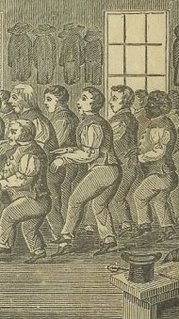
I came across an interesting woodcut over the weekend featuring an African-American Shaker. This is a woodcut from an 1831 issue of "Atkinson's Casket" and is titled "Shaker's Worshipping"-

It has many nice details, including hats and coats hung on pegs, a presumed “outsider” looking on, and, at the right side, an African-American Shaker. You don't hear too much about Afrian-American Shakers, or at least I never have. Here's a closer detail-
We put the print up for auction on Ebay last night -you can see the auction here, or click our Ebay Auctions link in the right-hand column.
It has many nice details, including hats and coats hung on pegs, a presumed “outsider” looking on, and, at the right side, an African-American Shaker. You don't hear too much about Afrian-American Shakers, or at least I never have. Here's a closer detail-

We put the print up for auction on Ebay last night -you can see the auction here, or click our Ebay Auctions link in the right-hand column.
Saturday, October 28, 2006
Time Tunnel-
I love old postcards. We're still unpacking boxes from the move a year ago, and today I found a stash of postcards from my old office drawer. It's like looking into a Time Tunnel (remember that show?).
The Japanese Garden at Boston's Museum of Fine Arts, around 1910-

"Mrs. Jack Gardner's Venetian Palace", now the Isabella Stewart Gardner Museum in Boston's Back Bay, on a postcard postmarked 1908-

This card is addressed to a "Miss Anne Hitchcock" of Utica, New York and has an interesting inscription- "I still want you but am going away in July. Will write a letter soon, Love FBS". You have to wonder...
Here is the Esplanade in Boston along the Charles River on a 1923 postcard. Today Storrow Drive's ugly four concrete lanes go right through ths scene-

The Japanese Garden at Boston's Museum of Fine Arts, around 1910-
"Mrs. Jack Gardner's Venetian Palace", now the Isabella Stewart Gardner Museum in Boston's Back Bay, on a postcard postmarked 1908-
This card is addressed to a "Miss Anne Hitchcock" of Utica, New York and has an interesting inscription- "I still want you but am going away in July. Will write a letter soon, Love FBS". You have to wonder...
Here is the Esplanade in Boston along the Charles River on a 1923 postcard. Today Storrow Drive's ugly four concrete lanes go right through ths scene-
Subscribe to:
Posts (Atom)