Friday, April 27, 2007

Father Himalaya-

I'm afraid I'm a bit behind in blogging this week- we were in New York for four days last week through the weekend, and then I had to rush to get the new catalog to the printer. But now that's all done, and as I was sitting here, browsing through images on my computer, I came across the picture you see to the left, which is part of a very interesting tale...

We once had a book which had the ownership inscription of a "Father Himalaya". Being curious, I did some digging and discovered a really amazing man-

Manuel Antonio Gomes 'Himalaya' [1868-1933] was known as "Father Himalaya", and is considered to be the father of solar energy in Portugal, and a visionary pioneer in the field of renewable energy. After taking Holy Orders in the Society of Jesus he studied natural sciences, physics, chemistry, mathematics and astronomy, and traveled to France where he studied with the noted chemist Marcelin Berthelot. In 1899 he was granted a patent by the French government for a device to produce heat by focusing the sun's rays.

In 1900 he constructed a test device in the Pyrenees and attained a temperature of 1100 degrees centigrade. In 1902 an experiment in Lisbon attained 2000 degrees, and he made a final, startling demonstration of the power of such a device at the St. Louis Exposition in Missouri 1904. There he constructed his "Pireliofero" (that's it in the picture), a 3-story high parabolic mirror mounted on a monstrous iron framework which focused sunlight on an oven mounted at the top of the structure. The oven reached a temperature of 3500 degrees, melting a test chunk of basalt, and Father Himalaya won a Grand Prize for his efforts.

He promoted other forms of renewable energy as well, including tidal energy and hydroelectric power, wind power, and geothermal power. Alas, there was plenty of cheap coal and oil available, and his work was generally ignored and forgotten. Father Himalaya retired to become chaplain at Viana Castle, a charity home, where he died at the age of 65. His work has excited interest in Europe in recent years, and his ideas have only lately attained a measure of the respect which eluded them in his lifetime.

That's what I love about bookselling- you find out all sorts of things you didn't even know you were looking for.

Tuesday, April 24, 2007

Our New Books on Glass Catalog-

Glass and the Book Elves have always been uneasy companions, whether we are talking about flying croquet balls going through plate glass windows or the fact that if you are going to buy a rare and expensive Lalique clock on Ebay you had better make sure the trademark is spelled with a "q" and not a "k"...

But before their latest "let's see how high we can stack the Baccarat stemware" contest crashed down to its inevitable, messy conclusion, they finished our "Books on Glass & Glassmaking" catalog. This catalog features 151 books and other items about antique glass, glassmakers, glass technology, and the history of glass.

Highlights include-

-A 1919 history of the Worshipful Company of Glaziers.

-An 1835 guide to Crown Glass cutting and glazing, written by the "Glass Cutter, Glazier and Stained Glass-Maker to the King of Scotland".

-A bound compendium of 19th century glass patents.

-An 1898 and a 1940 history of the Worshipful Company of Glass-Sellers.

-An uncommon catalog of a leading Arts & Crafts designers' work, including stained glass windows.

-The extremely scarce true first, private, edition of the first book on American glassmaking.

-A nice 1880 glass lamp catalog.

-Two early 19th century editions of Neri's "Art of Glass", including a rare edition published by Sir Thomas Phillipps' Middle Hill Press in 1826 in an edition of 100 copies.

-A ca.1810 broadside of terms for London Plate Glass Manufacturers.

-and many standard glass reference books.

The catalog is available in printed format, or you can see it here.

Monday, April 23, 2007

Monday, Monday...

A beautiful spring morning at Foggygates! It's going to be near 80 today, a day to sit on the porch with a good book and sip lemonade instead of hunkered down over the computer in my office. For those commuting to work today to their own offices, it could be worse- you could have to deal with boarding the commuter train using the railway's new "Super-Dooper Express Service"...

Monday, April 16, 2007

Monday, Monday...

Another cold and rainy start to the week here at Foggygates- I think I'm beginning to notice a trend.

In fact, it's so rainy here in New England that all the Patriot's Day celebrations and activities have been called off- all the parades in Concord and Arlington and the other towns, the re-enactment of the embattled farmers standing up against the British troops at Lexington Green -everything. About the only Patriot's Day acitvity going on is the Boston Marathon, and I understand that they are offering free snorkel equipment to the runners.

But even as the rain continues and I keep checking the basement for flooding, I'm reminded that there are worse ways to start the week...

I could, for example, be a human traffic light-


Sunday, April 15, 2007

Silly Sunday...

An industrial engineer was given a ticket by his boss for a performance of Schubert's "Unfinished Symphony."

The next morning, the engineer sent the following note to the orchestra's conductor:

MEMORANDUM:

1. For a considerable period, the oboe players had nothing to do. Their number should be reduced, and their work spread over the whole orchestra, thus avoiding peaks of inactivity.

2. All 12 violins were playing identical notes. This seems unnecessary duplication, and the staff of this section should be drastically cut. If large volume of sound is required, this could be obtained through use of an amplifier.

3. Much effort was involved in playing the 16th notes. This seems an excessive refinement, and it is recommended that all notes should be rounded up to the nearest 8th note. If this were done, it would be possible to use paraprofessionals instead of experienced musicians.

4. No useful purpose is served by repeating with horns the passage that has already by handled by the strings. If all such redundant passages were eliminated, the concert could be reduced from two hours to 20 minutes.

5. This symphony has two movements. If Schubert didn't achieve his musical goals by the end of the first movement, then he should have stopped there. The second movement is unnecessary and should be cut. In light of the above, one can only conclude that had Schubert given attention to these matters, his symphony would probably have been finished by now.

Friday, April 13, 2007

The Value of Art...


An interesting quote from an 1862 periodical review of the loan collection of art treasures that had just gone on view at the South Kensington Museum (now the V&A)-

"Art, far more than use, is the stimulus of expenditure. A sense of art makes Mrs. Brown envy and finally outshine Mrs. Jones’s d’Aubusson carpet, though her own Brussels was but little the worse for wear. Art urges Mrs. Jones to emulate Lady Robinson’s Minton dinner-service, while her previous set (over which Jones grumbled so much at Copeland’s only the year before last, and of which but one sauce-boat and three plates are yet broken) subside to lower shelves in her pantry as second best. Art relegates to the second-hand dealer in Tottenham-court-road those armchairs which Sir John Robinson so long persisted in proving to be perfectly comfortable, by dropping off in one of them every time Lady R. delivered her tirade on their shortcomings."

Wednesday, April 11, 2007

Trilobites and Fossils and Megatheriums- OH MY!!

In the 19th and early 20th centuries it was accepted practice to furnish museums with casts of all types, from classical statues to trilobites, and I thought I'd share some illustrations from an interesting catalog, published in 1866, which served the latter trade.

Henry A. Ward's "Catalogue of Casts of Fossils, from the Principal Museums of Europe and America, with short descriptions and illustrations" , offered a complete and comprehensive listing of fossils, from minute Ammonites to a complete Plesiosaur or a Megatherium, many taken from originals at the British Museum.


In the 1860s and 1870s dinosaurs were not yet a major subject for study- few had been discovered. Paleontologists were very excited though, by earlier plant and animal life, as shown here, and especially by another set of animals amply illustrated here- early mammals. The fight to discover and name early mammals was at least as heated as the dinosaur wars which would erupt a few decades later, because it was through these fossils that scientists were slowly attempting to prove Darwin's controversial theory of Evolution.


Ward catalogs everything in a scientific manner and also includes fossil tracks, and even replicas of the models shown at the Crystal Palace. At the rear of the catalog he offers skins and skeletons of contemporary American animals and also, grotesquely, "Aborigines -Indians of various Western Tribes: Skulls, from $15 to $25 each. (These are taken fresh, not disinterred from old graves)".


Henry Ward was one of the most interesting and omnipresent characters in Victorian natural history. After making a fortune supplying museums with natural history and paleontological exhibits he turned his attention to meteorites with the same zealous thoroughness. The chronicle of Henry A. Ward's career and various interests is well covered in Roswell Ward's 1948 biography.


I thought I'd finish here with the fold-out plate of a cast of one of the most famous fossils of the day, the Megatherium. My apologies- it's too wide to present here in a decent size unless I turn it on its' side-


Monday, April 09, 2007

Monday, Monday...

A sunny Monday morning at Foggygates, but unseasonably cold. They say it may snow Thursday...

Still, better to be driving to work on a Monday morning when the sun is out than when it is raining or cloudy. My wife's aunt from New York likes to tell a story about Monday mornings back in the '50s. She used to spend her Summer weekends at a popular resort area several hundred miles from the city, and there were a large number of Manhattanites on the last, late-night train back to the city on Sunday night. The train got into Grand Central station at about 3 a.m., and instead of waking everyone up, the engineer would simply pull the passenger cars off onto a siding and let everyone sleep. Along about 6 or 7 a.m. people would start to get up, brush their teeth and wander off to work.

The train, of course, is long gone, but I'll bet that a few booklovers manage to enjoy their Monday morning commutes-


Friday, April 06, 2007

What's in a Floor?

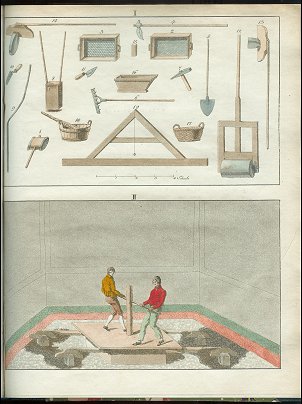
We have a beautiful book in our March catalog- H.F. Rodlich's "Praktische Anweisung zur Verfertigung der Venezianischen Estriche" is an 1810 guide to the art of making Venetian crushed-stone floors. It illustrates the tools and the step-by-step processes involved-

Venetian crushed stone floors are a rather difficult subject -very little material about them is available in the literature. Certainly the neo-classic elements are unmistakable, and the influence of recently excavated Roman ruins must have played a part in their popularity in Italy and, as this book illustrates, Germany.

The plates show the stone being prepared and colored, the floor surface being planned, laid-out and prepared, and the stone being applied and smoothed. The workmen are all stylishly dressed for such a dirty job, and appear very happy at their tasks. Young boys help with the work in a number of plates. Obviously a labor and time-intensive task, the laying of a stone floor is chronicled here in hand-colored plates that can only be described as jewel-like.

A scarce book, with only a single OCLC listing. Hardcover. 8.5"x10.5", 28 pages of text plus 24 hand-colored engraved plates on 12 leaves. We have a more extensive description in our March catalog.

Wednesday, April 04, 2007

Books on Furniture-

[update: when I posted this yesterday, Blogger, as it sometimes does, auto-converted the link I gave to our website to a Blogger-site link. I've corrected that now]

Just posted on our website-

We do love lists, and after some hard battles with wonky computers we've finished our latest Bibliography pages, which comprise our new Bibliography of Books about Furniture and Cabinetmakers!

These pages include entries for every book on furniture and cabinetmaking we have sold over the last decade. If you see a book listed which you would like to locate, please let us know.

We also have a printed catalog of books on furniture for sale- if you would like a free copy, please email us.

If you would like to see a list of books on furniture for sale from our stock right now, click here

Tuesday, April 03, 2007

Big Spring Sale!


Spring cleaning is never pretty, and it can get downright surreal when the Book Elves do it. There was, for instance, the unforgettable April when they decided to throw away their sense of shame, which was quickly followed in May with summonses for nude sun bathing on the porch roof.

But before they took up their shovels and rakes and implements of destruction and began going through the garage, searching for "more common sense than God gave a rutabaga" (which it was recently suggested to them they lack) they finished work on our new "Big Spring Sale" catalog, which features more than 250 selected books and catalogs on antiques and art which we would like to clean off our shelves, most reduced in price from 25% to 60%! The sale prices are good through May 1st. Unlike most of our other catalogs, this catalog is only available in printed format.

Monday, April 02, 2007

Monday, Monday-

The second gray Monday morning in a row at Foggygates. Still, as I sit at my desk surrounded by cats and books, I'm reminded that there are worse ways to start the week...

Saturday, March 31, 2007

Saturday Musings-

"Thanks to the Interstate Highway System, it is now possible to travel from coast to coast without seeing anything." -Charles Kuralt

"No one can have a higher opinion of him than I have, and I think he's a dirty little beast." -W.S. Gilbert

"If computers get too powerful, we can organize them into a committee-that will do them in." -anonymous

"Criminal: A person with predatory instincts who has not sufficient capital to form a corporation." -Howard Scott

"Stoop and you'll be stepped on; stand tall and you'll be shot at." -Carlos A. Urbizo

"You can fool too many of the people too much of the time." -Jameas Thurber

"Few things are harder to put up with than the annoyance of a good example." -Mark Twain

"Rock journalism is people who can't write interviewing people who can't talk for people who can't read." -Frank Zappa

"Nobody can be exactly like me. Even I have trouble doing it." -Tallulah Bankhead

"You can go a long way with a smile. You can go a lot farther with a smile and a gun." -Al Capone

"When they call the roll in the Senate, the Senators do not know whether to answer 'Present' or 'Not guilty.'" -Theodore Roosevelt

"Whenever people agree with me I always feel I must be wrong." -Oscar Wilde

"Conscience is the inner voice that warns us that someone might be looking." -H.L. Mencken

"The secret of success is sincerity. Once you can fake that you've got it made." -Jean Giraudoux

"Sometimes I think the surest sign that intelligent life exists elsewhere in the universe is that none of it has tried to contact us." -Bill Watterson

"Calamities are of two kinds: misfortunes to ourselves, and good fortune to others." -Ambrose Bierce

"When you go into court you are putting your fate into the hands of twelve people who weren't smart enough to get out of jury duty." -Norm Corbsy

"Cats are smarter than dogs. You can't get eight cats to pull a sled through snow." -anonymous

"Football is a mistake. It combines the two worst elements of American life. Violence and committee meetings." -George Will

Friday, March 30, 2007

Judging a Book by Its Cover-

The release this week of the new dust jacket art for the seventh, and last, Harry Potter book illustrates, in a dramatic fashion, how the publishers view their different markets.

The English edition aimed at kids is dramatic and action-filled-


On the other hand, the English edition aimed at adults could be a Cold War spy thriller-


Meanwhile, the American edition seems to try to cut right down the middle and be a bit of both, but leaning heavily towards the kid's market-


It seems obvious that Bloomsbury, the English publisher, takes its' adult audience a bit more seriously than Scholastic, the American publisher. That's not a new story- the very first title in the series, "Harry Potter and the Philosopher's Stone" had its' title changed by Scholastic to "Harry Potter and the Sorcerer's Stone", because
they thought nobody in America would buy a book with the word "Philosopher" in it.

I think I like the American cover best though. In the end, the English kid's cover is too silly, and the Engish adult cover is too chilly- so the American cover must be "just right"...

Wednesday, March 28, 2007

American Furniture Anthology-

I'm happy to say that the new edition of the Chipstone Foundation's acclaimed anthology of American furniture essays is available-

"American Furniture 2006", edited by Luke Beckerdite, features articles on: Peter Scott, Cabinetmaker of Williamsburg; Robert and William Walker: Scottish Design and Colonial Virginia Furniture, 1730-1775; The Furniture of Fredericksburg, Virginia, 1740-1820; The Careers and Work of William and Washington Tuck; Thomas Constantine & Co.’s Furniture for the United States Capitol, 1818-1819; also book reviews.

Card covers. 8.5”x11”, 255 pages, color and b/w illustrations. New. [90225] $60.00

Monday, March 26, 2007

Monday, Monday-

A grey Monday morning here at Foggygates. Grey, misty Monday mornings make one reluctant to even leave the house. But as I sip my morning tea I'm reminded that some folk's Monday morning commutes are rougher than others-

Sunday, March 25, 2007

Sunday Silliness...


Three lawyers and three accountants were traveling by train to a conference. At the station, the three accountants each bought tickets and watched as the three lawyers bought only a single ticket.

"How are three people going to travel on only one ticket?" asked an accountant.

"Watch and you shall see," answered one of the lawyers.

They all boarded the train. The accountants took their seats, but all three lawyers crammed into the tiny restroom and closed the door behind them.

Shortly after the train departed, the conductor came around collecting tickets. He knocked on the restroom door and said, "Ticket please."

The door opened just a crack, and a single arm appeared with a ticket in hand. The conductor took it and moved on.

The accountants saw this and agreed it was quite a clever idea.

So, after the conference they decided to copy the lawyers on the return trip and save some money. When they got to the station they bought a single ticket for the return trip. To their astonishment, the lawyers didn't buy any tickets at all.

"How are you going to travel without a ticket?", asked one perplexed accountant.

"Watch and you'll see," answered a lawyer.

When they boarded the train, the three accountants squeezed into a restroom, and the three lawyers squeezed into another one nearby.

The train departed. Shortly afterward, one of the lawyers left the restroom and walked over to the restroom where the accountants were hiding. He knocked on the door and said, "Ticket, please."

Friday, March 23, 2007

Updates-

Spring has finally come to Foggygates, and none too soon. Just one week ago we were having a St. Patrick's Day (weekend) blizzard, and yesterday the sun was out and it was in the 50s. I'm sure that we'll have the grill up and working within a few days, even if we have to shovel the last of the snow from the backyard to do it...

We've dispatched our new April catalog to the printer- look for it in the mail the week of April 2nd. It features our Big Spring Sale! The sale will include over 200 selected titles reduced in price (for a limited time) by as much as 60%!

This weekend we're putting the finishing touches on a new addition to our website- a bibliography of every book on furniture we've ever owned. This will join the two bibliographies we have up there now, on silver and mourning/gravestones.

Work on our new Books on Glass catalog continues, with a projected completion date of June. And I'm sure there are a few other interesting projects in the pipeline, so stay tuned!

Wednesday, March 21, 2007

New Book on Philadelphia Empire Furniture-

We've just recieved a great new book on Philadelphia Empire furniture!

"Philadelphia Empire Furniture" by John William Boor, with Allison, Jonathan, Christopher, & Peter Boor. Published by the University Press of New England: 2006.

“This volume looks closely for the first time at Philadelphia Empire furniture and the development of decorative arts in Philadelphia between 1800 and 1840. The authors explore Neo-Classicism, contemporary history of Philadelphia, the emergence of Greek-Revival architecture, and the cabinetmakers of Philadelphia Empire furniture.

"At the beginning of the 19th century Greek-inspired architecture gained popularity in Philadelphia and the city became known for its classically-inspired monumental buildings. Newly designed structures of ancient inspiration were decorated with classical furniture that became the prevailing style in private homes as well as public buildings. The arrival of immigrant craftsmen from Europe in the early 19th century and their subsequent collaboration with American furniture makers produced highly sophisticated Empire designs. Neither French nor English, the designs incorporated purely American elements and became known as American Empire. Nineteenth-century Philadelphia Empire craftsmen were particularly well-known for their extensive motif carving, which often has a fluid, three-dimensional character.

"‘Philadelphia Empire Furniture’ illustrates in color and describes in detail hundreds of Philadelphia decorative art forms from this period, including wood types, dimensions, and maker (if known). Chapters are dedicated to each of the following forms: card tables, platform pedestal tables, pier tables, worktables, sofas, chairs, sideboards, secretaries, chests, bedsteads, looking glasses, clocks, and other decorative elements.

A separate chapter is devoted to the previously unpublished sketchbook of accomplished craftsman Anthony G. Quervelle. Besides Quervelle, other talented and successful Philadelphia furniture makers included Michel Bouvier, Charles White, Cook & Parkin, and Joseph B. Barry, among several. This book provides historical data about their lives and careers. The furniture illustrated comes from various sources, including the Philadelphia Museum of Art, the Atheneum of Philadelphia, the Winterthur Museum in Delaware, The Metropolitan Museum of Art in New York, The White House Historical Association, and from many private collections.”

Hardcover. 9.5”x12.5”, 596 pages, 495 color and 126 b/w illustrations, dj. New. [90232] $140.00

Tuesday, March 20, 2007

Grave Matters-


The old saying is that you're not supposed to whistle in a graveyard, but the Book Elves were never ones for old sayings, even though whenever they whistle the Colonel Bogey March in unison every dog in the neighborhood starts howling.

They haven't been whistling in graveyards though, ever since last Halloween when they had a little too much hard cider and were using a shortcut through the town's 17th century burial ground, where old Len Anderson and his boy scout troop were waiting for them, hiding behind the gravestones with sheets and plastic pumpkins with those glowing red eyes...

But after they recovered from doing the 500-yard dash home in 17.6 seconds flat (and got even with Len at Christmas by putting live squirrels in his Christmas tree) they finished a new edition of our 'GRAVE MATTERS' newsletter, featuring recent acquisitions since our last GRAVE AFFAIR catalog. This issue includes books and other materials on mourning, graveyards, epitaphs and related subjects. We have printed copies available, or you can browse a fully-illustrated version on our website.

Monday, March 19, 2007

Monday, Monday-

It's Monday again, time to dust off the weekend cobwebs and get back to work. Of all the commuting days, Monday must be the worst. Here's an image from our "There's no way I'm carpooling with him, I think I'll just walk, thank you!" file-


Saturday, March 17, 2007

A Beautiful Tool Book-


We just got a great new publisher's overstock title in on tools- "Tools. Rare and Ingenious. Celebrating the World’s Most Amazing Tools" by Sandor Nagyszalanczy was published in Newtown by The Taunton Press in 2004.

Over the centuries craftsmen have transformed inherently humble objects- drills, saws, planes and levels, into works of art. This beautiful book offers a breathtaking tour of antique tools that rarely leave the jealous hands of their owners. In more than 375 color photographs we see tools ranging from calipers in the shape of ballerinas to a drill shaped like a violin. The old, hand-polished woods gleam, the antique brass shines, and the dedication and imagination of hundreds of anonymous craftsmen from other times is evident on every page.

This book is a hardcover. 9.5”x10”, 210 pages, packed with color illustrations, dj. New. Published for $37.00.

Available for a very limited time for $20.00

Wednesday, March 14, 2007

Keep Digging!


This classic letter has been around the internet for a few years so some of you may have read it already, but I always get a chuckle out of it.

- - -

Smithsonian Institute
207 Pennsylvania Avenue
Washington, DC 20078

Dear Mr. Williams:

Thank you for your latest submission to the Institute, labeled "93211-D, layer seven, next to the clothesline post...Hominid skull."

We have given this specimen a careful and detailed examination, and regret to inform you that we disagree with your theory that it represents conclusive proof of the presence of Early Man in Charleston County two million years ago.

Rather, it appears that what you have found is the head of a Barbie doll, of the variety that one of our staff, who has small children, believes to be "Malibu Barbie."

It is evident that you have given a great deal of thought to the analysis of this specimen, and you may be quite certain that those of us who are familiar with your prior work in the field were loathe to come to contradiction with your findings. However, we do feel that there are a number of physical attributes of the specimen which might have tipped you off to its modern origin:

1. The material is molded plastic. Ancient hominid remains are typically fossilized bone.

2. The cranial capacity of the specimen is approximately 9 cubic centimeters, well below the threshold of even the earliest identified proto-homonids.

3. The dentition pattern evident on the skull is more consistent with the common domesticated dog than it is with the ravenous man-eating Pliocene clams you speculate roamed the wetlands during that time.

This latter finding is certainly one of the most intriguing hypotheses you have submitted in your history with this institution, but the evidence seems to weigh rather heavily against it. Without going into too much detail, let us say that:

A. The specimen looks like the head of a Barbie doll that a dog has chewed on.

B. Clams don't have teeth.

It is with feelings tinged with melancholy that we must deny your request to have the specimen carbon-dated. This is partially due to the heavy load our lab must bear in its normal operation, and partly due to carbon-dating's notorious inaccuracy in fossils of recent geologic record. To the best of our knowledge, no Barbie dolls were produced prior to 1956 AD, and carbon-dating is likely to produce wildly inaccurate results.

Sadly, we must also deny your request that we approach the National Science Foundation Phylogeny Department with the concept of assigning your specimen the scientific name Australopithecus spiff-arino.

Speaking personally, I, for one, fought tenaciously for the acceptance of your proposed taxonomy, but was ultimately voted down because the species name you selected was hyphenated, and didn't really sound like it might be Latin.

However, we gladly accept your generous donation of this fascinating specimen to the museum. While it is undoubtedly not a Hominid fossil, it is, nonetheless, yet another riveting example of the great body of work you seem to accumulate here so effortlessly. You should know that our Director has reserved a special shelf in his own office for the display of the specimens you have previously submitted to the Institution, and the entire staff speculates daily on what you will happen upon next in your digs at the site you have discovered in your Newport back yard.

We eagerly anticipate your trip to our nation's capital that you proposed in your last letter, and several of us are pressing the Director to pay for it. We are particularly interested in hearing you expand on your theories surrounding the trans-positating fillifitation of ferrous ions in a structural matrix that makes the excellent juvenile Tyrannosaurus rex femur you recently discovered take on the deceptive appearance of a rusty 9-mm Sears Craftsman automotive crescent wrench.

Yours in Science,

Harvey Rowe
Chief Curator- Antiquities

Tuesday, March 13, 2007

Drama in a Print-

We had a copy of Phillip Barraud's 1782 book "A New Book of Single Cyphers, Comprising Six Hundred Invented and Engraved by Ph. D. Barraud" in our March catalog. We sold the book, but I wanted to share one of the engraved frontispiece plates at the front-


I just love dramatic copper-plate engravings like this.

Monday, March 12, 2007

Odd Jobs-

It's Monday, everyone's least-favorite day of the week. But today we have an illustration for the pleasure of our office-bound comrades showing that, no matter how bad your job is, there are people out there who have it worse. You could, for instance, have been a model in the Middle Ages...

Sunday, March 11, 2007

Winter Loses Its Grip-

Somebody stole an hour's worth of sleep from me last night, but that's ok, because I was about done with Winter anyway. I'm not big into wintertime sports, and I very much do not ski. My one experience skiing was about 20 years ago when a "friend" who was also a ski instructor decided that the quickest way to teach me was to strap a pair of skis on my feet, drag me to the top of a local mountain only slightly smaller than the Matterhorn, point me down over the edge of a 80-degree downhill slope and push me off.

Well, perhaps I exaggerate a bit. But I'm no fan of heights, and it looked to me as if we were high enough up to be in danger of getting whacked by a passing Space Shuttle. And then there was my question of "once you get going, how do you stop?" to which my helpful friend replied that usually you hit something.

I have not been near a ski slope since. My wife used to cross-country ski, and if we had had snow for more than a few weeks this year I might have tried it. Maybe next year. But downhill skiing, no way. While I was frantically tobaggoning down that slope on my keister those many years ago, I thought I saw Death ski past me, and I know he's still out there on a slope someplace, lurking...


Friday, March 09, 2007

A Poetic Silkworm?

We have an interesting 18th century silk-related title in our current catalog-

"The Silkworm: A Poem. In Two Books. Written by Marcus Hieronymus Vida, and translated into English Verse by the Reverend Samuel Pullein, of Trinity College, Dublin" Published in Dublin; printed by S. Powell, for the author: 1750.

This is quite a remarkable piece of poetry- both the original and the translation. Marcus Hieronymus Vida [1470-1566] of Cremona was a gifted poet who was patronized by the Pope and did quite a remarkable job of, as Pullein notes, making a detailed poem about the raising of silk worms interesting.

Pullein [b.1713] was himself no slouch, and won the Royal Dublin Society’s Madden Prize for this work. In the same year that he published this poem, Pullein wrote an essay to promote the culture of silkworms in Ireland, and several years later he wrote his influential book “The culture of silk, or an Essay on Its Rational Practice and Improvement for the Use of the American Colonies”.

The engraved frontispiece shows the interior of a silkworm room-


The engraving has many interesting details, including the trays on which mulberry leaves and stems are kept-


The fancy ceiling with medallions-


And a Classical doorway; we can also see potted plants in the yard ourside-


The Classical theme continues as the worms are tended by several women in robes vaguely resembling those of ancient Greece-


This is a hardcover. 6.25”x10”, x, 141 pages, engraved frontispiece; with the final errata and “Observations” sheet, which is often lacking. Newly rebound in green “silked” cloth with paper spine label; new endpapers; title page repaired at the top, not affecting the text; text with light toning and a few spots, but overall nice. [30745] $500.00

Tuesday, March 06, 2007

Our New March Catalog-

It’s going to be Saint Patrick’s Day soon, and since it involves food and beer, it’s one of the Book Elves favorite holidays. They’ve always thrown a big party to celebrate, but after last year’s “mishap”, and the ensuing court costs, they decided to do a dry run a few weeks ahead of time this year.

Now here’s the thing- it’s never a good idea to pair the phrases “Book Elves’ party preparations” and “30,000 gallons of green, vegetable-based food coloring”, especially if you live within a quarter mile of the Connecticut River...

But before the squadron of helicopters from the EPA Rapid Response SWAT Team descended and started fingerprinting everyone, the Book Elves finished this new catalog of books-

"RECENT ACQUISITIONS for March, 2007" is now available on our website or in printed format. It features 201 books and catalogs on furniture, silver, ceramics, glass, textiles, art, architecture and related fields, with highlights including-

-A nice 1782 book of decorative cyphers for silversmiths & engravers.

-Several important 19th century color books by George Field.

-A lovely Victorian facsimile of a 1677 London Merchant directory.

-A 1698 catalog of ancient Egyptian amulets.

-A 1750 poem about raising silkworms, with a marvelous engraved frontispiece.

-An important 1837 book of designs for gate houses and lodges, owned by a founder of
the Boston Society of Arts & Crafts (Henry Wadsworth Longfellow's nephew!).

-An uncommon 1862 collection of Renaissance silver designs.

-A fascinating and detailed 1840s survey of trades and manufactures in Britain.

-and much, much more!

Request a printed copy, or browse the catalog on our website.

- - -

This month's catalog also has a special feature on fakes, forgeries and frauds, a topic which has always fascinated me.

- - -

We’ve finally begun to get some Winter weather here at Foggygates, with several snow storms in the last three weeks. As soon as it gets cold enough for the local bears to start hibernating, we put bird feeders out in the side yard and by the back deck. (We know it’s time to take them away in the Spring when we find one of the pole feeders flattened and ripped up by the bear, but that’s another story).

At this time of year we have a huge crowd of birds at the feeders, from early in the morning until dusk. But the three pairs of cardinals, several woodpeckers, bunches of wrens, finches, doves and other assorted little birds (plus half a dozen fat squirrels) are now being joined on a regular basis by a young red-tailed hawk. He first showed up a week or so ago, sitting in the tall tree behind the carriage house, and has lately taken to sitting on the railing of the deck, or in the small fruit tree we hang the feeders on just beside it. I am afraid he may not be here for the seeds...

Tuesday, February 27, 2007

Gargoyles & Grotesques-

Someone was writing about gargoyles the other day, and that made me think of a passage in Robert Williams' 1835 book "An Historical Sketch of the Art of Sculpture in Wood" which is not precisely about gargoyles, but about such grotesque carvings in general, and what their inspirations often were-

"There are many bas-reliefs, particularly those carved underneath the seats of the choirs of different religious structures, that represent grotesque , and even obscene subjects, altogether at variance with the sacred character of the buildings in which they are placed. Something of this kind may be observed in Worcester cathedral, in Ely cathedral, in the priory church of Great Malvern, and in many other ecclesiastical edifices.

"What may be thought most singular, is, that these sculptures sometimes represent priests and other religious persons, engaged in actions of a very profane description. For a satisfactory reason for this, I am indebted to my friend, Mr. Cottingham. The sculptors who executed those carvings were the caricaturists of the time and, as different religious communities were frequently at variance with each other, they employed these artists to satirize their mutual follies and vices.

"Under their seats they concealed from the public eye, but exposed for their own private gratification, a series of pictorial libels. In one place, the monks of a certain order are represented as licentious, ridiculous, and depraved: -in the building belonging to these holy fathers, will, probably, be found a similar series of bas-reliefs, exposing the secret debaucheries of the sacred brotherhood by whom they have been libelled- but never, in any church, will a priest of that order be represented in an unholy character. He will very likely be discovered thus pictured in the church of the Franciscan, while the follower of St. Francis receives the same treatment from the Carthusian brethren in their own buildings.

"The various monastic establishments, which at one time were exceedingly numerous in England, generally regarded each other with considerable jealousy and, more than once, their animosities and squabbles have disturbed the peace of the kingdom, and brought disgrace upon the un-reformed religion. This occasioned some of our most ancient ecclesiastical edifices to be disfigured with grotesque and offensive designs"

Thursday, February 22, 2007

Cat Cam-

I've managed to get myself a bit behind the 8-ball today, with the new March catalog due to be shipped to the printer tomorrow by 5, and me still cataloging books this morning, with set-up, cut & paste, cover design, & proofing all still to be done (well, I can always say I proofed it, and the Book Elves snuck in later and retyped that entry to read "dust jacket lightly oiled".

Anyway, the point of this all is that I'm going to let one of our hardworking book cats, Pyewackett, entertain you. So I've set up a web-camera, and you can just keep checking back, because she does all sorts of interesting things.

Really.

I know it may look like this is just a .jpeg, not a live webcam, but I assure you, it's refreshed every 1/10th of a second.


Just look at her go.

Monday, February 19, 2007

How George Washington's Candlesticks Killed G.D. Smith


Reposted from last President's Day, but still a good tale.

On this President's Day we turn to the tale of a pair of "George Washington's" candlesticks which killed a leading rare book dealer.

In early 1917 a man named William Lanier Washington showed up at the doors of Mitchell Kennerly's Anderson Galleries, a leading New York auction firm. A “direct descendant of two of George Washington’s brothers”, William Lanier Washington arrived with cartloads of Washington-family memorabilia at an opportune time.

The craze for all things Colonial-related was reaching new heights, and in the first auction of this material, held in April, 1917, he offered many interesting and rare Washington busts, portraits, mourning items and other Washington-related memorabilia. He also offered personal relics, including George Washington’s shoe and sword buckles, wine glasses, snuff boxes, coat buttons, pants, a pair of Sheffield candlesticks from Washington’s Mt. Vernon desk, and many more items.

These relics were eagerly snapped up by the preeminent collectors of the day, including William Randolph Hearst and G.D. Smith, the man who single-handedly helped Henry Huntington assemble the famous Huntington Library and one of the greatest American book dealers of all time.

All seemed well until William Lanier Washington showed up at the Anderson Galleries with yet another cartload of Washington relics, at which point Mitchell Kennerly had the sense to send him packing. Not to be so easily discouraged, William simply switched venues and took his “relics” to the American Art Association, through which he held another sale in February, 1920.

He also sold his offerings door-to-door, and it was this which brought about the premature demise of G.D. Smith. On March 4th, 1920, William Lanier Washington arrived at Smith’s door, attempting to sell him yet another set of Sheffield candlesticks used by George Washington on his desk at Mt. Vernon. Smith, who had already bought “the” pair at the 1917 auction (lot 27), questioned just how many candlesticks George Washington kept on his desk, got into a heated argument with Washington, and dropped dead on the spot.

Thus ended the career of one of America’s greatest booksellers. William Lanier Washington would hold one more Washington-relic sale at the AAA, in February, 1922, which finally seemed to exhaust his supply. He died in 1933, but the legacy of his auctions, which contained at least some authentic memorabilia, and a whole lot else, continues on through the auction catalogs and an interesting tale.

Thursday, February 15, 2007

The Case of the Etruscan Terracotta Warriors in the Metropolitan Museum of Art.

This is the story of a gigantic (so to speak) scholarly “oopsie”-

In late 1915 Gisela Richter, renowned expert on Greek and Roman antiquities at New York’s Metropolitan Museum of Art, received a letter from John Marshall, the Museum’s veteran purchasing agent in Italy, describing a newly discovered life-size Etruscan warrior figure in terra-cotta which had been discovered in an Italian field.
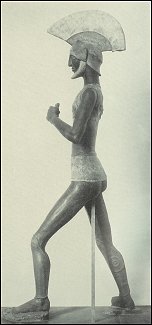
The “old warrior” (he had a white beard and was emaciated, somewhat like, as one observer commented later, a Giacommetti sculpture) was soon followed by a massive four-foot tall terra cotta warrior’s head, and there was even talk of a greater treasure waiting to be found...

It was, of course, all fakery, carried out on a grand, almost “mythic” scale, a scale meant to make experts put aside all their nagging doubts and see the “Etruscans” as what they were not (namely, ancient). The white-bearded warrior and the massive head had been created by Riccardo Riccardi and Alfredo Fioravanti, two young men of skill and a certain vision. Riccardo’s father and brothers had also specialized in historic pottery, but Riccardo was the true genius of the family. With his friend Alfredo he first created the anorexic, white-bearded warrior.

The figure was modeled as one piece and then broken up into 24 fragments for firing, as the kiln was not large enough to accomodate the entire figure. The warrior is missing his right arm for the simple reason that the two forgers could not agree on how to position the arm, so they compromised by breaking it off and discarding it.

After selling the figure to the Metropolitan, the pair began work on another figure, this time a gigantic warrior's head. Working from a description by Pliny of a 25-foot tall statue of Jupiter in a Roman temple, the pair made the head four and a half feet tall. This was broken into 178 pieces, fired, and shipped off to the Met. And then Riccardo and Alfredo had to leave to serve their time in the Italian Army.

When they returned they began their most audacious project yet- a Colossal Warrior in terra cotta, standing over eight feet tall. Then tragedy struck. Riccardo was killed in a fall from his horse that winter, and his place was taken by two less-skilled cousins. As with the earlier pieces, the statue had to be fired in pieces as it was much too large for the kiln.

It proved, in fact, to even be too large for the room it was being modeled in, and by the time they had modeled up as far as the waist it was obvious that the elegant classical proportions of genuine Etruscan sculpture would have to be ignored -there simply was not enough room for the upper body without going through the ceiling. The odd result- classical legs and a stocky, disproportionate torso, troubled some scholars.
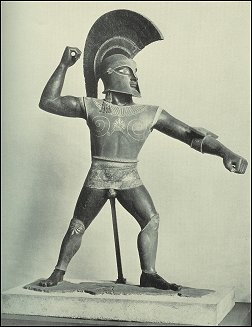
In 1921 the Met. purchased the warrior for an undisclosed price said to have approached 5 million dollars in today’s money. The statue was reconstructed from the fragments by the Met's experts with one odd exception- the genitals, which had been carefully modeled (the warrior, like many Etruscan statues, was partially nude from the waist down) were left off and apparently kept in storage. It may have been just as well. One story that came to light later related that while the body of the figure was based upon that of Riccardo's cousin and helper Teodoro, the "privates" were modeled after Riccardo's own, and had been recognized by a number of young Italian ladies of his hometown...

Attempts to erase doubts that were already being whispered in art circles in Europe, as well as the hope that the “secret” field they had been found in might be divulged by their “discoverers”, delayed the publication of a scholarly monograph on the three figures until 1937. For Richter, bringing them to the Met. and publishing them represented one of the crowning achievements of her distinguished career, and it was undoubtedly this fact that blinded her to what was becoming all too obvious to other scholars who were not emotionally or professionally attached to the warriors.

The talk about their true origins swirled quietly for the next decade or two, but after a visiting Italian scholar was offered a chance to see all three statues in 1959, and commented that he did not need to see them since he knew the man who had made them, authorities at the museum decided something had to be done. In 1960 a series of tests concluded that the glazes on all three specimens contained chemicals which had not been in use before the 17th century, and in 1961 Fioravanti signed a confession of the whole affair, and supplied a missing thumb which fit perfectly.

At that point several other “bothersome” points that had been noted over the years began to make more sense- the Colossal Warrior, for instance, could not even support its own weight, and when compared to real Etruscan statuary, simply looks crude and even modern. Today the statues are stored far away from prying eyes, but they still provide an entertaining and sobering lesson in fake busting.
A much more detailed account of the warriors was written by David Sox in his excellent book “Unmasking the Forger, The Dossena Deception” (1987), from which most of the material for this essay was taken; Thomas Hoving, the former Director of the Met., also deals with the story, and speculates on the role of John Marshall, in his book "False Impressions: The Hunt for Big-Time Art Fakes" (1996).
Tuesday, February 13, 2007

New Books on Ceramics Catalog-

The Book Elves have a tradition of being hard on pots and plates- there was the time they decided to "Class Up" the greenhouse by repotting all the cacti in the 18th century Sevres; there was that regrettable incident after too much eggnog last Christmas when they tried to find out how high "too high" was when it came to stacking the Wegdwood dinnerware; and we're all trying to forget last July 4th's infamous "Great Minton Shoot"...
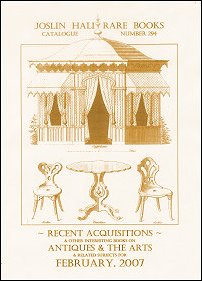
But before they reduced 200 years worth of the potter’s art to several bucketfuls of shiny shards that are being donated to the local arts center to be made into a mosaic for the new bus station, the finished our latest catalog-

"BOOKS ON CERAMICS" is now available on our website or in printed format. It features 270 books and catalogs on pottery, porcelain and related topics, with highlights including-

-The catalog to Brother Thomas's first pottery exhibition.

-A scarce 1951 catalog of Masonic pottery.

-The uncommon original 1908 edition of Henry Mercer's guide to the mosaic tiles at the Pennsylvania State Capitol.

-A beautifully illustrated 1900 survey of Egyptian ceramics by Henry Wallis, limited to 200 copies..

-A massive biography of Lady Diana Beauclerk, 18th century Society Lady and Wedgwood artist.

- and much, much more!

Request a printed copy, or browse the catalog on our website.

Tuesday, February 06, 2007

Our February Catalog-

It was an odd January here at Foggygates- lots of cold, but no snow. That, however, was not going to stop the Book Elves from enjoying themselves, so after a hard day in the Cataloging Cave they planned to hit the “slopes” in the neighbor’s field, making snow with the help of two garden hoses, 300 feet of heavy duty extension cord and a dozen old industrial fans they picked up cheap at a local farm auction.

I’m not sure how the ski areas make snow, but I’m betting it’s not like that.

However, after blowing every fuse in the house out twice, the Book Elves got everything set, started the fans, turned on the hoses, and then left for Mama Maria’s bar & grill just down the street for a quick dinner and a few beers before some late-night sledding.

If only they’d remembered to anchor the bases of the fans… But before they encased the neighbor’s house in 3 inches of solid ice, the Book Elves finished our new catalog-

"RECENT ACQUISITIONS for February, 2007" is now available on our website or in printed format. It features 231 books and catalogs on furniture, silver, ceramics, glass, textiles, art, architecture and related fields, with highlights including-

-A rare 1840s Italian woodwork design book.

-A nice 1905 auction catalog of Japanese arms & armor, featuring items collected by noted dealer Bunkio Matsuki.

-An unusual 1873 book on soluble glass.

-An uncommon 1881 exhibition catalog of modern tapestries.

-The scarce original 1908 edition of Henry Mercer's guide to the tiles of the Pennsylvania state capitol.

-A rare 1824 biography of Jacques Louis David.

-A copy of Ure's important 1821 Dictionary of Chemistry with the 1850 ownership inscription of an American dyer.

and much, much more!

Our February Catalog.

Thursday, February 01, 2007


This was posted on an email list a few days ago. Apparently it has been around for a while, though I had never seen it-

Jovanovichy

'Twas potter, and the little brown
Did simon and schuster in the shaw;
All mosby were the ballantines,
And the womraths mcgraw.

Beware Jovanovich, my son!
The knopfs that crown, the platts that munk!
Beware the doubleday, and shun
The grolier wagnallfunk!

He took his putnam sword in hand,
Long time the harcourt brace he sought -
So rested he by the crowell tree
And stood awhile in thought.

And as in harper thought he stood,
Jovanovich, with eyes of flame,
Came houghton mifflin through the wood
And bowkered as it came!

Dodd mead! Dodd mead! and from his steed
His dutton sword went kennicatt!
He left it dead, and with its head
He went quadrangling back.

"And hast thou slain Jovanovich?
Come to my arms, my bantam boy!
Oh, stein and day! Giroux! McKay!"
He scribnered in his joy.

'Twas potter, and the little brown
Did simon and schuster in the shaw;
All mosby were the ballantines,
And the womraths mcgraw.