Sunday, July 30, 2006

More Things We Find in Books-

One of the most fascinating things about bookselling can be the odd items you find in books, and the stories they can lead you to unearth once you begin hunting around. A case in point is a copy of Stanley Casson's 1928 study "Some Modern Sculptors" which we bought a few years ago. It's a great book, but neither scarce nor expensive.

However, when we examined our copy we found that it had once been owned by Francis Henry Taylor, a Director of the Metropolitan Museum of Art, and had three typewritten letters from Casson to Taylor tucked inside the rear endpapers!

Well, that seemed interesting, so we started doing some further research...

Stanley Casson (1889-1944) was a multi-talented art scholar and army officer who read Classical Archaeology at Oxford, served as Assistant Director of the British School at Athens, Special Lecturer in Art at Bristol University, and was Director of British Academy Excavations at Constantinople in 1928-1929. His publications include numerous articles and books on the subject of Classical Antiquities.

He also had two distinguished war records, starting the First World War as an officer with an infantry regiment in the trenches of Flanders before becoming part of the British Salonika Force in 1916 and finally serving on the General Staff in 1918. His war poems, written in the Flanders mud, are now part of the War Poetry Collection at Napier University in Edinburgh.

Starting in 1939 he again served the British government in Holland, and later transferred to Greece where he was serving as a liaison officer when he was killed in an airplane crash in 1944.

Now, what about Francis Henry Taylor? Taylor (1903-1957), was a former Curator of Medieval Art at the Philadelphia Museum of Art, Director of the Worcester Art Museum at about the time the letters we found were written, and eventually became Director of the Metropolitan Museum of Art.

The three typewritten letters were written to Taylor by Casson, on New College, Oxford letterheads, from the early 1930s. The first letter simply greets him and extends Casson's admiration for an article that Taylor wrote on Greek sculpture; the other two were evidently written after Taylor had taken a trip to London and the two had become friends.

A few excerpts give a general idea of the scholarly goings on:

[Aug 7th] "I enjoyed that evening in London more than I have enjoyed anything in this country for a very long time. My only sorrow is that I cannot give the return party to you here... How precisely I got home after you had decanted me from the taxi I cannot say. By strange luck I got into the right train and there remained semi-comatose until Oxford. Again Heaven aided and there was actually a taxi at the station... Meantime I suggest a good line of research would be to find out if Miss [R] keeps a stature of Hermes in her bedroom... By the way, Wilenski has just written a crazy book on "Modern Sculpture" that I find would serve as an admirable whipping post for discussing the ultra-modern coprolite-sculptors... Eric Gill, whom I saw on Sunday after our carouse, is commissioned to do some 150 full size figures on a new cathedral at Guildford in Surrey. He is getting together a band and going to do it in the real mediaeval manner (I mean as regards the organisation)."

[Nov 2, 1932] "As to the statue, actually I see no reason to doubt it and it really is a scoop... but there will be Hells own row in Greece and someone will get the permanent push in Athens. I cant imagine how on earth they get such things out without being spotted. ... Meantime if in due course I can come over your way, as you suggest, I feel little doubt that I shall see U.S.A. a bit more from the right viewpoint than most of the many academics that sour the atmosphere of your genial land. Gawd, what stiffs we do send you sometimes!".

I love this stuff. Sometimes it's true- you can't judge a book by its covers!

Saturday, July 29, 2006

It's Hot Outside!

Well, "late next week" turned into more than two weeks, but we are back now, and will be posting here on a regular basis for the rest of the Summer. We've got our new Summer catalog coming out this coming week- watch for more announcements about that in the next few days!

We haven't been blogging the past few weeks, but we've been quite busy getting ready for August and the Fall.

Stay tuned!

Tuesday, July 04, 2006

Some Patriotic Music-


Just in time for 4th of July Week, we found an 1831 salute to Old Glory, a single leaf printing the music and words to “Our Flag is Here! An American Patriotic Song”, removed from a disbound portion of the August, 1831 edition of ‘Atkinson’s Casket’. We do not normally go around slicing pages, but this edition was already mutilated, and it seemed that the song would be of interest to American flag enthusiasts of all stripes. The note at the top of the page states-

"The Music and Words of the following Song, were, we understand, composed by a sailor, on board the Java frigate. They have never before, we believe, been published. The feelings of an American tar, are truly expressed in these words, and many a landsman will cordially join in the Chorus. The Song has, we judge, only to be known to become very popular.”

The “Java frigate” referred to was an American 44-gun vessel, named for the famous War of 1812 naval battle between the USS Constitution and the British frigate Java. The American frigate was laid down in Baltimore in 1814, and made her maiden voyage from Baltimore under the command of Captain Oliver Hazard Perry on August 5, 1815. After fitting out she was ordered to the Mediterranean in 1816, still under Perry’s flag, and while there Perry went ashore in Algiers and “persuaded” the Dey of Algiers that it would be better to stop harrassing American interests, as he had promised in a treay signed the previous summer, than to ignore it as he had been doing before the American fleet showed up. Before returning home Perry and Java also sailed, in company with the Constellation, Ontario, and Erie to show the flag off Tripoli. In 1827 Java returned to the Mediterranean under Captain William M. Crane, and was the flagship of Commodore James Biddle for a time. She returned to America in 1831, was based at Norfolk for several years, and was broken up in 1842.

As for the song's immortality, a Google search for the title only brings up one possible match, a transcription of verse by the same title in the Civil War journal of a young woman. The words, while not quite as memorable as those of the Battle Hymn of the Republic or as moving as those of America the Beautiful, have a certain ring to them-

“Our flag is here! Our flag is here!
We hail it with three loud huzzas!
Our flag is here! Our flag is here!
Behold its’ glorious stripes and stars.
That flag is known in every sphere,
The standard of a gallant band,
Alike unstain’d in peace or war,
It floats o’er freedom’s happy land.

Stout hearts have fought for that bright flag,
Strong hands maintain’d it mast-head high;
And oh! To see how proud it waves,
Brings tears of joy in ev’ry eye.

Our flag is here, &c.

That flag has stood in battle’s war,
‘Mid foemen strong and foemen brave,
Strong hands have tried that flag to low’r,
And found a speedy, wat’ry grave.

Our flag is here, &c.


We have put the sheet up on Ebay in an auction starting July 6th. "Foggygates" will be on vacation mode for the week, and will return late next week.

Wednesday, June 28, 2006

Catalogs & stuff-

Things are slowing down at Foggygates as we move toward the 4th of July Week, but we do have a new catalog out this week- Books on Decorative Arts, including folk art, interiors, metalware & iron, textiles, & other “Americana” & related subjects. This catalog is available only as a printed catalog, so if you would like a copy, please let us know.

Things are also quiet on Ebay as we juggle our own and other folks vacations around the 4th; we have a pair of aviation items up now, and will be adding new material beginning on July 1st. Stay tuned for more details...

Friday, June 23, 2006

Gentlemen- More Dolce, Please...

I'd like to spend today featuring one of my favorite items in our current crop of books on Ebay- I'll be sad to see this one go to a new home. It's an uncommon early American traveler's phrase book for a popular 1830s destination of American writers and artists- Italy!

The title is "De Porquet’s Italian Phrases; or, Il Fraseggiatore Toscano. A Copious Choice of Italian Sentences to facilitate a complete knowledge of the formation of the verbs and syntax of that elegant tongue" and it's by Carlo Alfieri, "Professor of the Italian language, London". Published in Boston by S. Burdett & Co., in 1832. “With familiar and easy dialogues in Italian and English, and rules on the different forms of addressing persons, used by the Italians”.

Entire books have been written on the exodus of Americans to the Continent in general, and Italy in particular, in the 1830s and 40s. Nathaniel Hawthorne, Herman Melville, and sculptors Hiram Powers and Horatio Greenough all sojourned there. American artist Rembrandt Peale wrote his own guide to traveling in Italy, and sculptor Thomas Crawford settled down in Rome and became a leading figure in the American expatriate community there for several years.

Charleston, South Carolina artist James DeVeaux loved Italy so much that he lived there for several years before his tragic early death in 1844. In fact, although he loved Rome and Venice and Florence, DeVeaux did not enjoy the excess of visiting Americans very much. While staying in Florence he wrote- "There are American painters and sculptors here of all sorts. I find nothing in their society to please me, and so keep to myself. Strange that so much venom should exist among professors of a liberal art -but the truth is, that envy and jealousy are our (painters) besetting sins, and the first thing I heard of here was a flare up at Rome 'mongst the American artists, and now they are all in Florence for the summer, so I keep housed."

And yet, the warm Italian sun and pretty signoras and centuries of art and monuments would draw the visitor out again. DeVeaux continued a few months later-

"Whilst looking down from the steeple of the Campodoglio upon Rome, my companion warmed into a classic fit, and bringing up from the bottom of his pockets notes and memoranda of history gathered from Goldsmith and others, he would glance from one scene to another, till I was deluged in declamation, -flinging his arms into the air and stretching himself so far over the railing, as to induce me to wrap the skirt of his coat around my hands to ensure his safety, -he pointed to the spot where "Ceasar's body lay", -passed to Lucrezia the chaste, and Virginia the innocent, -Camillus pausing to look back upon the city, from whence he was issuing a banished man; and had got as far into his story as to be busily engaged with the Goths and Vandals in sacking Rome over again, when the old attendant cut short the oration by declaring that the "Signore" had detained him too long, as his wife waited his presence for dinner."

But we have strayed far from our charming little phrase book. Or perhaps not, because this is just the sort of book any of these American travelers would have picked up when preparing to take the “The Tour”, or join the expatriate community there. An interesting little piece of Americana and not all that common- a search of internet sources failed to turn up another copy, and the OCLC database of institutional library holdings (which is an imperfect tool, but still gives some indication of scarcity) locates only 3 copies.

It sells on Ebay Sunday evening, and I'll be sorry to see the little fella go.

Thursday, June 22, 2006

A Great 19th Century American Library Catalog

Every so often a book will give us a glimpse of an important change in the way we do or see things. Such is the case with Charles Ammi Cutter's "Catalogue of the Library of the Boston Athenaeum 1807-1871", published in Boston between 1874 and 1882.

Cutter [1837-1903], a founding member of the American Library Association, was an important influence on modern librarianship and cataloging. He graduated third in his class at Harvard at age 18, spent several years cataloging the Harvard library, and married Sarah Appleton, one of the first female library assistants in the Harvard cataloguing department.

The Boston Athenaeum was a leading literary and artistic society in the 19th century, and its library contained a wide breadth of important material on American art, history and literature.

When Cutter became the Librarian of the Boston Athenaeum he was faced with the daunting task of cataloging its quarter-of-a-million volumes, a project that would eventually take almost a decade. Cutter's approach, which was designed to be most helpful to the patron looking for books (instead of the librarian or cataloguer organizing them) would be expanded upon in his "Rules for a Dictionary Catalog", and would become a cornerstone of modern Library Science. Throughout his career at the Athenaeum and as a President of the ALA and editor of its Journal, Cutter would be concerned with making the library more useful to patrons, especially those who needed it to further their educations and place in life.

After he left the Athenaeum and was Librarian of the Forbes Library in Northampton, Massachusetts, Cutter would write- "We are to buy the best books... Not the best book for the librarian, nor for the book committee, nor for the self-educated book committee outside the library, nor for the shelves (to keep them warm by never leaving them); but the best books to satisfy our clients for amusement and knowledge and mental stimulus and spiritual inspiration. The library should be a practical thing to be used, not an ideal to be admired."

Wednesday, June 21, 2006

Ben Franklin rewrites the Bible-

Got time for another Ben Franklin tale? I've been a big fan of ol' Ben, from the time I first read Robert Lawson's "Ben and Me" in third or fourth grade.

We recently found a copy of a little American Institute of Graphics Arts keepsake booklet done in 1927 called- "The Parable Against Persecution. A Proposed New Chapter for the Bible. By Benjamin Franklin".

Why, you ask, was Ben Franklin writing Bible chapters? That's a perfectly reasonable question...

The parable itself can be traced back to ancient times (but it was never in the Bible)- it tells the tale of a visitor to Abraham who is at first welcomed, and then chased into the night when he admits that he does not worship God. God then rebukes Abraham- “Have I borne with him (the visitor) these hundred and ninety eight years, and nourished him, & cloathed him, notwithstanding his rebellion against me; & couldst thou not, that art thyself a sinner, beare with him one night!

So Ben Franklin rewrote the original parable in Biblical verse and committed it to memory. When he was in the company of a Bishop or other church figure Franklin would open a Bible and then recite the parable from memory, while pretending to read from the book. He'd then slam the book shut and demand of the churchman what chapter and verse he had just read.

Now was that really very nice?

The fun was ruined when a friend in England published the parable and attributed it to Franklin. We put the booklet, which has a striking Art Deco illustration by Carl Purlington Rollins, up on Ebay. Click our Ebay link for more info.

Monday, June 19, 2006

Glass Furniture?

We just got a carton full of a great new book from the Corning Museum of Glass- "European Glass Furnishings for Eastern Palaces" by Jane Shadel Spillman. Corning Museum of Glass: 2006.
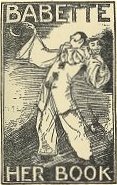
“Written as a supplement to the Museum's major summer exhibition, ‘Glass of the Maharajahs’, this book explores the little-known era in glassmaking history when European glass manufacturers tailored one-of-a-kind and limited-production glass furniture to the tastes of the wealthy Indian elite. The very idea that a chair could glitter like a diamond, catch light like a colored gemstone, and still function as seating must have astounded those who first encountered glass furniture in the mid- to late-19th century. Some of the furniture and printed materials are drawn from The Corning Museum of Glass; others are borrowed from Indian palaces, private homes and archival collections.”

A fascinating catalog. The text begins by discussing the early 19th century glass furniture of Europe and Russia, and then moves on to India. Firms such as F.& C. Osler, Jonas Defries & Sons, Coalbourne Hill Glass Works, Baccarat and Elias Palme are all discussed at length. One of the most fascinating aspects of this book was the ability of the author to find modern photographs, period prints, and original factory designs for the same pieces of furniture and lighting.

Hardcover. 8.5”x11”, 144 pages, 125 illustrations. New. [90217] $24.95

Friday, June 16, 2006

Which Washington?

We have a charming and interesting little limited edition, 1927 book about bookplates selling tomorrow night on Ebay. It's called "Washington Bookplates" and I bought it at an auction a few weeks ago, thinking it was about George Washington's bookplates, or bookplates featuring him, or connected with him, or something like that... but no, it's about bookplates created for Washington-state artists for Washington-state bibliophiles. Well... rats! Not that there's anything wrong with that, it's just that I was expecting otherwise. So, we put it up on Ebay, with no reserve, and it will go to the highest bidder tomorrow. Click the Ebay auctions link to see the listing.

And next auction I will look at the books more carefully...

Fridays-

We've finally got some decent weather here at Foggygates, so the outside of the house is swarming with painters and roofers. They got the last of the gutters down (it came crashing to earth right outside my office window), and the new sheathing is going up. Exciting, eh? Well, it looks a lot better.

We put in a real burst of energy and posted a number of auctions for Americana and related stuff on Ebay. Click our auction link to the right for details- we included a very nice collection of 19th century maps of the Panama-area, a scarce 1825 American militia manual, some good hunting books -all sorts of stuff, all starting at $9.99 with no reserves. Go ahead- get a bargain!

The Furniture Catalog is out this week, and you can see a copy on the website, or let us known and we can mail you one.

Thursday, June 15, 2006

The Problem with Publishers-

We put a very amusing Ben Franklin item up for auction on Ebay last night, which is worth quoting from. The booklet is titled "A Letter from Benjamin Franklin, Passy, April 21, 1785, to Benjamin Vaughan, containing some observations on the prodigal practices of publishers". It was published in Princeton by the Friends of the Princeton Library in 1949. This is a facsimile of Franklin’s famous letter denouncing the practices of English publishers, together with a line-by-line transcription, and introductory remarks by Carl Van Doren and Julien P. Boyd. Franklin begins by writing of the controversy over cheap Irish goods in the English marketplace, and eventually gets around to books-

"If Books can be had much cheaper from Ireland, (which I believe for I bought Blackstone there for 24s when it was sold in England at 4 Guineas) is not this an Advantage, not to English Booksellers indeed, but to English Readers and Learning? And of all the Complainants perhaps these Booksellers are least worthy of Consideration. The Catalogue you last sent me amazes me by the high Prices, (said to be the lowest) affix’d to every Article. And one can scarce see a new Book, without observing the excessive Artifices made use of to puff up a Paper of Verses into a Pamphlet, a Pamphlet into an Octavo Volume, and an Octavo into a Quarto, with Scab-boardings, white Lines, sparse Titles of Chapters, & exorbitant Margins, to such a degree, that the Selling of Paper seems now the Object, and Printing on it only a Pretence".


For more information click the "Our Ebay Auctions" link in the right-hand column.

Tuesday, June 13, 2006

Our New Furniture Catalog-

The Book Elves are glued to World Cup action on the TV in the Cataloging Cave, and were quite upset by yesterday's loss by Team USA. However, before they donned the traditional black and crimson robes which either signify deep mourning or graduation from an Ivy League College (we're still not quite sure where they got them) they finished our new catalog-

Catalog #277: BOOKS ON FURNITURE & CABINETMAKERS is now available, either as a printed catalog (please send us your mailing address) or you can browse it on our website.

If you'd like a printed copy, please let us know (and include your mailing address).

Monday, June 12, 2006

Speaking Plainly-

Today we're happy to bring you an important American furniture reference which has just been reissued- "Neat Pieces. The Plain-Style Furniture of 19th Century Georgia" by William & Florence Griffin, et al. University of Georgia Press: 2006.

This is a new edition of the classic and important 1983 catalog. This loan exhibition of Georgia "plain" furniture of the period 1820-1860 was the result of five years of painstaking work; 2,000 pieces of furniture were studied before the final 126 were chosen. Each piece is carefully described and illustrated, and there is an introduction which explains the development of Georgia, her cabinetmakers, and their furniture. In addition to the furniture the organizers turned up a wealth of information on individual Georgia cabinetmakers, and this information is also presented here. An important contribution to the literature on early Southern decorative arts. This augmented edition features color illustrations of most of the pieces, and a new Introduction. Softcover. 8"x11", 236 pages, color and b/w illustrations. New. [90193] $39.95

Friday, June 09, 2006

Trapped in Poetry

An interesting thread came up on an eamil list earlier in the week. Somebody mentioned "The Eyre Affair" by Jasper Fforde, in which one of the minor characters gets trapped inside a Wordsworth poem. This brought up the question- if you could be trapped inside a poem, what poem would it be? Or, if you feel like you are trapped inside a poem, what poem is it?

For some reason for me Lewis Carroll immediately sprang to mind...

`Twas brillig, and the slithy toves
Did gyre and gimble in the wabe:
All mimsy were the borogoves,
And the mome raths outgrabe.

"Beware the Jabberwock, my son!
The jaws that bite, the claws that catch!
Beware the Jubjub bird, and shun
The frumious Bandersnatch!"

He took his vorpal sword in hand:
Long time the manxome foe he sought --
So rested he by the Tumtum tree,
And stood awhile in thought.

And, as in uffish thought he stood,
The Jabberwock, with eyes of flame,
Came whiffling through the tulgey wood,
And burbled as it came!

One, two! One, two! And through and through
The vorpal blade went snicker-snack!
He left it dead, and with its head
He went galumphing back.

"And, has thou slain the Jabberwock?
Come to my arms, my beamish boy!
O frabjous day! Callooh! Callay!'
He chortled in his joy.

`Twas brillig, and the slithy toves
Did gyre and gimble in the wabe;
All mimsy were the borogoves,
And the mome raths outgrabe.


well now.

Here's the poem that started the discussion-

"Daffodils" by William Wordsworth (1804)

I Wander'd lonely as a cloud
That floats on high o'er vales and hills,
When all at once I saw a crowd,
A host, of golden daffodils;
Beside the lake, beneath the trees,
Fluttering and dancing in the breeze.

Continuous as the stars that shine
And twinkle on the Milky Way,
They stretch'd in never-ending line
Along the margin of a bay:
Ten thousand saw I at a glance,
Tossing their heads in sprightly dance.

The waves beside them danced; but they
Out-did the sparkling waves in glee:
A poet could not but be gay,
In such a jocund company:
I gazed -- and gazed -- but little thought
What wealth the show to me had brought:

For oft, when on my couch I lie
In vacant or in pensive mood,
They flash upon that inward eye
Which is the bliss of solitude;
And then my heart with pleasure fills,
And dances with the daffodils.


Of course, given the fact that it's been raining here for about a month and a half, maybe something about rain would be more appropriate...

Wednesday, June 07, 2006

Railroads...

We have some interesting lithographs of the early West up for auction on Ebay this week. These plates are from the 12-volume set "Reports of Explorations and Surveys, to ascertain the most practicable and economical route for a railroad from the Mississippi River to the Pacific Ocean", published by the Government Printing Office between 1855 and 1861. What was this all about? The answer is a single word: Railroads.

In the 1850s everyone agreed that a transcontinental railroad should be built, but the question was where to build it. Political and business rivalries contended to stop any project, or even preparation for the project, for a number of years. Which states would it traverse and, most importantly, where would it start and end? Did the Constitution even allow the Federal Government to be involved in the project? Finally, in 1853-4, Senator Gwin of California got an appropriation into the War Department budget to allow the Secretary of War (Jefferson Davis) to send out surveying parties. The trouble was just beginning...

After the political and sectional dust settled there were four routes to be surveyed- a northern route along the Missouri River, over the northern Rockies and to Puget Sound, along the 47-49th parallels. A middle route, favored by Senator Thomas Hart Benton, following the Kansas River to the Arkansas, through Salt Lake, along the 37-39th parallels. Another route, the 35th parallel route, went from Arkansas through New Mexico and Arizona and across the Mojave Desert. The fourth route, the southern-most and the one favored by Secretary of War Davis, traveled from Texas along the Gila River to San Diego. There were further surveys on the Pacific coast, outlining routes to link San Diego with San Francisco, and San Francisco and the Pacific northwest. Originally the project report was envisioned as taking up three or four volumes.

By the time the final volume was published in 1861 the number of volumes had swelled to twelve and the country had other problems to deal with. The final volumes were an unparalleled survey of the flora, fauna, peoples and landscape of the American West. The books and illustrations provided details not only on the topography of the land, but the scenery, animals, plants and inhabitants. It remains a cornerstone piece of Americana, and a complete set today can cost $10,000.

We have some interesting prints from various volumes in the set. One word of explanation- the prints we are selling (illustrated here) are not actually framed- I've done some computer wizadry to show them as they will look when they are framed. And just so there's money left over for framing, we're starting them at $9.99 each, with no reserve. Click our Ebay auction link in the right-hand sidebar for all our current auctions.

Monday, June 05, 2006

A Whale of a Silver Book-

Have we got a silver book for you! "English, Irish, and Scottish Silver: at the Sterling and Francine Clark Art Institute" by Beth Carver Wees is a giant of a book, 9"x12", and 595 pages. Here's what the publisher had to say-

"The Clark Institute in Williamstown, Massachusetts, holds one of the largest and finest collections of English silver outside of England, including many masterpieces. It was begun in the 1910s by Singer sewing machine heir Robert Sterling Clark, who bought both luxury items by prominent makers and domestic wares, many of which had been owned by the most celebrated patrons of the 18th and 19th centuries. This substantive volume, with more than 1200 duotone illustrations and 19 color plates, catalogs every object in the collection, including 76 pieces by Paul de Lamerie and many more by other great Huguenot silversmiths. Detailed entries about some 850 objects provide marks, inscriptions, heraldry, construction notes, comments, provenance, and exhibition and publication history."

The book was published for $125. We have a limited number available for $40.

Wednesday, May 31, 2006

Let the Sunshine In-

As I have mentioned before, sometimes I come across books which have interesting stories behind them. Usually the stories concern either the author or the history of the book itself, but sometimes they have to do with prior owners.

We have a copy of an 1884 book by Arthur Charleston titled "Tin: Describing the Chief Methods of Mining, Dressing & Smelting it Abroad". An interesting enough book itself, if you are inclined tin-ward, but additionally, this copy bears the ownership signature- "Rev. M.A.G. Himalaya, Braga, Portugal, 1907" on the title page, and therein lies another story.

Manuel Antonio Gomes 'Himalaya' [1868-1933(?)], "Father Himalaya", is considered to be the father of solar energy in Portugal, and a visionary pioneer in the field of renewable energy. After taking Holy Orders in the Society of Jesus he studied natural sciences, physics, chemistry, mathematics and astronomy, and traveled to France where he studied with the noted chemist Marcelin Berthelot.

In 1899 he was granted a patent by the French government for a device to produce heat by focusing the sun's rays; in 1900 he constructed a test device in the Pyrenees and attained a temperature of 1100 degrees centigrade.

In 1902 an experiment in Lisbon attained 2000 degrees, and he made a final, startling demonstration of the power of such a device at the St. Louis Exposition in Missouri 1904. There he constructed his "Pireliofero", a 3-story high parabolic mirror mounted on a monstrous iron framework which focused sunlight on an oven mounted at the top of the structure. The oven reached a temperature of 3500 degrees, melting a test chunk of basalt, and Father Himalaya won a Grand Prize for his efforts.

He promoted other forms of renewable energy as well, including tidal energy and hydroelectric power, wind power, and geothermal power. Alas, there was plenty of cheap coal and oil available, and his work was generally ignored and forgotten. Father Himalaya retired to become chaplain at Viana Castle, a charity home, where he died at the age of 65. His work has excited interest in Europe in recent years, and his ideas have only lately attained a measure of the respect which eluded them in his lifetime.

Father Manuel Antonio Gomes 'Himalaya' and his "Pireliofero"

Friday, May 26, 2006

Gutters and Moles and... Bears?? Oh my...

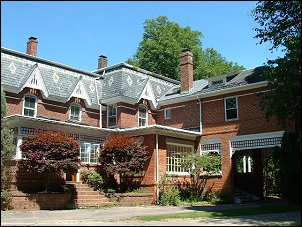
Well, the bucket-truck has been called off. Our contractor has a new roofer who thinks the job of removing the old gutters and replacing the facia on the house crown can be done with scaffolding, so next week they're going to put that up. It'll be less dramatic, but also better for the lawn- we weren't all that thrilled about a big truck driving all around the house, though with the front lawn currently a Mole Paradise I'm not sure it would have looked all that different. If you used to have problems with moles under your lawn and you don't have any this year, they're all at Foggygates, chawing down.

Speaking of wildlife- I walked down to the local barbershop yesterday (about a quarter mile away), and on my way back, in the middle of a sunny afternoon, I saw a big black bear come across the church rectory's lawn (right next door to us), wait for a passing car, and then lope across the street and wander off into the woods on the other side. That caused a little excitement in town for a while. I'd never seen a bear in the wild before; Amy saw some years ago while camping at Yellowstone, but I think the operative words there are "camping" and "Yellowstone", which seem more appropriate venues for bear watching than "the neighbor's lawn".

And our cats wonder why we don't let them out...

Tuesday, May 23, 2006

Auction Catalogs-

The Book Elves have been pruning the trees and shrubs here at Foggygates, and somebody (I'd really, *really* like to know who) sent them a little book titled: "Erotic Topiary Designs for Beginners" which they have been using on the azaleas. We now have a thirty-year old azalea shaped like the picture on the cover of the latest Madonna album, and traffic on our little street has increased tenfold this week.
However, before they got us summoned before the next meeting of the Board of Selectman, they finished our new printed catalog #274, "Going Once... Going Twice... A Selection of Auction Catalogs from Our Stock", which is now available.

This issue includes catalogs covering Collectors & Collections; French Decorative & Fine Arts; Furniture & Americana; Folk Art; Metals; Garden Furniture & accessories; Ceramics; Glass; Silver; Jewelry; Judaica; Russian Arts; Miniatures; and Horology.

Please let us know if you would like a printed copy. You can also browse it on our website.

Monday, May 22, 2006

Spring?


Well, the sun has finally come out at Foggygates -but it's cold! It seems that this May we either have rain or chilly weather. I miss Spring. The rains of the last few weeks caught our roofers just as they were about to remove the gutters and replace the facia boards around the top of the house crown, but they hope to do that in the next few days. It's going to be quite an operation- because of the shape of the roofs, they can't get up there safely with ladders to remove the facia, so they are going to bring in one of those bucket trucks. It's going to be quite a sight for the neighbors, and I'll try to get some pictures.

We've got our new Catalog of Auction Catalogs hitting the streets tomorrow- let us know if you would like a free copy. It will also be on our website. More about that tomorrow.